Degree and value
Before any operation, write the polynomial in descending powers of x and name its degree, leading coefficient and constant term. To work out P(a), substitute x, with brackets when a is negative.
Polynomials are the language of secondary school algebra: expressions are added, multiplied and divided as if they were numbers, and factorising them paves the way for quadratic equations and algebraic fractions. This free polynomials worksheet generator makes A4 worksheets on degree and value, the four operations, long division, synthetic division, the remainder and factor theorems, special products both ways and factorising, for Grades 8 to 10, with a fully worked answer key.
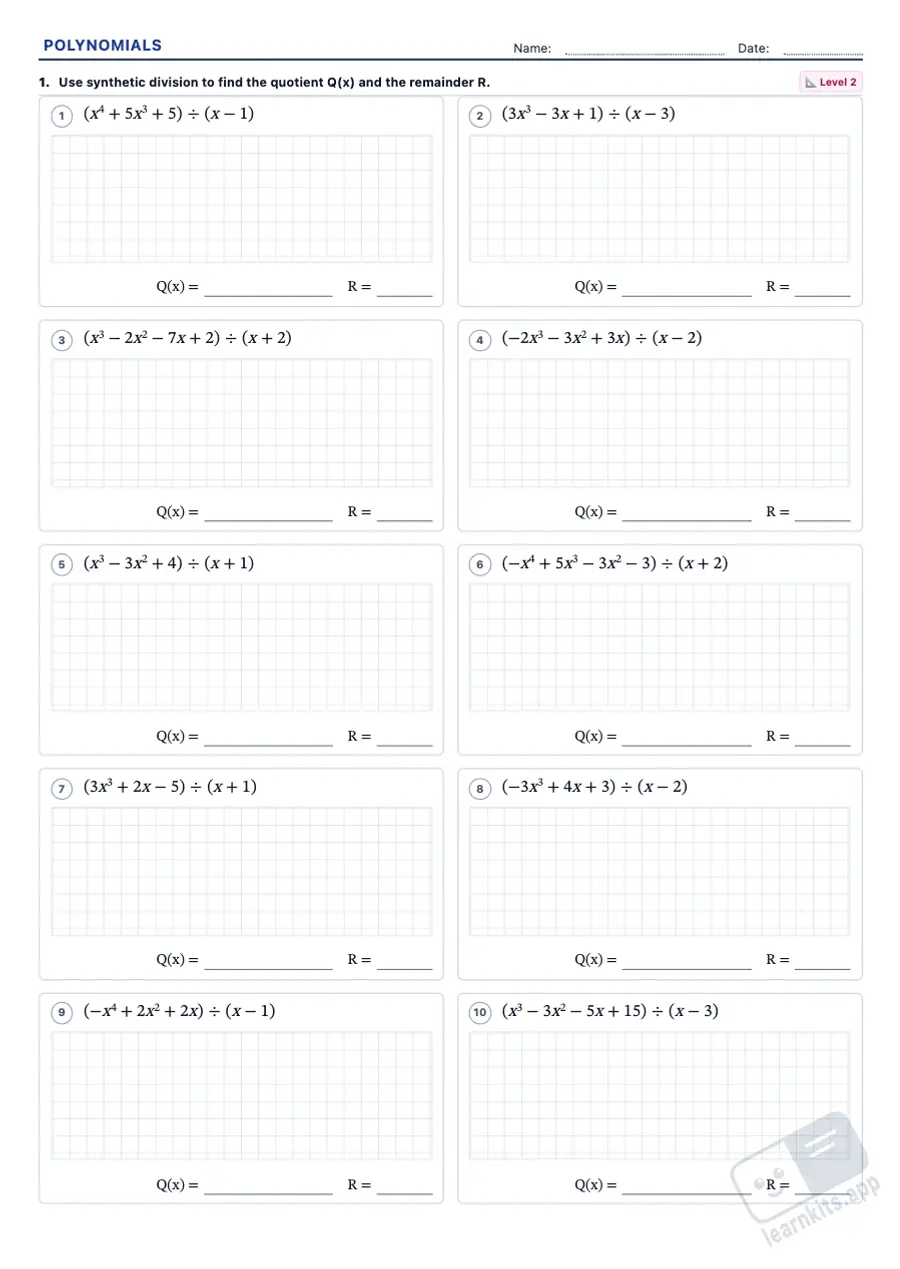 Student worksheet
 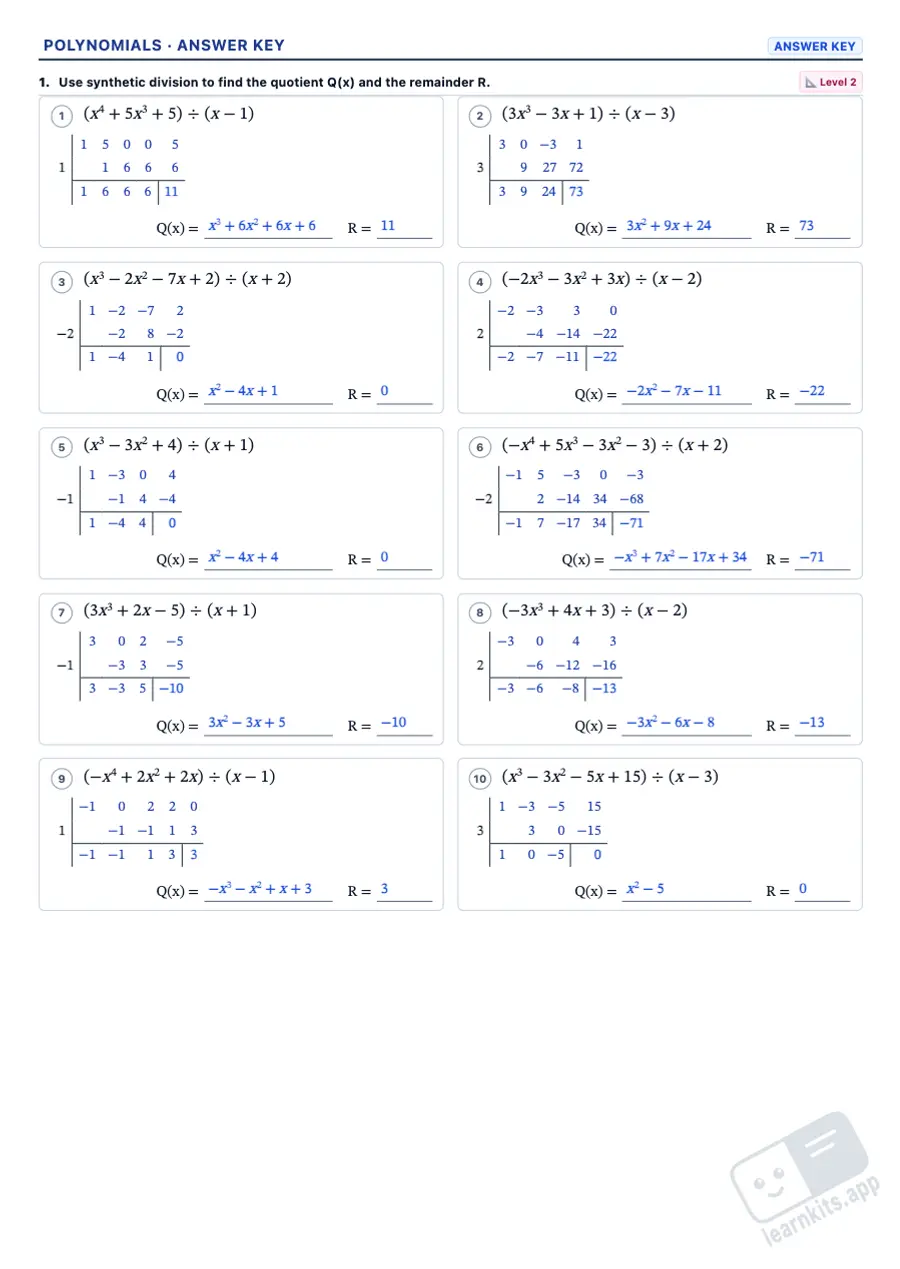 Answer key
 Before any operation, write the polynomial in descending powers of x and name its degree, leading coefficient and constant term. To work out P(a), substitute x, with brackets when a is negative.
Line up like terms in columns; to subtract, add the opposite. To multiply, take each term times the whole bracket and collect like terms, or use the column method as with numbers.
Divide the first term, multiply the divisor by it, subtract and repeat until the remainder has a lower degree than the divisor. The answer key shows the whole bus stop layout.
To divide by x − a, the coefficients are enough: synthetic division (Ruffini's rule) gives the quotient and the remainder, which is P(a).
(a + b)² = a² + 2ab + b², (a − b)² = a² − 2ab + b² and (a + b)(a − b) = a² − b², to expand and, above all, to spot inside a polynomial.
First the common factor, then special products and, when needed, synthetic division with the factors of the constant term until every factor is linear.
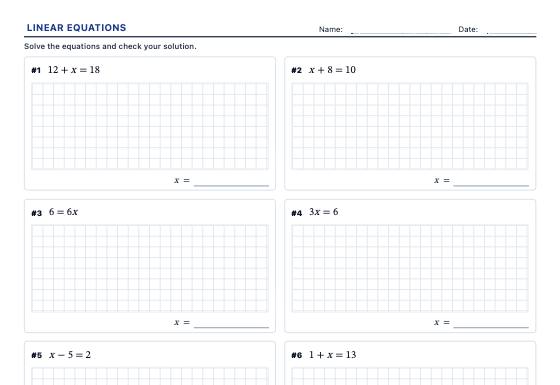
One-step and two-step linear equations, x on both sides, brackets and fractions, with whole, negative or fraction solutions and a step-by-step answer key with the check.
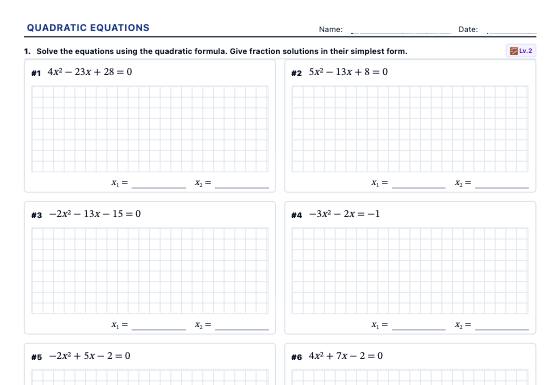
Incomplete quadratics and the quadratic formula, equations with brackets and fractions to rearrange, the number of solutions from the discriminant and the equation from its roots, with a step-by-step answer key.
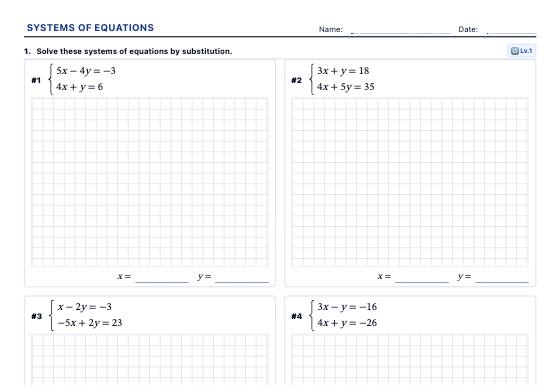
Systems of two equations in two unknowns (simultaneous equations) by substitution, equalisation and elimination, the graphical method, classifying systems and word problems, with a step-by-step answer key.