The number line
Reading and marking integers on the line, from −10 to 10 and in steps of 2, 5 or 10, so negative numbers have a place before pupils calculate with them.
Integers are the whole numbers, zero and the negative numbers. In Grade 6 pupils place them on the number line and compare them; in Grades 7 and 8 they add, subtract, multiply and divide them with the sign rules. This free generator creates A4 worksheets for every step, from reading the number line to removing square brackets and working out powers with a negative base, with an answer key that shows the rule used.
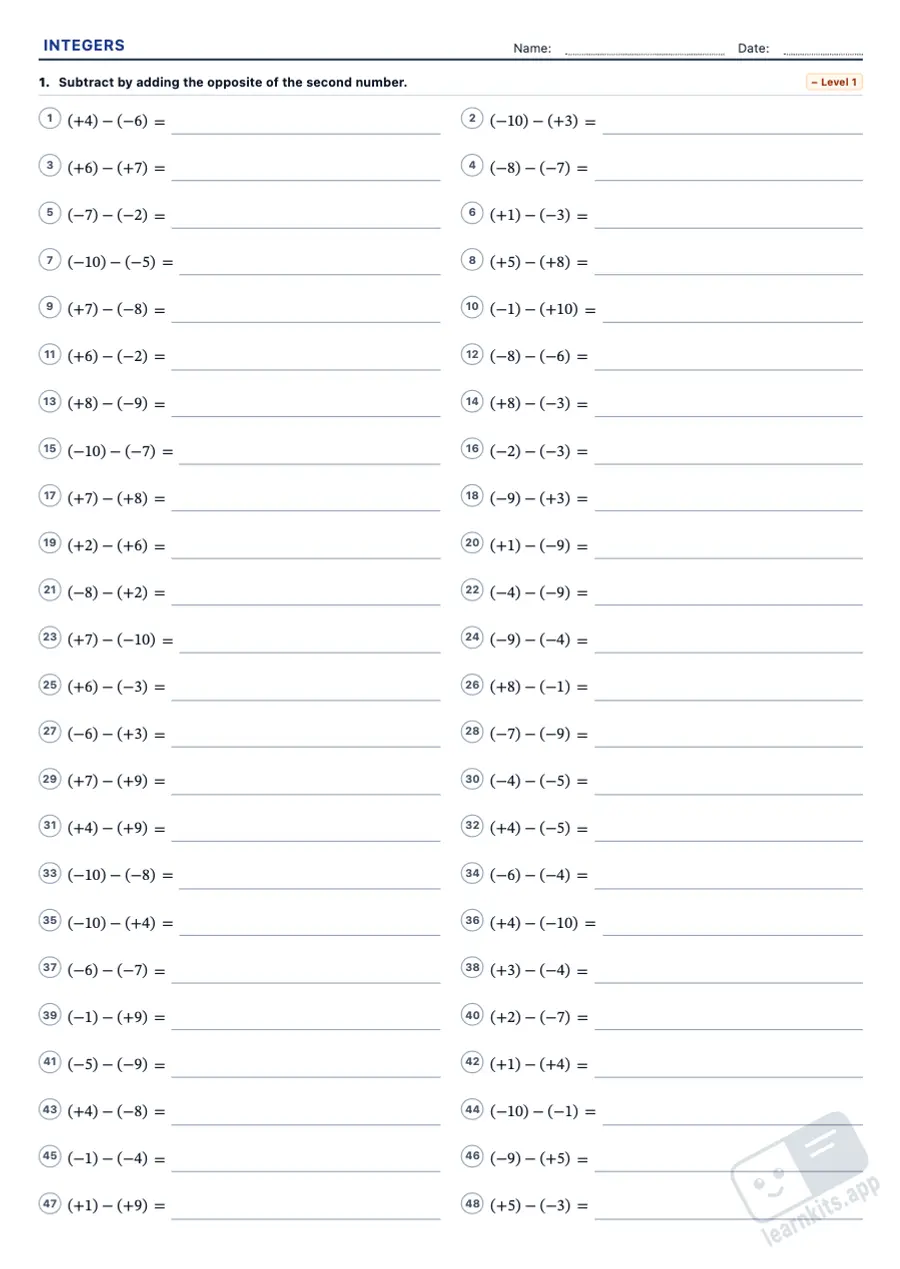 Student worksheet
 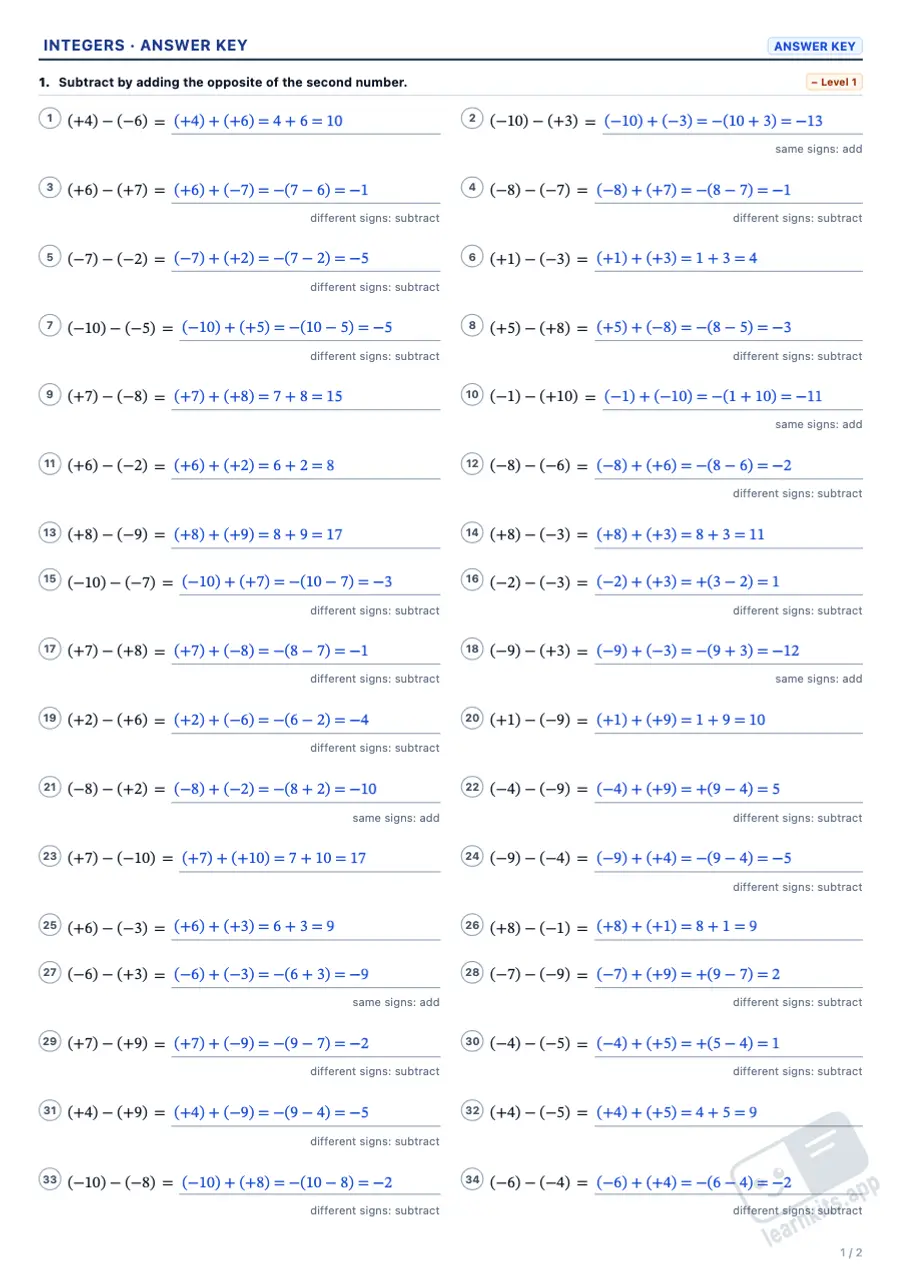 Answer key
 Reading and marking integers on the line, from −10 to 10 and in steps of 2, 5 or 10, so negative numbers have a place before pupils calculate with them.
Opposites, absolute value and order: −8 < −3 because it is further left, even though 8 is greater than 3.
Same signs, add; different signs, subtract. Subtracting is adding the opposite, and chains are solved by grouping positives and negatives.
A − before a bracket changes the sign of every term inside it. With square brackets, start with the innermost brackets.
The sign rules of multiplication and division, the sign of a product of three or four factors and the difference between (−2)⁴ and −2⁴.
Every answer with its step, such as −(8 − 5) = −3 or +(4 × 6) = 24, and the rule used beside it. Write (+5) or just 5, and choose × or ·.
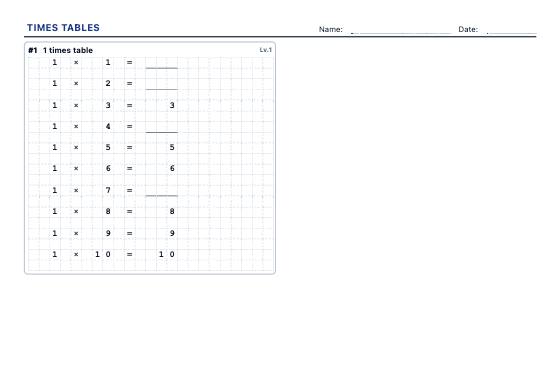
A4 worksheets for the tables you choose: complete the table, shuffled facts, missing factors, multiplication grids and division facts, in three levels with an answer key.
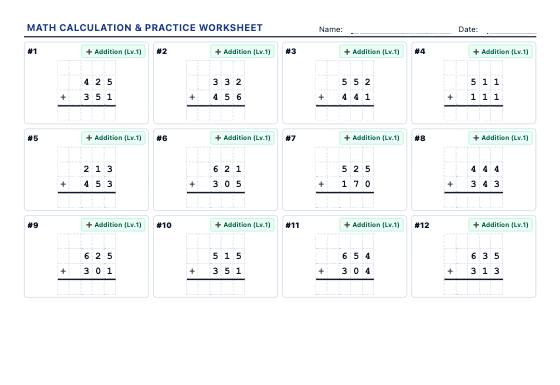
Generate high-density A4 printable worksheets (15-20 problems per sheet) with regrouping addition, borrowing subtraction, multi-digit multiplication, long division, and square roots.
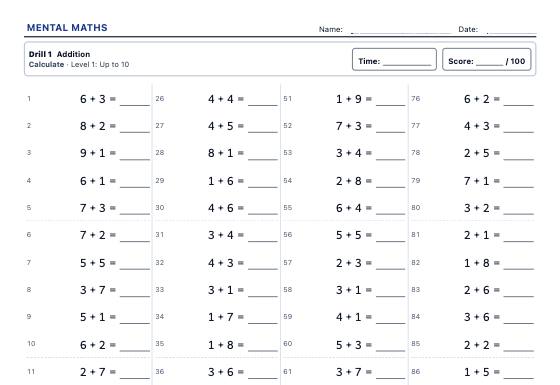
Drills of 50 to 100 quick facts in line with time and score boxes: addition, subtraction, number bonds to 10 and 100, ± 10, doubles and halves, times tables and × 10, 100 and 1000.