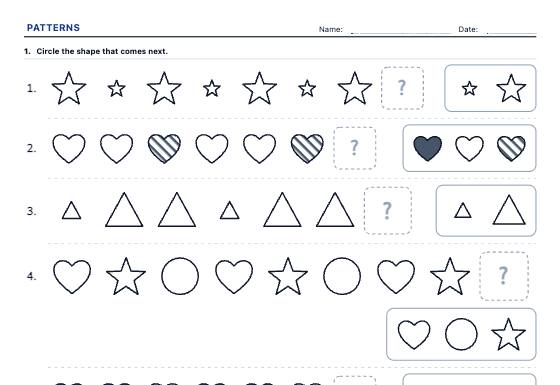
Patterns
Shape pattern worksheets: what comes next, continue the pattern, what is missing and spot the mistake, with AB, AAB, ABC, AABB… patterns of shape, size, fill, direction or colour, and growing patterns.
Printable Pre-K worksheets for 4-year-olds: tracing, dot-to-dot, counting to ten, shapes, patterns and first words with pictures, free and ready to print or save as PDF.
A cover, contents and a week of practice in every subject. Open it and change anything you like.
Open the workbook Shape pattern worksheets: what comes next, continue the pattern, what is missing and spot the mistake, with AB, AAB, ABC, AABB… patterns of shape, size, fill, direction or colour, and growing patterns.
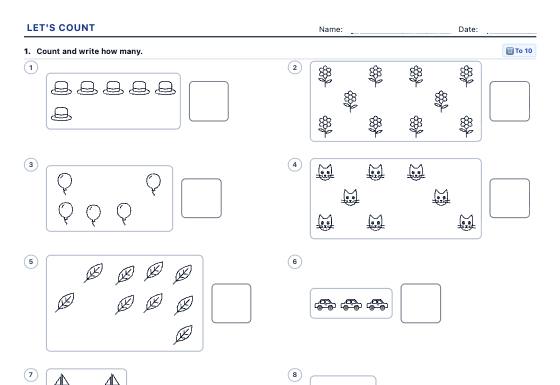
Count and write, circle the number, match each group to its number, draw and colour as many as the number shows and ten frames, with pictures to colour and an answer key.
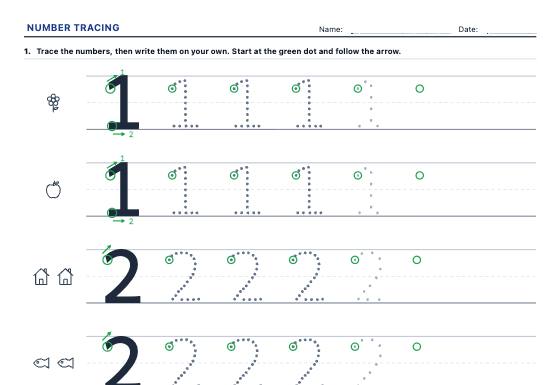
A4 sheets to learn to write the numbers 0 to 20: a model with start dots and arrows, dotted copies that fade, a picture to count and, at the small size, the number word.
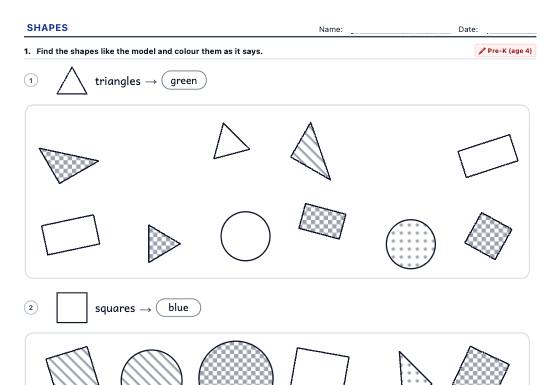
Shapes worksheets: colour the ones like the model, count them in a table, match them to their names, trace them and find them in a picture, from circles, squares and triangles to pentagons and first 3D shapes.
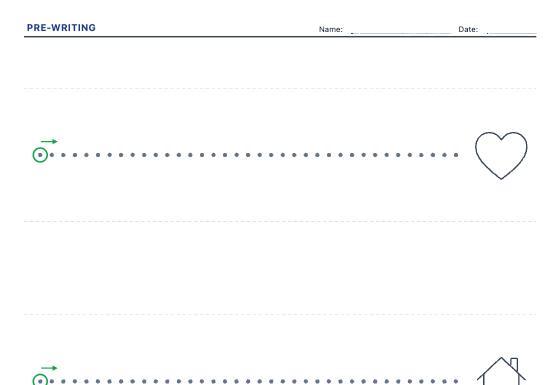
Pre-writing worksheets with dotted strokes to trace: straight lines, zigzags, waves, loops and spirals, with a start dot and graded sizes.
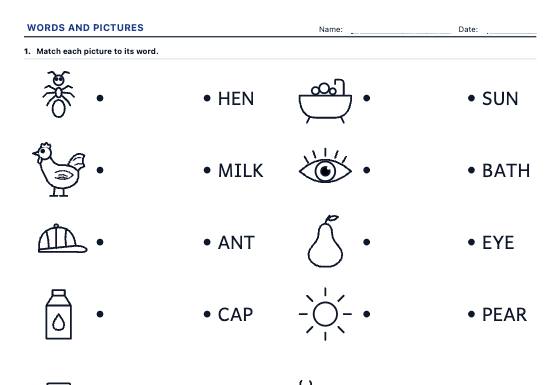
Match each picture to its word, circle it and write it, and match capital and lowercase letters and print to cursive, with over 130 pictures and English words.
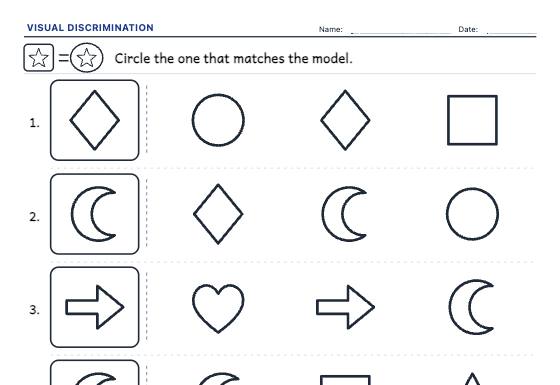
Visual discrimination worksheets for ages 3 to 5: find the one that matches the model, spot the odd one out and match the pairs, with differences in shape, pattern, orientation or small details.
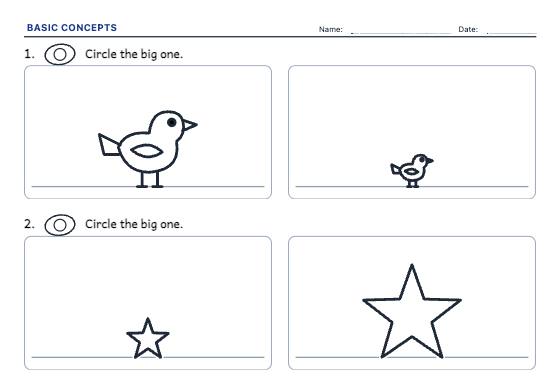
Opposites worksheets for ages 3 to 5: big and small, long and short, tall and short, on and under, inside and outside, in front and behind, near and far, many and few, full and empty. To circle, colour, cross out or draw.
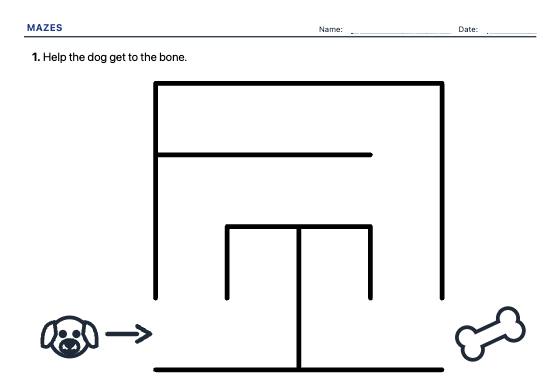
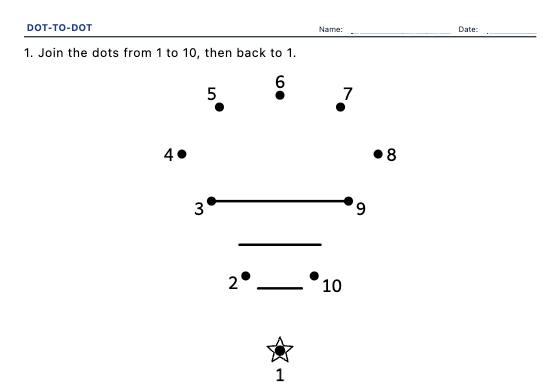
A4 worksheets to join the dots and reveal the picture: from 1-10 up to 1-100, counting in 2s, 5s and 10s or the alphabet, with over 30 pictures and the finished picture in the answer key.
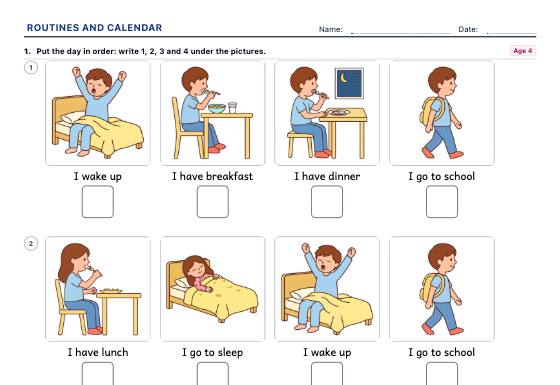
Visual schedules for morning, school, afternoon and bedtime routines, a "Today is" circle time board, the real calendar of any month, ordering the day and the days of the week.
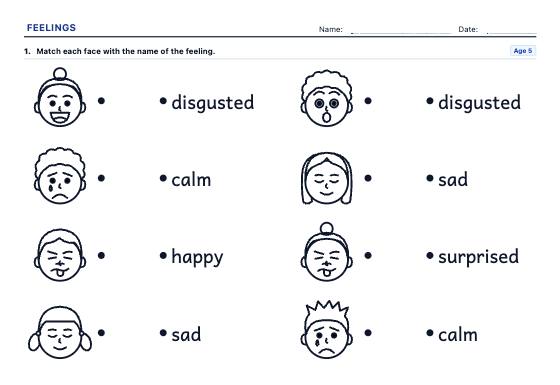
Feelings with drawn faces: match faces that feel the same or with their names, how would you feel in everyday situations, draw a feeling, an emotion wheel to colour and a daily check-in, with an answer key.
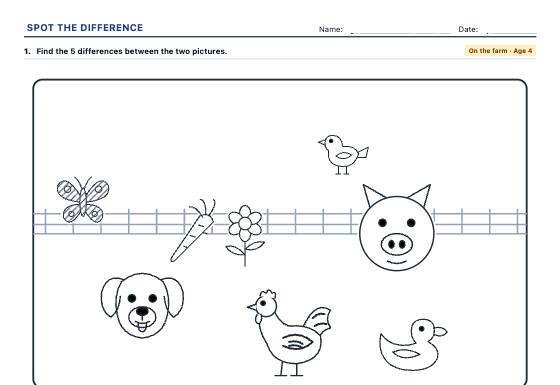
Picture pairs with 3 to 10 differences to find (something missing, swapped, smaller, striped, turned around or moved), in 9 scenes and 4 levels, with the differences circled in the answer key.
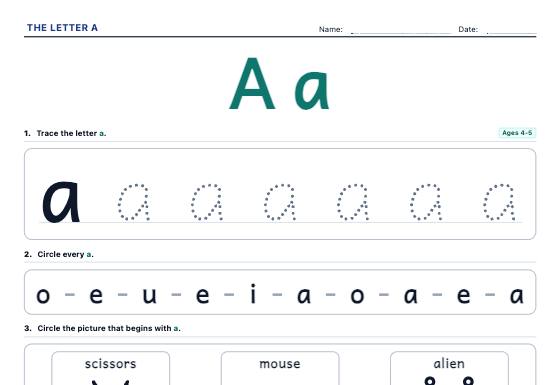
One sheet per letter or number: trace it, circle it among others, find the picture that begins with it and build the word by cutting out or writing, ages 4 to 7, with an answer key.
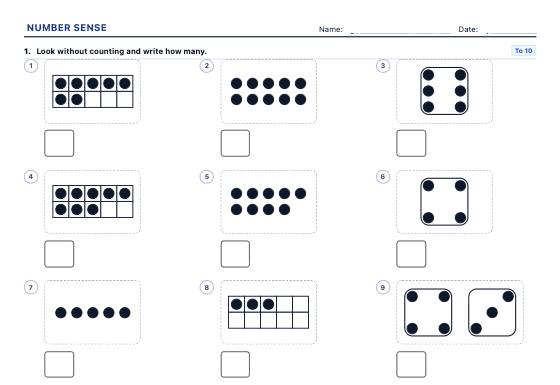
Number sense to 5, 10 and 20: how many at a glance (dice, ten frames, rows of five), amount, numeral and word, which has more, number bonds and number lines without numbers, with answers.
Four-year-olds can usually follow a line with more care, sit for a little longer and enjoy a small challenge. Their counting goes further, they begin to notice that sounds and written words belong together, and they love spotting a rule in a row of shapes. This is a good age for sheets that join two skills, such as counting and drawing, or looking and matching. The worksheets below grow with the child: start at the easy level and move on as soon as a page feels too simple.
Curves, zigzags and loops in the tracing worksheets prepare the movements of letters and numbers. Dot-to-dot pictures with numbers in order turn counting into a drawing that appears line by line, a reward that keeps children going to the end.
At four, many children count objects up to ten and begin to recognise written numerals. The number tracing sheets show each digit with start dots and arrows, then dotted copies that fade, while counting pictures to match each group with its number gives meaning to what they write.
Repeating patterns such as red, blue, red, blue are early algebra: the pattern worksheets ask what comes next and what is missing. The word and picture matching sheets link a drawing to its written word, a first, playful contact with reading.
A short routine works better than a long session: one sheet after breakfast or at the start of a class activity. Mix a tracing exercise with a counting one on the same page, keep the level easy at first and use regenerate to give each child or each day a fresh version.