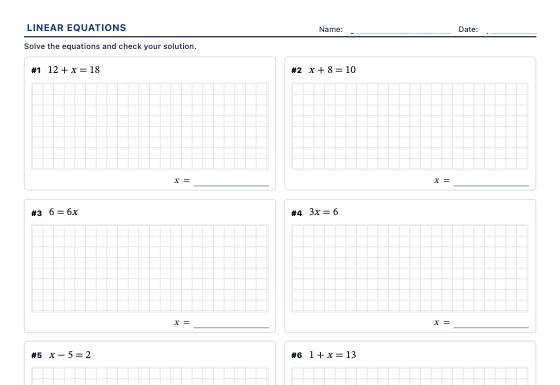
Linear Equations
One-step and two-step linear equations, x on both sides, brackets and fractions, with whole, negative or fraction solutions and a step-by-step answer key with the check.
Grade 10 worksheets for 15-year-olds: equations and systems, functions, polynomials, Punnett squares, chemistry, physics problems and personal finance. Free, printable and with answer keys.
A cover, contents and a week of practice in every subject. Open it and change anything you like.
Open the workbook One-step and two-step linear equations, x on both sides, brackets and fractions, with whole, negative or fraction solutions and a step-by-step answer key with the check.
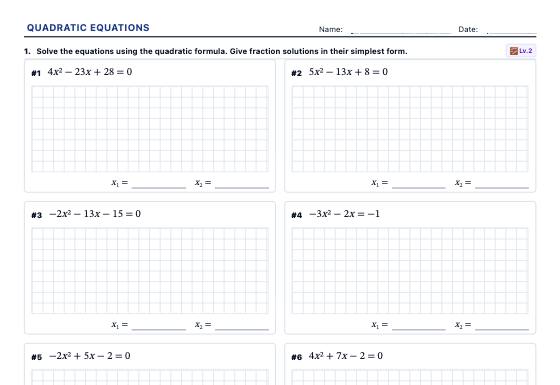
Incomplete quadratics and the quadratic formula, equations with brackets and fractions to rearrange, the number of solutions from the discriminant and the equation from its roots, with a step-by-step answer key.
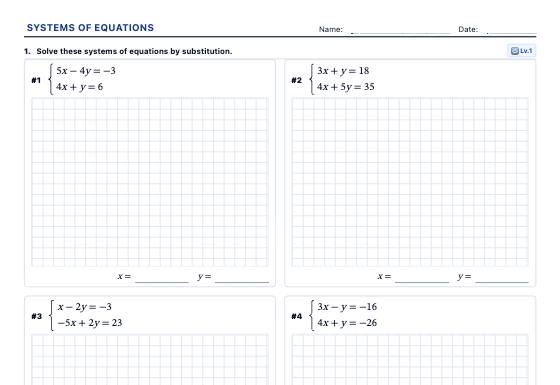
Systems of two equations in two unknowns (simultaneous equations) by substitution, equalisation and elimination, the graphical method, classifying systems and word problems, with a step-by-step answer key.
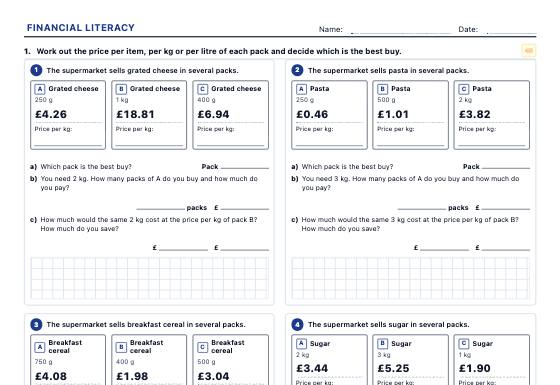
Shelf labels, invoices, receipts, budgets, payslips and bank statements to practise unit price, discounts, VAT, tariffs, simple and compound interest and loans, with a step-by-step answer key.
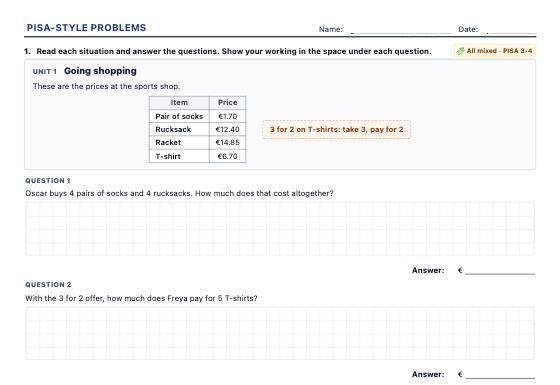
PISA-style units: prices, recipes, timetables, charts, chance, tariffs, maps and floor plans to scale, with questions of rising difficulty and a marking guide with full, partial and no credit.
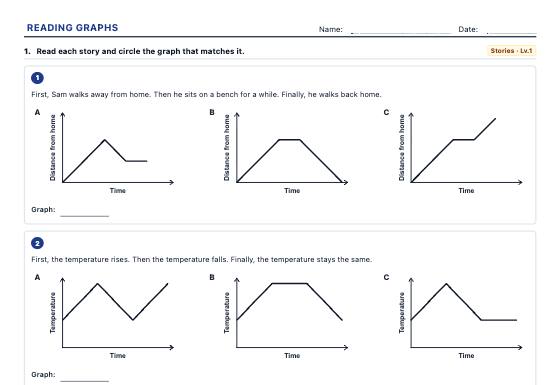
Everyday graphs to match to a story, read values and rates of change, describe trends, compare two series and spot misleading graphs, with an answer key.
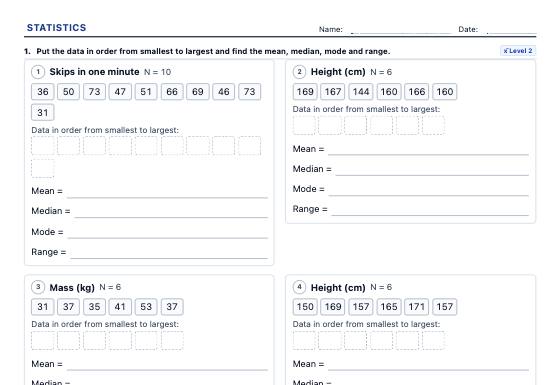
Mean, median, mode and range of lists and tables, frequency tables, quartiles and box plots, standard deviation and grouped data, with new data every time and an answer key with the working.
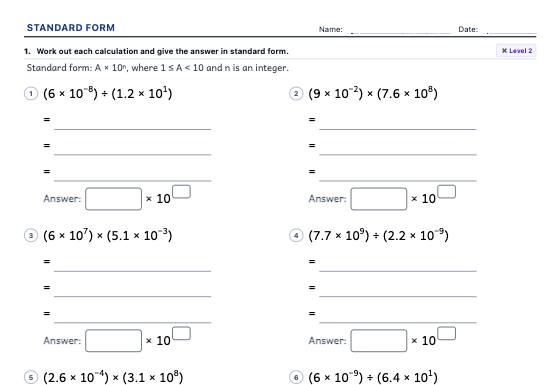
A4 worksheets on scientific notation (standard form): write large and small numbers, write them out in full, correct, compare and order, multiply, divide, add and subtract, and problems about space, cells and atoms.
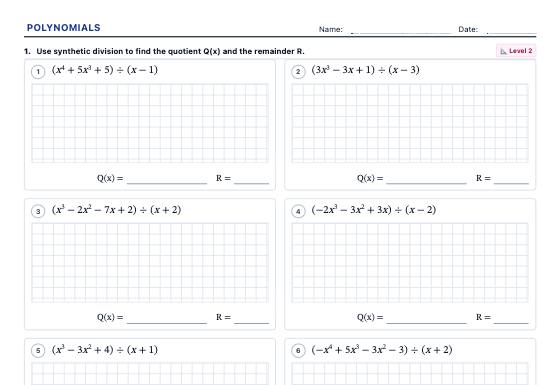
Polynomials: degree and value, adding, subtracting and multiplying, long division, synthetic division and the remainder theorem, special products both ways and factorising, with a fully worked answer key.
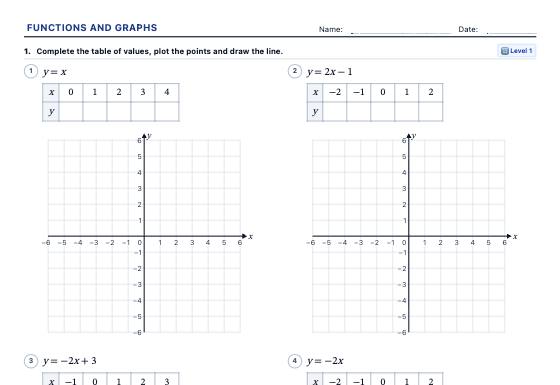
A4 worksheets on functions: tables of values and graphs, gradient and y-intercept, the line through two points and parallel lines, quadratic graphs, domain, range, increasing intervals and turning points, and equations to match to graphs.
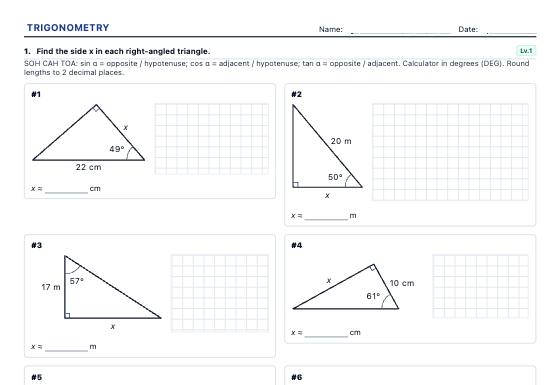
Right-angled triangle trigonometry worksheets: sin, cos and tan, missing sides and angles, solving triangles, angles in shapes and word problems with angles of elevation, with a step-by-step answer key.
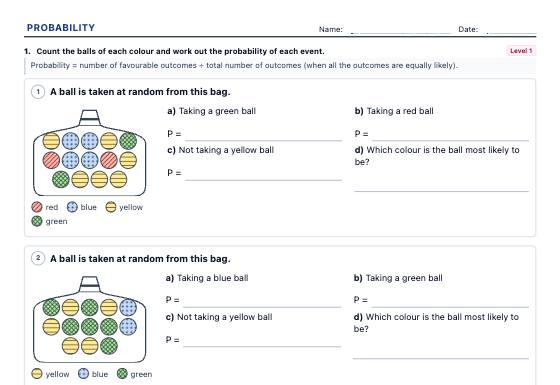
Dice, bags of balls and spinners, tree diagrams, two-way tables, counting and combinations, and relative frequency, with new experiments every time and an answer key with the working.
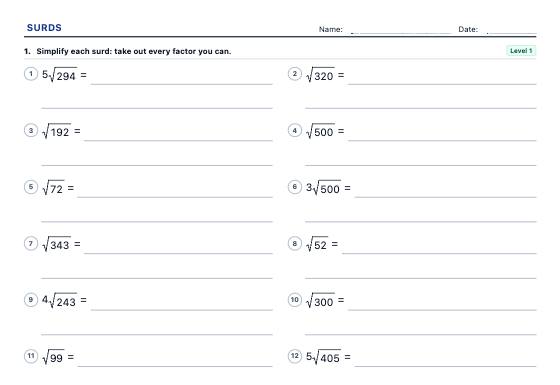
Surds and radicals: fractional indices, equivalent roots and a common index, simplifying surds, adding, multiplying and dividing them and rationalising the denominator, with a fully worked answer key.
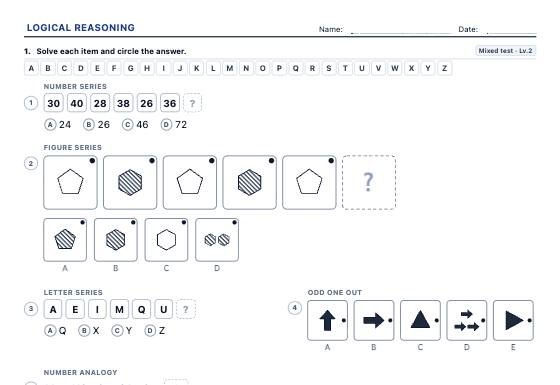
Reasoning test style worksheets: number, letter and figure series, 3 × 3 matrices, analogies and odd one out, in four levels, each item with exactly one answer and its rule on the answer key.
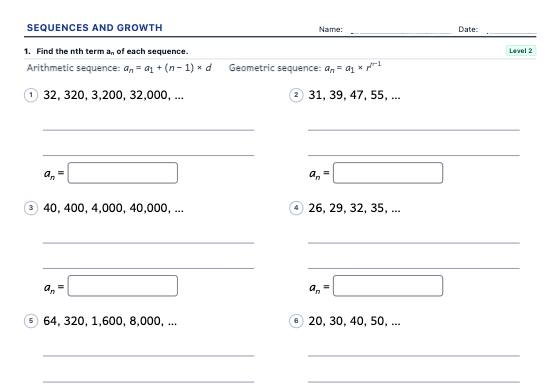
Arithmetic and geometric sequences: recognise them, the nth term, a term and its position, the sum of n terms and to infinity, and linear or exponential growth in context with tables and formulas, with a step-by-step answer key.
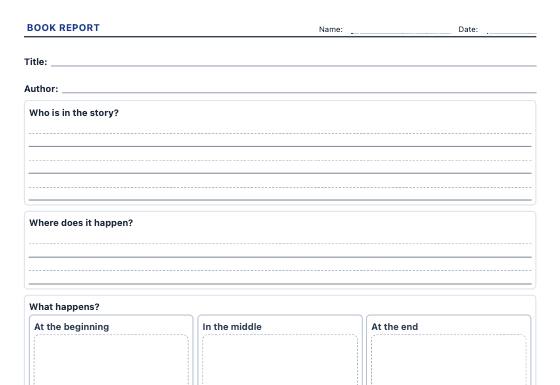
Create A4 sheets for any book: book report, character profile, story map, reading log and reading challenge passport, with line spacing and questions adapted to every stage.
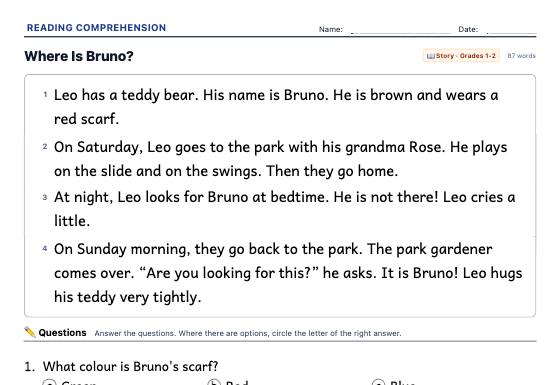
Worksheets with original passages levelled by grade (stories, information, everyday and opinion texts, multiple sources and non-continuous texts), literal, inference, vocabulary and evaluation questions and lined space to answer.
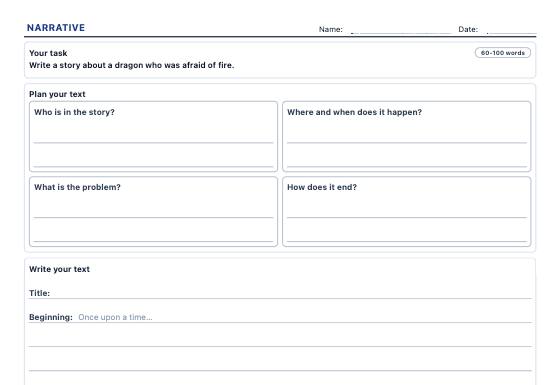
A4 writing frames for stories, descriptions, letters, news reports, opinion texts, instructions and emails: task, planning box, parts of the text, lines by age, a self-check list and a teacher guide with a rubric.
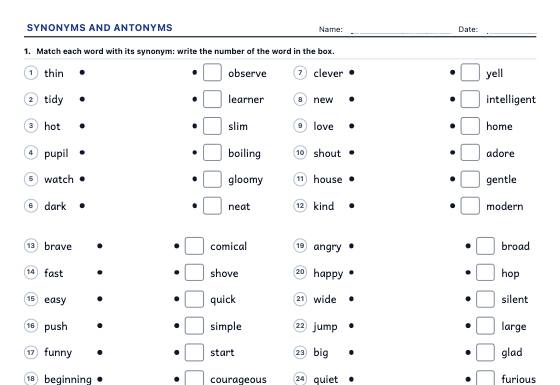
Match pairs, circle the synonym or antonym, write the opposite, replace the word in a sentence and sort pairs, with a levelled dictionary of English synonyms and antonyms.
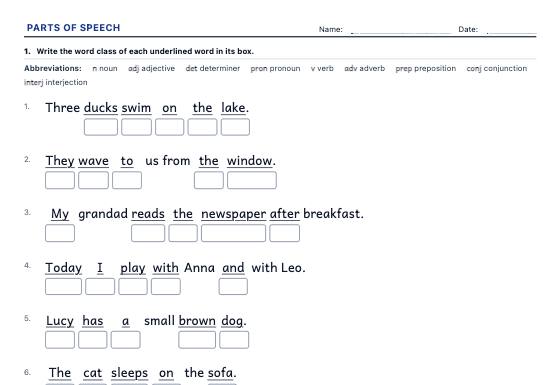
Label the word class of underlined words, circle the nouns, verbs or pronouns and sort every word into a table, with original sentences tagged word by word.
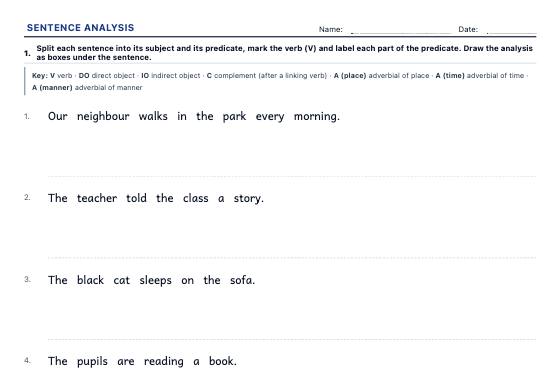
Simple sentences to split into subject and predicate, find the objects, complements and adverbials, analyse every phrase as boxes or a tree, and classify.
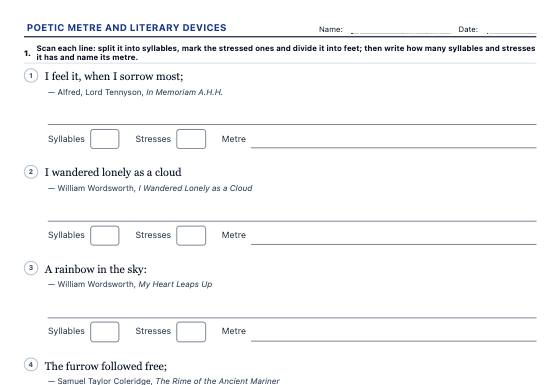
Scan lines into feet, write rhyme schemes, name stanza forms and spot literary devices, with public-domain poems by Shakespeare, Wordsworth, Keats or Dickinson.
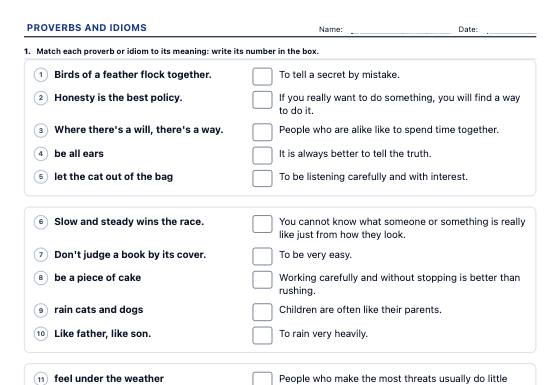
English proverbs and idioms: complete the end of a proverb, match sayings to their meanings, choose the meaning or the saying that fits a situation and explain it, in three levels with an answer key.
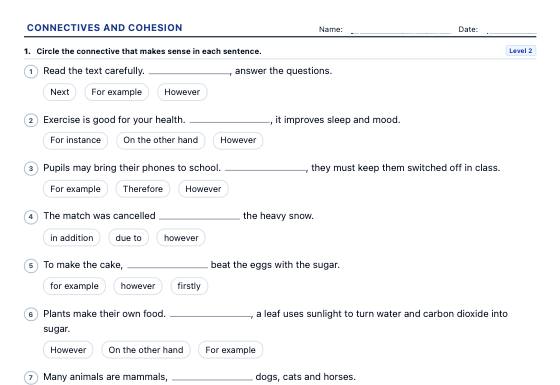
Text cohesion worksheets: choose the connective by its meaning (addition, contrast, cause, result, sequence, example, conclusion), sort connectives, put the paragraphs of a text in order and find what pronouns and synonyms refer to, with sentences written in English, in three levels with an answer key.
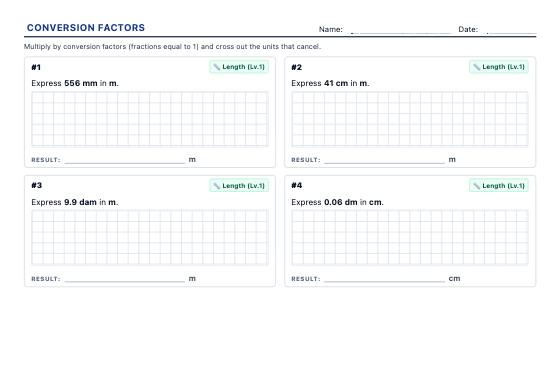
Unit conversion worksheets using chained conversion factors: length, mass, time, speed, density, area and volume, with scientific notation and a step-by-step answer key.
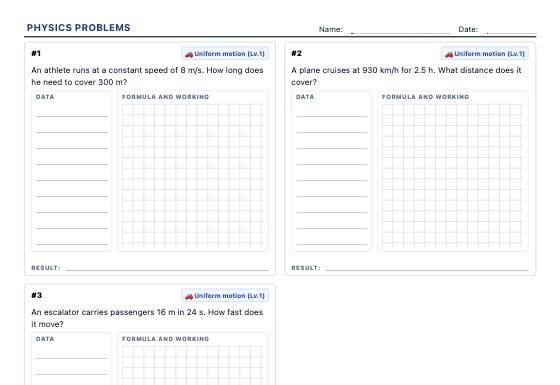
Uniform and accelerated motion, free fall, density, Ohm's law, weight, Hooke's law, Newton's second law, pressure, kinetic and potential energy, work, power, efficiency and heat problems with realistic data and unit conversions, plus an answer key with data, formula, rearranging, substitution and result.
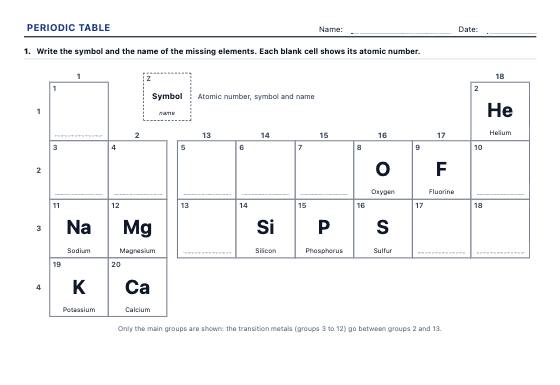
Blank periodic tables to complete, symbols and names, group and period data tables, clue puzzles and metal and non-metal sorting, from the first 20 elements to the whole table, and atomic structure: protons, neutrons and electrons, ions and isotopes, Bohr model, electron configuration and valence electrons, with an answer key.
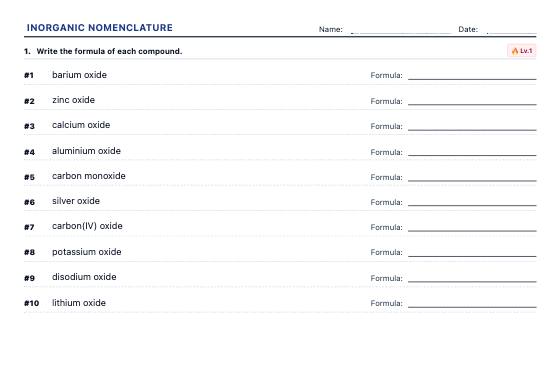
Worksheets to write formulas and name oxides, peroxides, hydrides, hydracids, binary salts, hydroxides, oxoacids and oxosalts, with stoichiometric, Stock and traditional names and an answer key with every name.
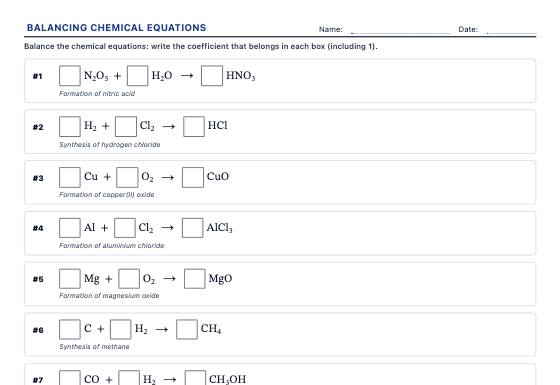
Real reactions to balance with coefficient boxes and an atom-count table, from simple formulas to groups in brackets, hydrates and large coefficients, with an answer key that checks every element.
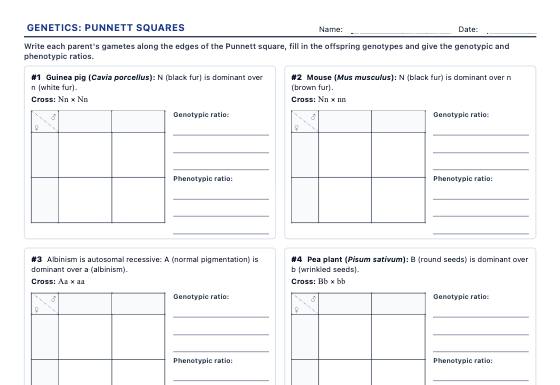
Genetics problems with Punnett squares: monohybrid and dihybrid crosses, incomplete dominance, codominance, ABO groups and sex-linked traits, with gametes, the completed square and the ratios in the answer key.
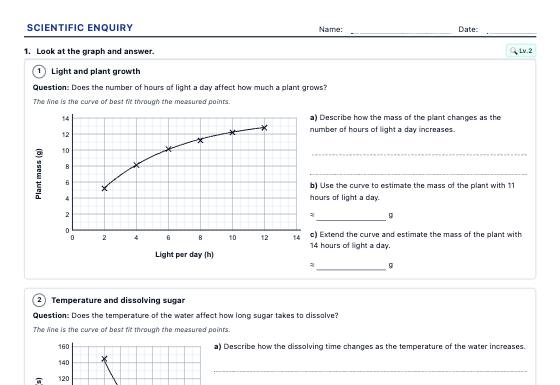
Scientific method worksheets with experiments and realistic data: variables, hypotheses, fair tests, graphs, trends, anomalous results and correlation versus causation, with a reasoned answer key.
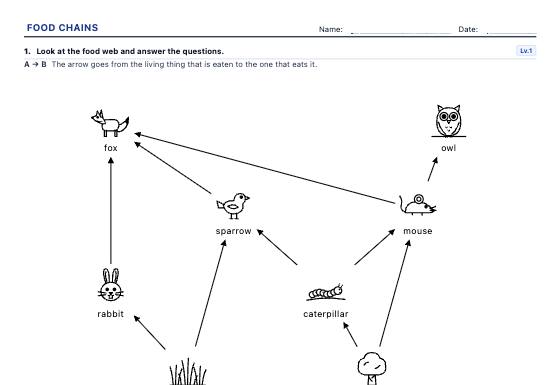
Food chain worksheets from five drawn ecosystems: order the chain, producers and consumers, trophic levels, reading a food web, what happens if a living thing disappears and the energy pyramid, with an answer key.
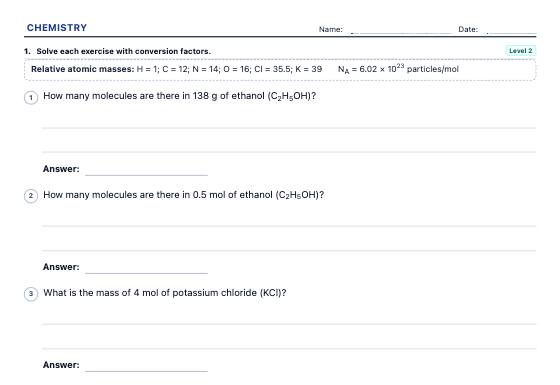
Chemistry exercises: concentration in g/L, percentage by mass and by volume and dilutions, molar mass, grams, moles and particles, molarity and stoichiometry on balanced equations, in three levels with an answer key by conversion factors.
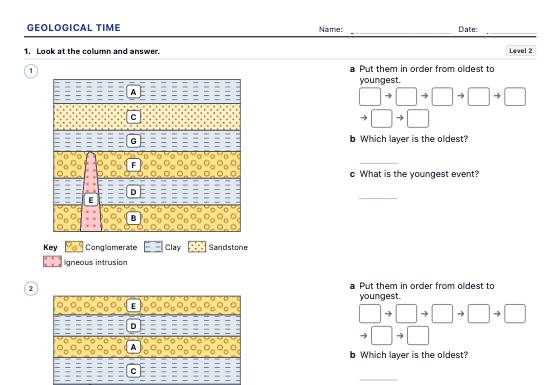
Geological time worksheets: eras and periods and their events, relative dating of rock columns with faults and intrusions, correlating with index fossils, fossilisation and Earth's history to scale with carbon-14 half-life, in three levels with an answer key.
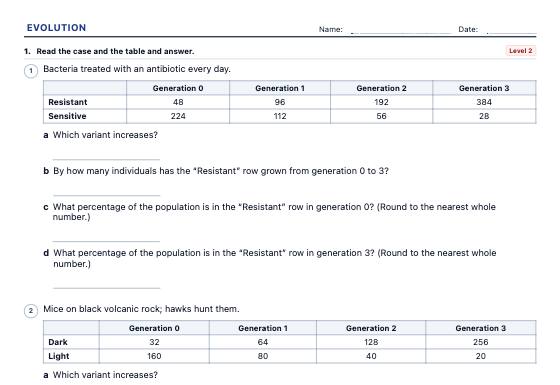
Evolution worksheets: adaptations to the environment, Lamarck's and Darwin's explanations, natural selection with population data over generations, evidence for evolution (homologous structures, fossils, DNA) and phylogenetic trees, in three levels with an answer key.
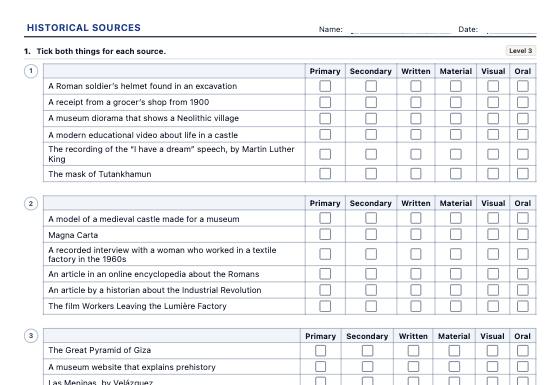
Worksheets for working with historical sources: primary or secondary, written, material, visual or oral, the card of a real source (author, date, place, purpose), dating and ordering sources, fact and opinion and comparing two sources on one event, in three levels with an answer key.
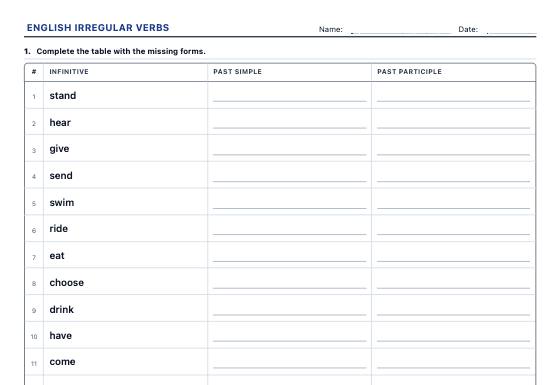
Fill-in tables of irregular verbs with gaps in any column, grouped by level and by spelling pattern, with translation and an answer key.
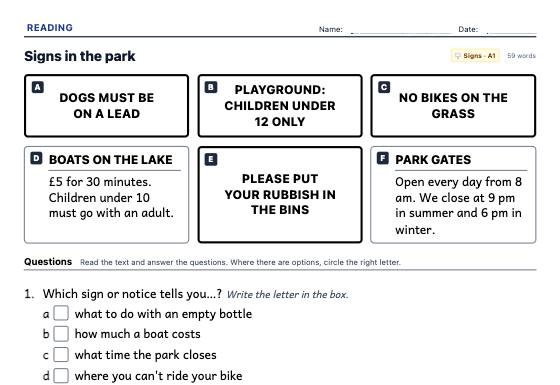
Original English texts levelled by the CEFR: signs and notices, messages and emails, adverts, articles and stories, with Cambridge-style questions and an answer key.
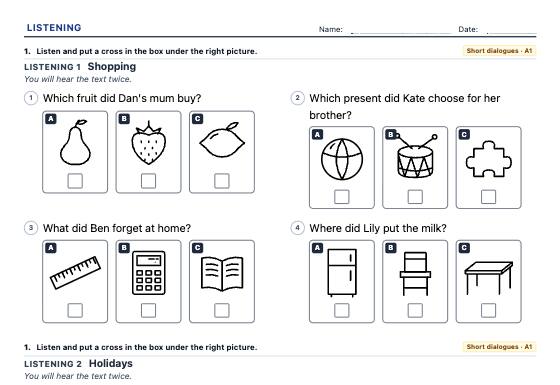
Original English scripts levelled by the CEFR, from Pre-A1 to B1, for the teacher to read aloud: tick the right picture, match, true or false and complete the notes, with the answers in the script.
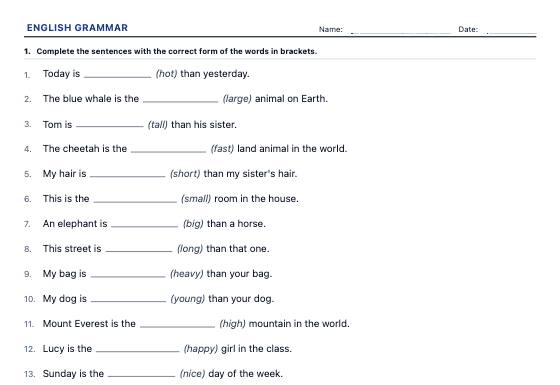
English sentences to fill in, choose the correct option, find the mistake or rewrite: there is, pronouns, possessives, plurals, some and any, comparatives, prepositions, can, must and should, conditionals, the passive, reported speech and relative clauses, three levels per point, with an answer key.
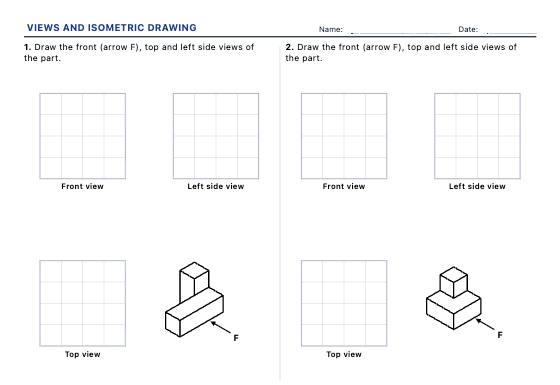
Always-new parts made of cubes to draw the front, top and side views, draw the isometric from the views or identify each view, with hidden edges at higher levels.
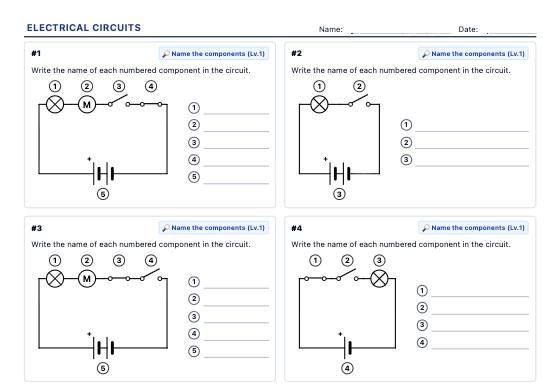
Always-new, properly solved circuits with standard symbols: name the components, predict which bulbs light up, tell series from parallel, draw diagrams and work through Ohm's law step by step.
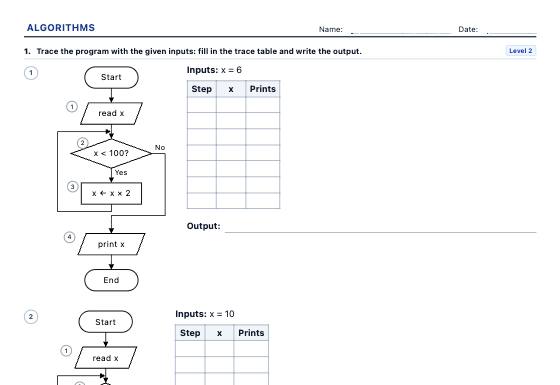
Computational thinking worksheets: trace a flowchart or pseudocode with a trace table, complete the missing step, find the bug, put the steps in order and draw the flowchart, with sequence, selection and loops in three levels and an answer key.
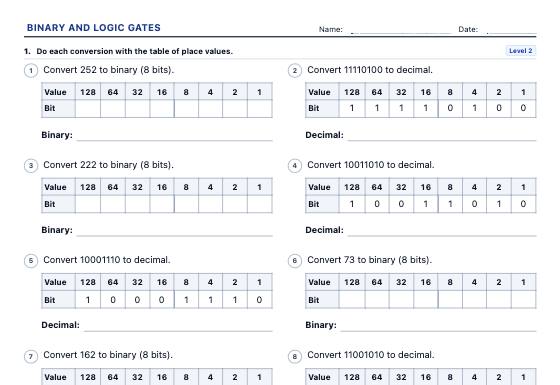
Data representation worksheets: binary, decimal and hexadecimal, bits and bytes, pixel pictures to encode and decode, and AND, OR, NOT, NAND, NOR and XOR logic gates with truth tables and circuits, in three levels with an answer key.
Grade 10 rounds off the compulsory years and prepares students for further study or work. Maths becomes more fluent algebra and the interpretation of functions and data; science covers genetics with Punnett squares, chemical reactions and physics with units and laws. It is also a year to connect school knowledge with adult life, from loans and interest to reading statistics in the news. Fifteen-year-olds learn best when they can practise independently and check reasoning, so these worksheets come with complete worked solutions.
Equations of every kind meet in this course: quadratic equations, systems of equations and polynomials with Ruffini’s rule and factorising. The functions and graphs worksheets read slopes, vertices and intervals from formulas and graphs.
Dominant and recessive alleles, sex-linked traits and dihybrid crosses are worked out on Punnett square worksheets with ratios counted from the square. Chemical equations, nomenclature and the periodic table keep chemistry in steady practice.
Uniform and accelerated motion, free fall, density and Ohm’s law: the physics problems worksheets give data in mixed units, and the key shows the formula, the conversion and the result. Conversion factors practise changing units step by step, a skill every science subject needs.
Payslips, budgets, interest and loans appear in the financial literacy worksheets, with every calculation explained. Together with statistics measures and graphs in context, they help students make sense of the numbers they will meet as adults.