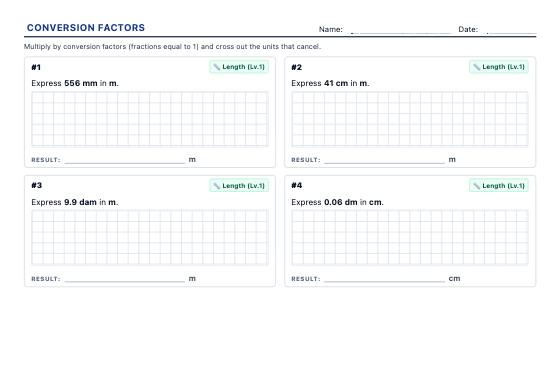
Unit Conversion Factors
Unit conversion worksheets using chained conversion factors: length, mass, time, speed, density, area and volume, with scientific notation and a step-by-step answer key.
Printable science worksheets with an answer key: the human body, animals, life cycles and the solar system for younger children, and physics, chemistry, genetics and the scientific method for teens.
Unit conversion worksheets using chained conversion factors: length, mass, time, speed, density, area and volume, with scientific notation and a step-by-step answer key.
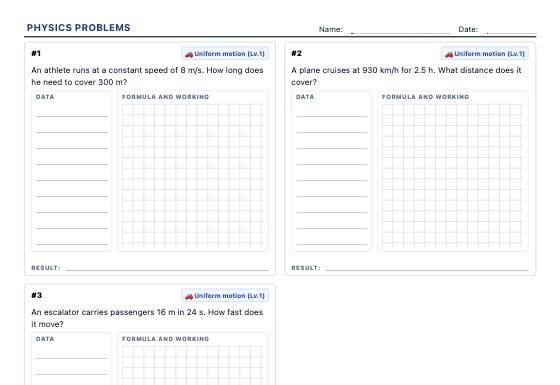
Uniform and accelerated motion, free fall, density, Ohm's law, weight, Hooke's law, Newton's second law, pressure, kinetic and potential energy, work, power, efficiency and heat problems with realistic data and unit conversions, plus an answer key with data, formula, rearranging, substitution and result.
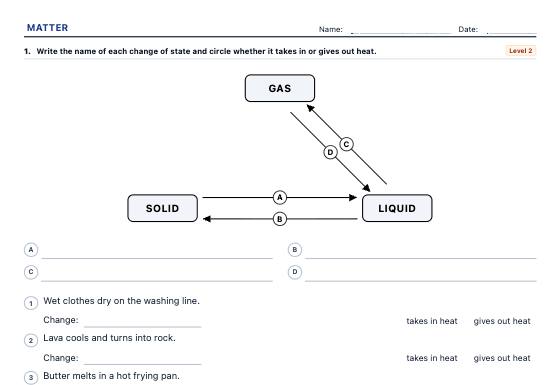
A4 worksheets on matter: properties of materials, states and the particle model, changes of state, heating and cooling curves, pure substances and mixtures and separation methods, in three levels with an answer key.
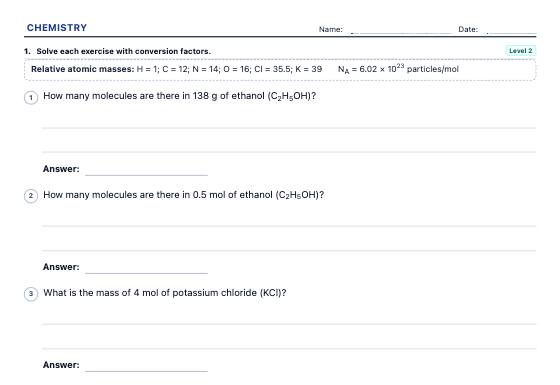
Chemistry exercises: concentration in g/L, percentage by mass and by volume and dilutions, molar mass, grams, moles and particles, molarity and stoichiometry on balanced equations, in three levels with an answer key by conversion factors.
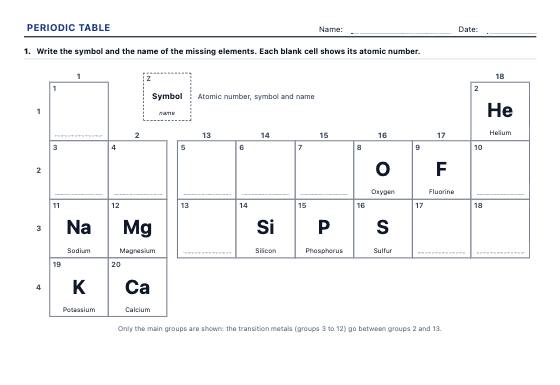
Blank periodic tables to complete, symbols and names, group and period data tables, clue puzzles and metal and non-metal sorting, from the first 20 elements to the whole table, and atomic structure: protons, neutrons and electrons, ions and isotopes, Bohr model, electron configuration and valence electrons, with an answer key.
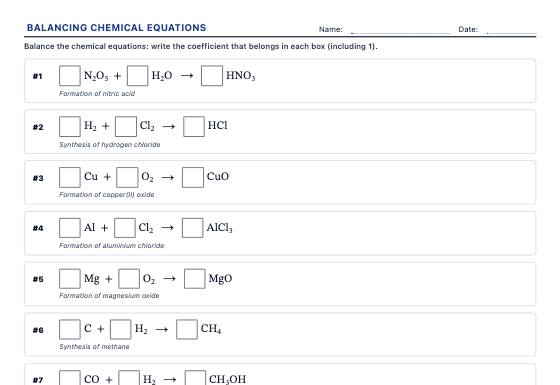
Real reactions to balance with coefficient boxes and an atom-count table, from simple formulas to groups in brackets, hydrates and large coefficients, with an answer key that checks every element.
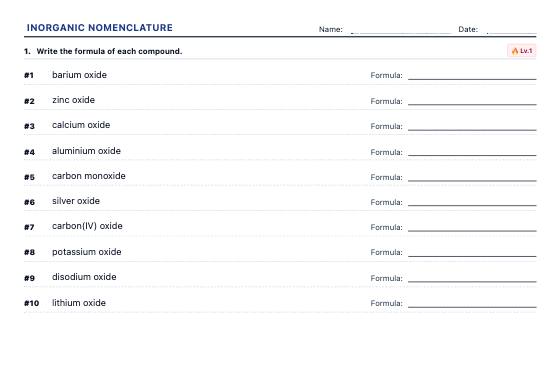
Worksheets to write formulas and name oxides, peroxides, hydrides, hydracids, binary salts, hydroxides, oxoacids and oxosalts, with stoichiometric, Stock and traditional names and an answer key with every name.
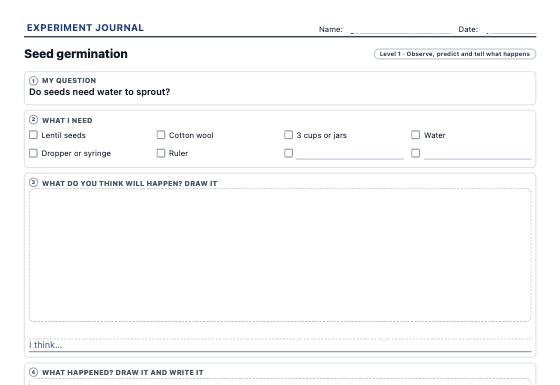
Guided sheets to record an experiment step by step with the scientific method: question, hypothesis, materials, procedure, data table, graph and conclusion, tailored to each stage.
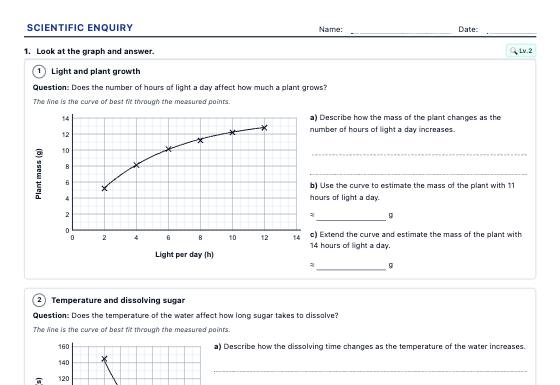
Scientific method worksheets with experiments and realistic data: variables, hypotheses, fair tests, graphs, trends, anomalous results and correlation versus causation, with a reasoned answer key.
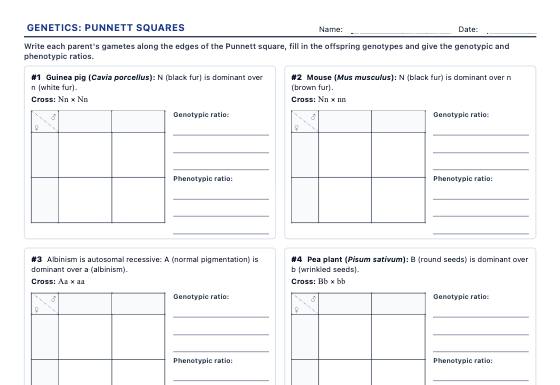
Genetics problems with Punnett squares: monohybrid and dihybrid crosses, incomplete dominance, codominance, ABO groups and sex-linked traits, with gametes, the completed square and the ratios in the answer key.
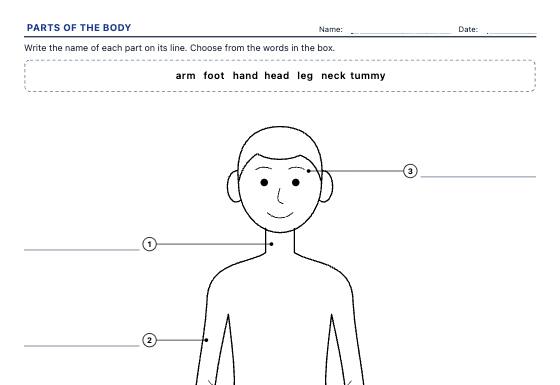
Human body diagrams to label with our own line art: parts of the body and face, skeleton, muscles, internal organs and the digestive, respiratory and urinary systems, in three levels with an optional word bank.
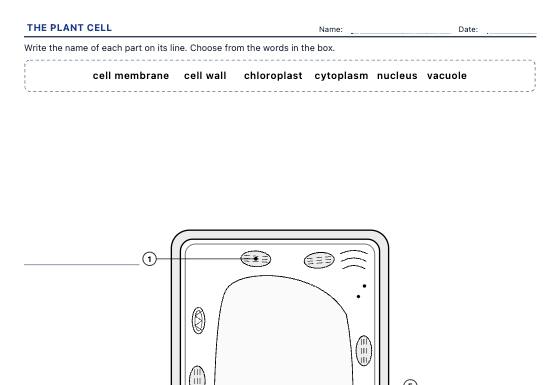
Diagrams to label with our own line art: the animal and plant cell, the microscope, the parts of a plant and a flower, seed germination and photosynthesis, in three levels, with an optional word bank and an answer key.
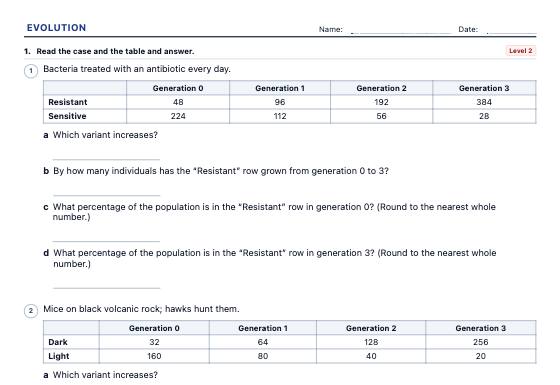
Evolution worksheets: adaptations to the environment, Lamarck's and Darwin's explanations, natural selection with population data over generations, evidence for evolution (homologous structures, fossils, DNA) and phylogenetic trees, in three levels with an answer key.
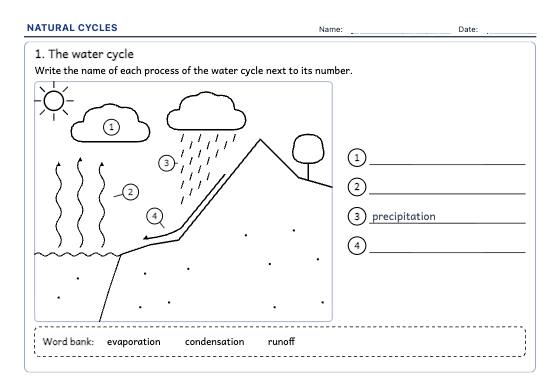
Worksheets to label and sequence the water cycle and the life cycles of a plant, the butterfly, the frog and the chicken, with our own drawings, a word bank and an answer key.
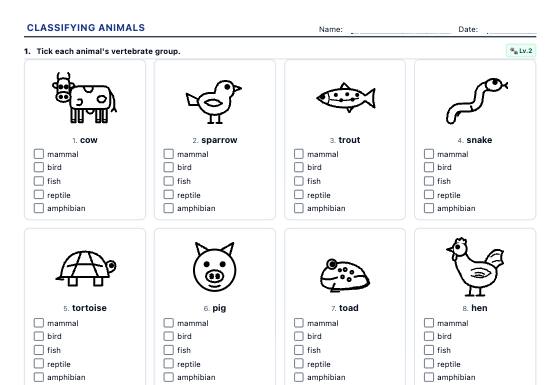
Worksheets to classify animals with our own drawings: vertebrates and invertebrates, groups, diet, reproduction, body covering and breathing, animal fact files and dichotomous keys, with an answer key.
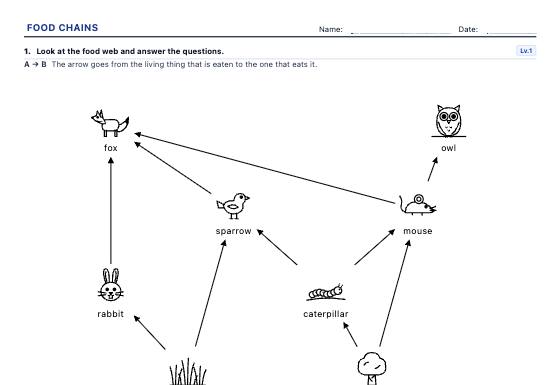
Food chain worksheets from five drawn ecosystems: order the chain, producers and consumers, trophic levels, reading a food web, what happens if a living thing disappears and the energy pyramid, with an answer key.
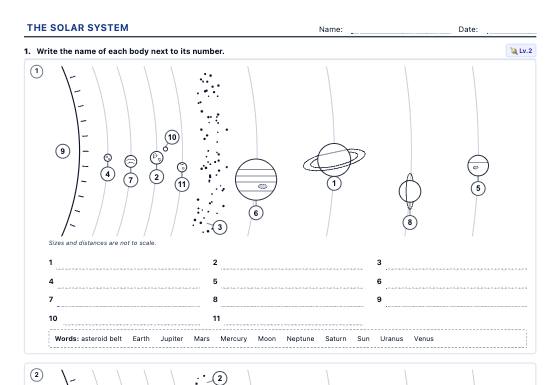
Worksheets to label and order the planets, answer questions from real NASA data and understand day and night, the seasons, the phases of the Moon and eclipses, with our own drawings and an answer key.
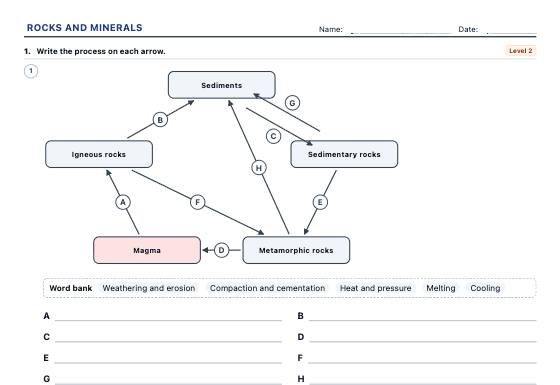
Geology worksheets: hardness on the Mohs scale and identifying minerals with a table of properties, igneous, sedimentary and metamorphic rocks, the rock cycle, the layers of the Earth and plate boundaries, in three levels with an answer key.
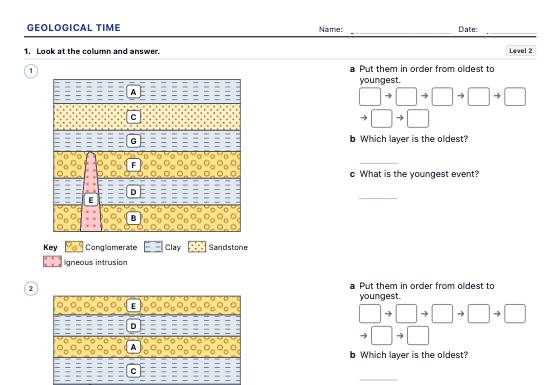
Geological time worksheets: eras and periods and their events, relative dating of rock columns with faults and intrusions, correlating with index fossils, fossilisation and Earth's history to scale with carbon-14 half-life, in three levels with an answer key.
Science at school moves from looking closely at the living world to explaining it with models, data and numbers. Younger children label body parts, sort animals and order the stages of a life cycle with clear line drawings. Older students balance equations, solve motion problems, read real data and plan fair tests. These kits draw every diagram for you and compute every answer from the values printed on the sheet, so the key always matches. Planets use real NASA data and physics problems use realistic values. Choose a topic and level, and print the sheet or save it as a PDF.
With human body labelling worksheets, children name the parts of the body and face, then the skeleton, muscles, organs and body systems, with an optional word bank. Animal sheets sort vertebrates and invertebrates, diets and body coverings, and dichotomous keys teach how scientists classify. Food chain worksheets from woodland, river and sea lead from producers and consumers to food webs and the energy pyramid.
Order the stages of the water cycle and the life cycles of a plant, a butterfly, a frog and a chicken with life cycle worksheets. Then explore day and night, the seasons, the phases of the Moon and eclipses on solar system worksheets whose drawings stay scientifically right.
Practise motion, density and Ohm’s law with physics word problems solved step by step: data, formula, rearranging and result. In chemistry, complete the periodic table, name compounds and balance chemical equations with an atom-count table that checks every element.
The scientific enquiry worksheets give experiments with realistic data to identify variables, judge whether a test is fair, read trends and spot anomalous results. Genetics students can work through Punnett squares, from simple crosses to sex-linked traits, with the ratios in the key.
A labelling sheet makes a quick starter before a new topic, and the same sheet at the end shows what stayed. For practical work, pair a lab report with a data question on graphs and trends. Each sheet is new, so a student who missed a lesson can catch up with a fresh version.