Column Addition
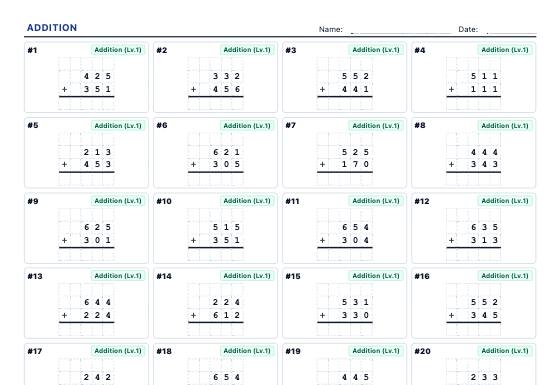
A4 column addition worksheets on a 4 mm grid: without carrying, with carrying, three addends and five digits, plus a custom level (up to 5 addends of 7 digits). With answer key.
Printable Grade 3 worksheets for 8-year-olds: multiplication and division, fractions, measurement, punctuation, guided writing and science topics, all free and with an answer key.
A cover, contents and a week of practice in every subject. Open it and change anything you like.
Open the workbook A4 column addition worksheets on a 4 mm grid: without carrying, with carrying, three addends and five digits, plus a custom level (up to 5 addends of 7 digits). With answer key.
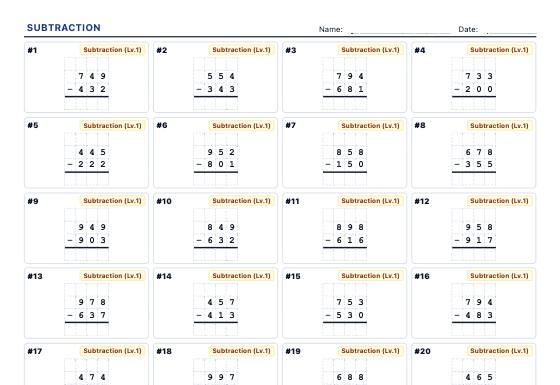
A4 column subtraction worksheets on a 4 mm grid: without borrowing, with borrowing, across zeros and five digits, plus a custom level (up to 7 digits). With answer key.
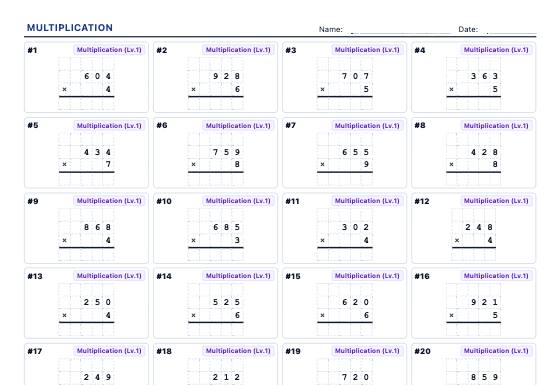
A4 column multiplication worksheets on a 4 mm grid: by one digit, by two, zeros in the multiplier and by three digits, plus a custom level (up to 6 × 4 digits). Answer key with partial products.
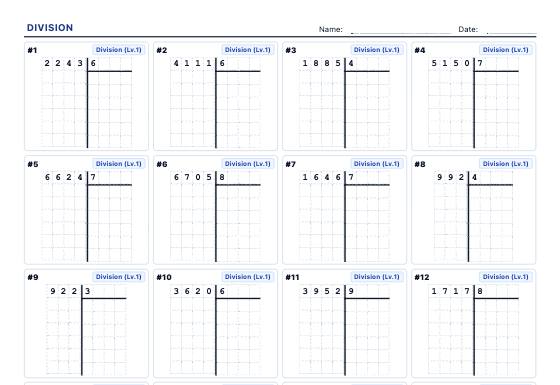
A4 division worksheets on a 4 mm grid: one- and two-digit divisors, zeros in the quotient and five-digit dividends, plus a custom level (up to 8 by 4 digits). Mental or written subtraction and a step-by-step answer key.
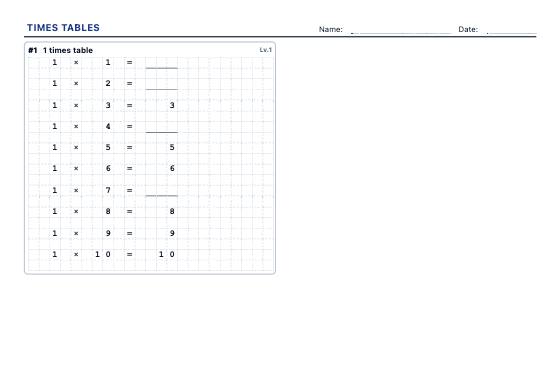
A4 worksheets for the tables you choose: complete the table, shuffled facts, missing factors, multiplication grids and division facts, in three levels with an answer key.
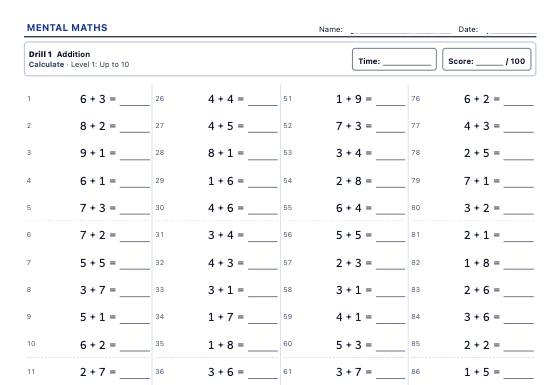
Drills of 50 to 100 quick facts in line with time and score boxes: addition, subtraction, number bonds to 10 and 100, ± 10, doubles and halves, times tables and × 10, 100 and 1000.
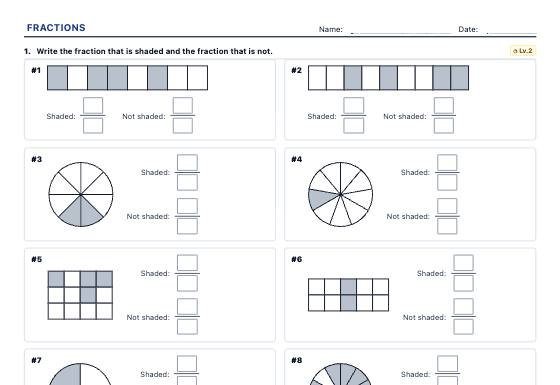
Worksheets to understand fractions: read and shade fractions of bars, circles and grids, fractions of a set and of an amount, fractions in words, improper fractions and mixed numbers, and comparing with pictures, with answer keys.
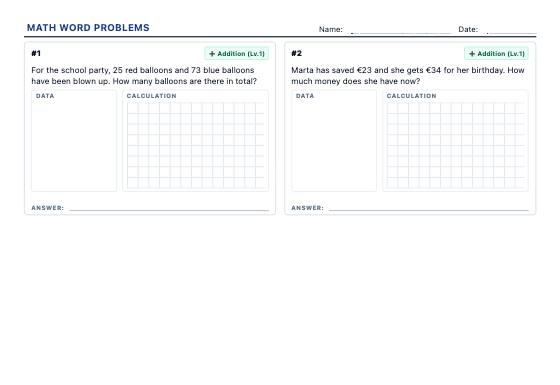
Printable real-world math word problems with dedicated sections for given data, workspace calculation grid, and sentence answer formulation.
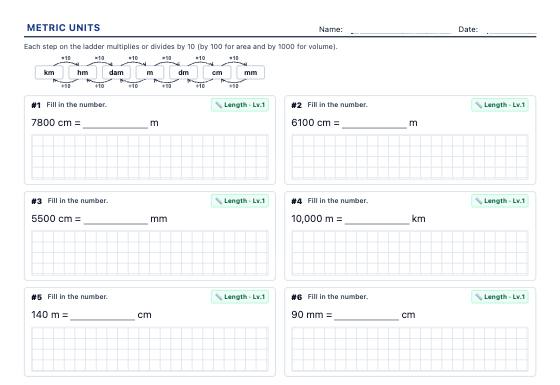
Metric conversion worksheets: length, mass, capacity, area and volume, with mixed units, comparing and ordering, and an answer key showing how the decimal point moves.
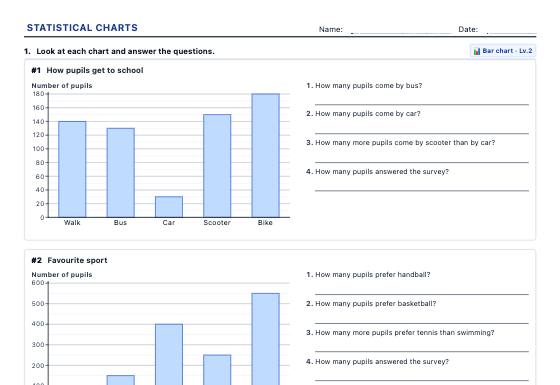
Pictograms, bar charts, line graphs and pie charts to read and to draw, and frequency tables with mode, mean and median, with new data every time and an answer key.
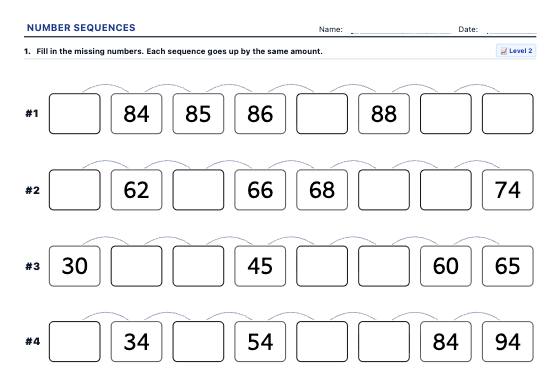
A4 number sequence worksheets: skip counting, counting on and back with missing numbers, continuing a sequence, finding the rule and number patterns, to 20, 100 or 1000.
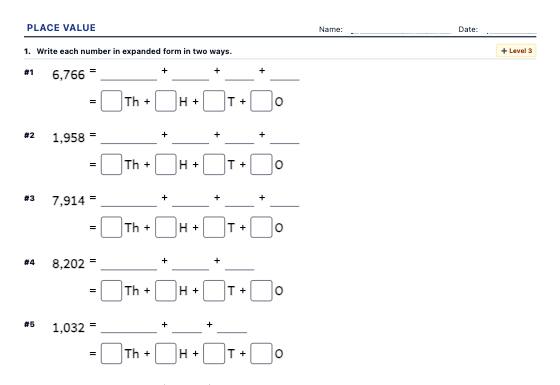
A4 place value worksheets: base ten blocks, place value charts, expanded form, building numbers, the value of a digit and numbers in words, up to 999,999 with an answer key.
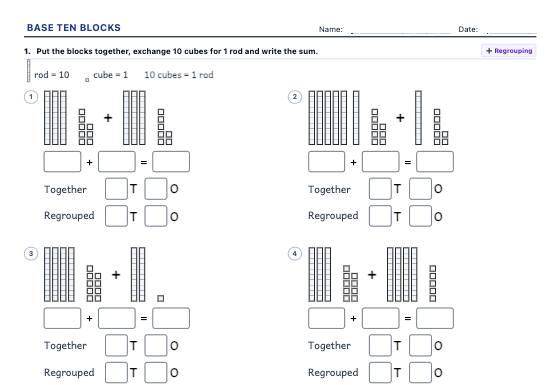
A4 base ten blocks worksheets: read and draw numbers with flats, rods and cubes, regroup, compare, add and subtract with blocks and show a number in different ways, up to 999 with an answer key.
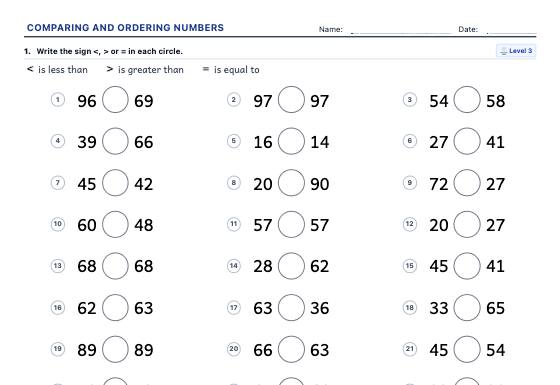
A4 worksheets to compare numbers with the signs <, > and =, compare calculations, order from smallest to greatest, find the greatest and smallest and the numbers in between, 10 to 999,999.
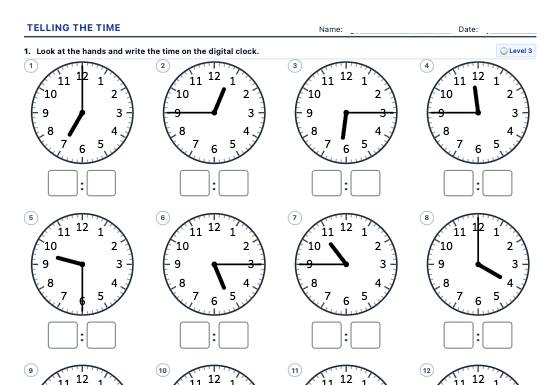
A4 worksheets for telling the time: read analogue clocks, draw the hands, the time in words (quarter past, half past, quarter to), what time it will be and the 24-hour clock.
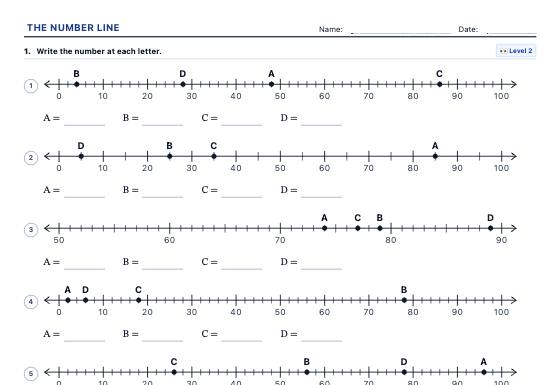
A4 number line worksheets: read and place numbers to 1000, add and subtract in jumps, multiply with equal jumps, negative numbers either side of zero and fractions on a number line.
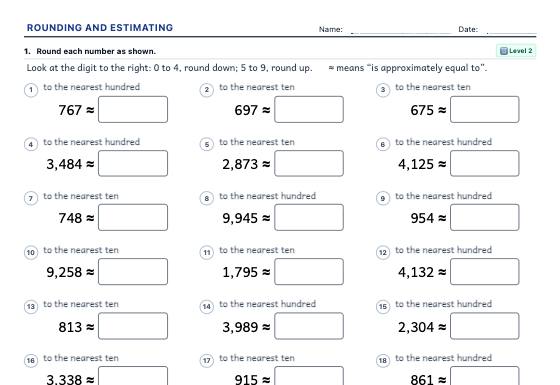
A4 worksheets to round numbers to the nearest ten, hundred and thousand on a number line and in tables, round decimals, estimate sums, differences and products and decide whether an answer is reasonable.
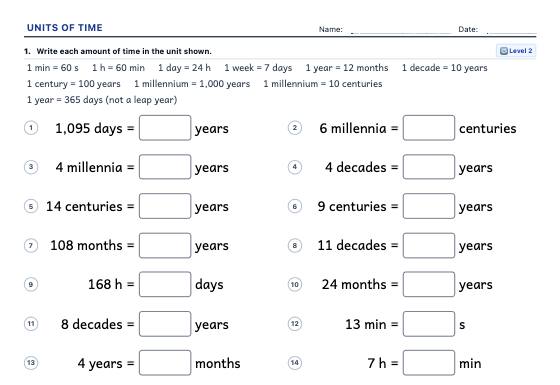
A4 worksheets to convert units of time (hours, minutes, seconds, days, weeks, years and centuries), write times in mixed units, add and subtract times in columns and solve timetable problems.
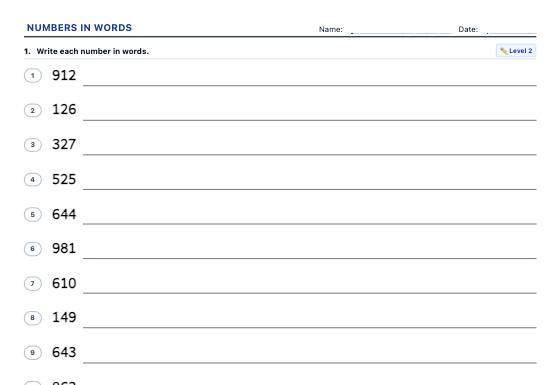
A4 worksheets to write numbers in words and in figures with the right hyphens and spelling, fill in missing words, match, spot the mistake and ordinals, 99 to millions.
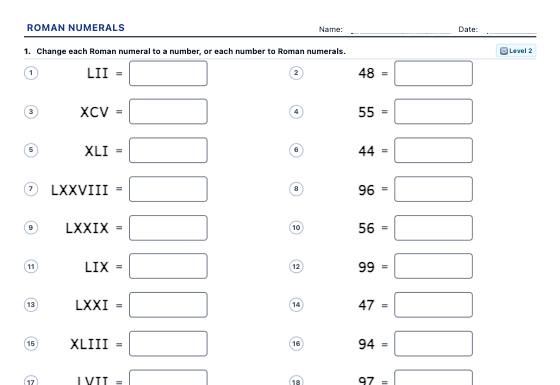
A4 worksheets to convert Roman numerals to numbers and back, spot mistakes like IIII or IC, compare, order, add and subtract, read kings and chapters and the clock face.
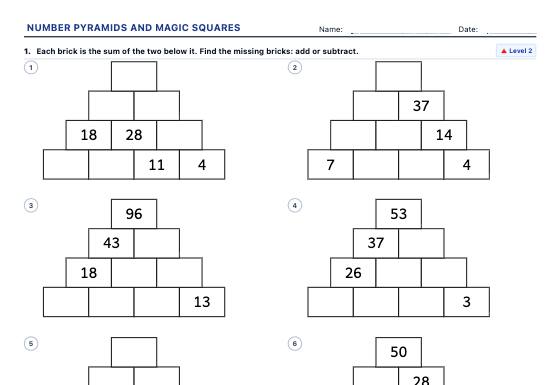
Addition and multiplication number pyramids (from the bottom up or with missing bricks, with decimals and negative numbers) and 3 × 3 and 4 × 4 magic squares to complete or check, with an answer key.
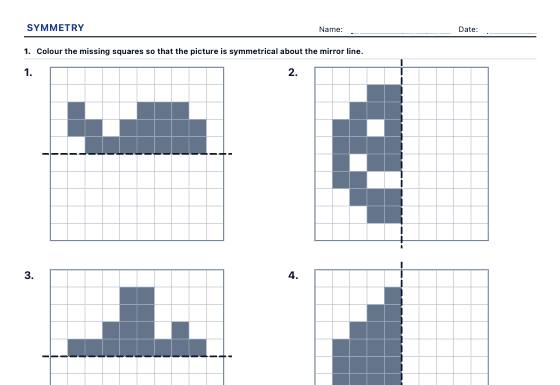
Symmetry worksheets on a grid: complete the symmetrical half of a picture, reflect a shape in a mirror line, decide whether a line is a line of symmetry and draw every line of symmetry of a shape, with an answer key.
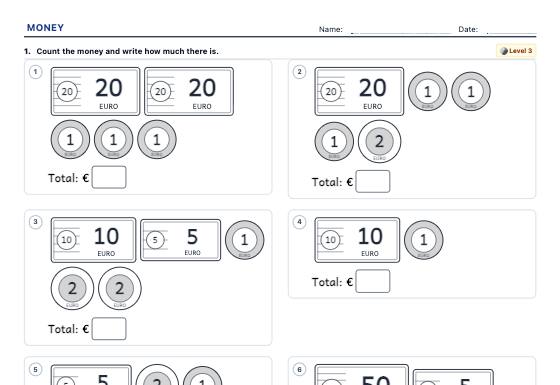
A4 worksheets with drawn euro coins and notes to count money, pay a price with the fewest pieces, compare purses, work out the change and solve shopping problems.
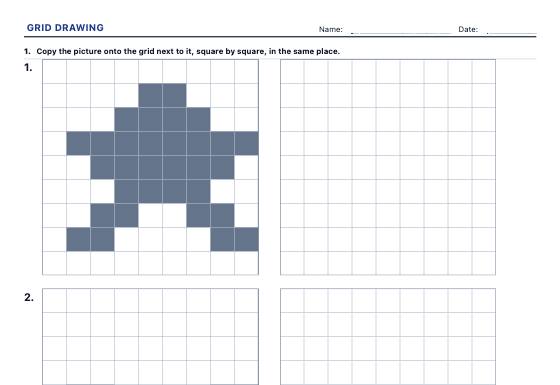
Grid drawing worksheets: copy a picture square by square, follow an arrow code along the grid lines, write the code of a path and colour mystery pictures from coordinates, with an answer key.
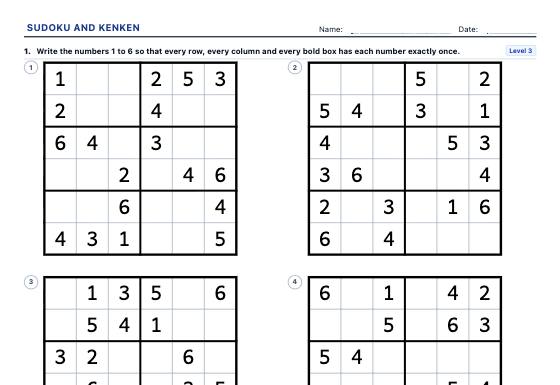
4 × 4, 6 × 6 and 9 × 9 sudoku from easy to hard and KenKen (maths sudoku) with addition, subtraction, multiplication and division, each with exactly one solution and an answer key.
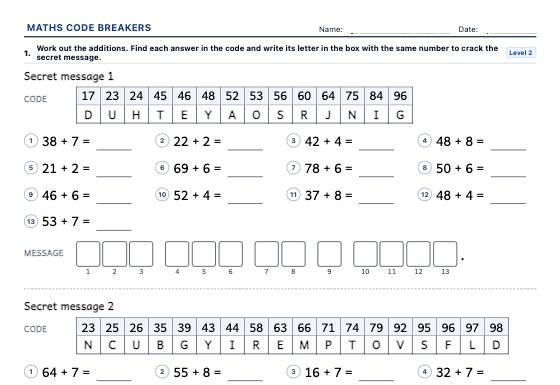
A4 worksheets of additions, subtractions, times tables and divisions that hide a secret message: each answer is a letter of the code, and at the end pupils read a riddle, a joke or a fact.
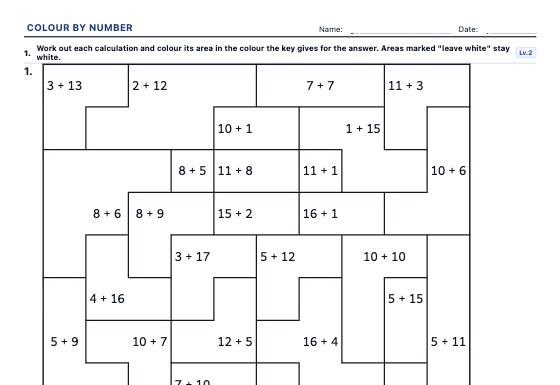
Hidden pictures to colour by the answer: every area has an addition, a subtraction, a times table fact or a division, and the key says which colour goes with each answer. Three picture sizes and a coloured answer key.
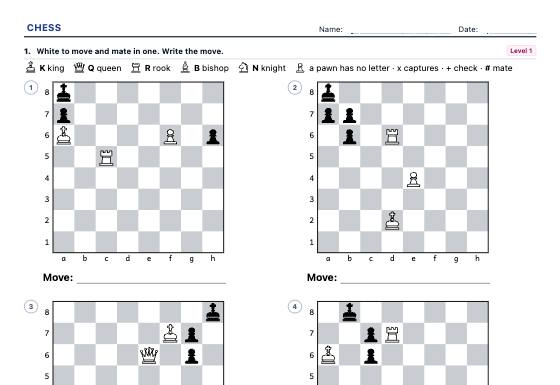
Chess in schools: board coordinates, how the pieces move, check or not, mate in one and mate in two, with positions checked by a legal-move generator (exactly one solution) and an answer key.
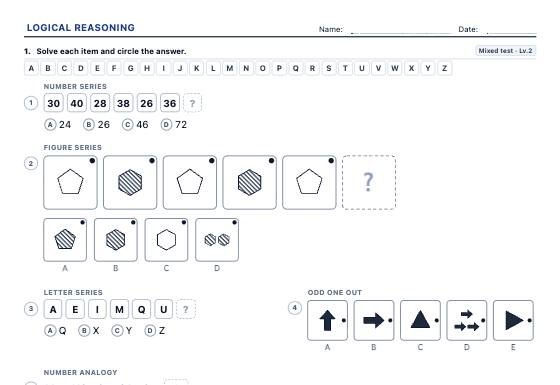
Reasoning test style worksheets: number, letter and figure series, 3 × 3 matrices, analogies and odd one out, in four levels, each item with exactly one answer and its rule on the answer key.
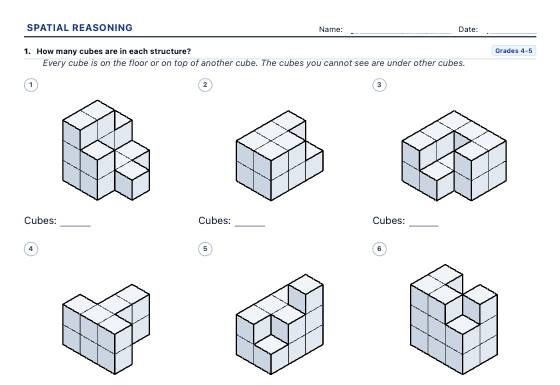
Spatial reasoning worksheets: count the cubes in a structure (hidden ones too), pick the view from the front, top or side, find the rotated shape among mirror images and fold cube nets with marked faces, with an answer key.
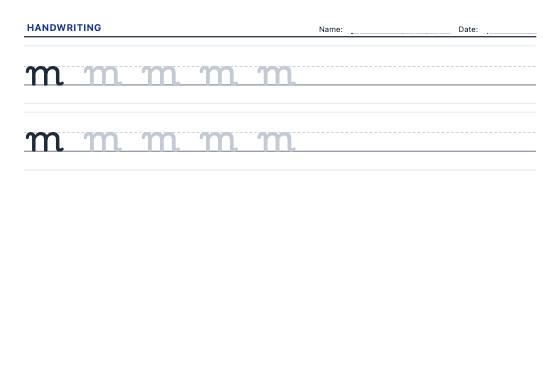
Create A4 handwriting worksheets with letters, words, sentences or your own text to trace and copy, in cursive or print, on Montessori, double, grid or single lines.
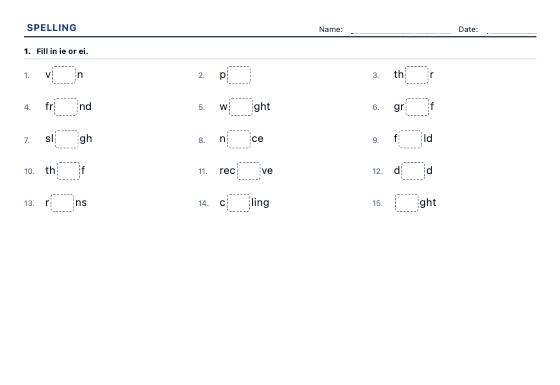
Words to fill in with the right letters, choose between two spellings or sort into columns: ie/ei, silent letters, double consonants, -tion/-sion, c/k/ck and homophones.
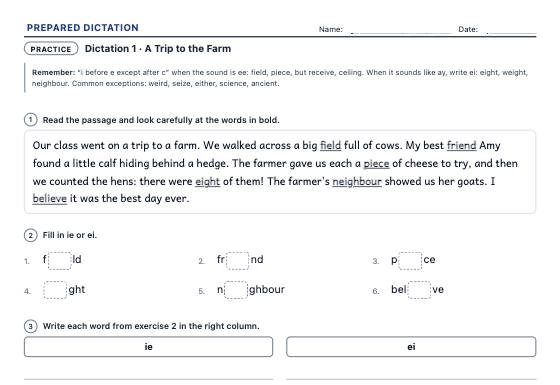
Original passages for each spelling pattern: a practice sheet with the key words to fill in and sort, a dictation sheet and the teacher's text to read aloud.
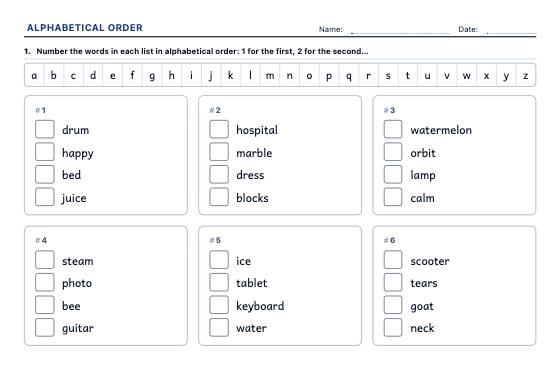
Lists of real words to put in alphabetical order by the first, second or third letter: number them, write them in order or circle the one that comes first, with the deciding letter in the answer key.
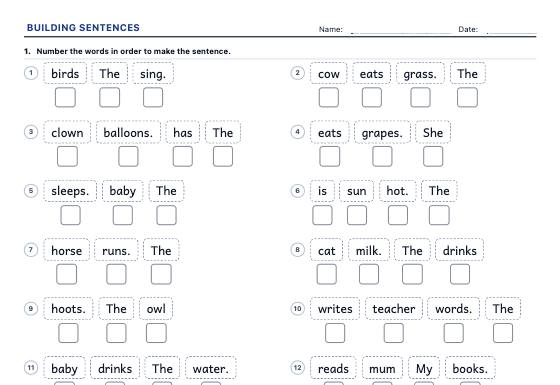
Scrambled sentences to number and unscramble the words, write the sentence with a capital letter and a full stop, pick the right order and count the words.
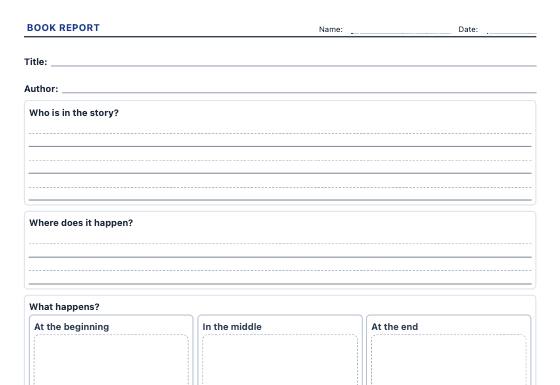
Create A4 sheets for any book: book report, character profile, story map, reading log and reading challenge passport, with line spacing and questions adapted to every stage.
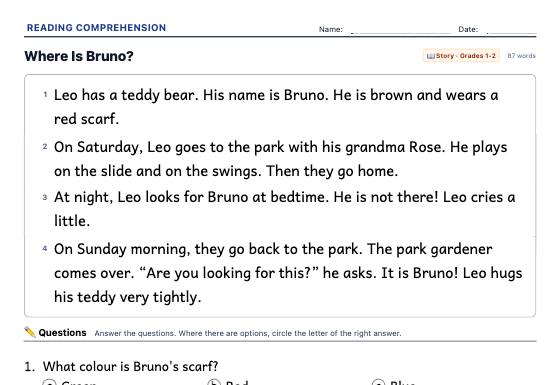
Worksheets with original passages levelled by grade (stories, information, everyday and opinion texts, multiple sources and non-continuous texts), literal, inference, vocabulary and evaluation questions and lined space to answer.
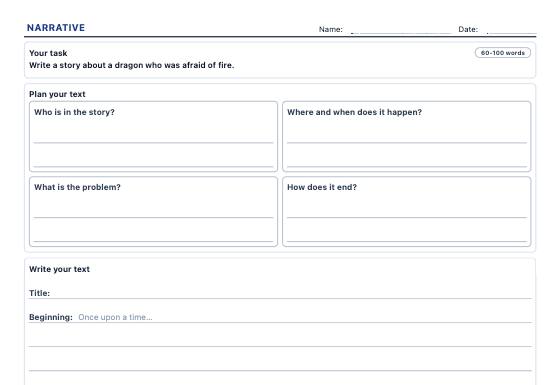
A4 writing frames for stories, descriptions, letters, news reports, opinion texts, instructions and emails: task, planning box, parts of the text, lines by age, a self-check list and a teacher guide with a rubric.
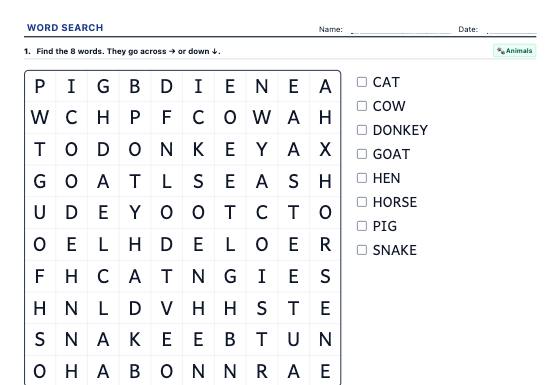
Word searches with topic vocabulary, the word list beside the grid and more directions and longer words at each level: animals, food, school, jobs, countries, feelings and more.
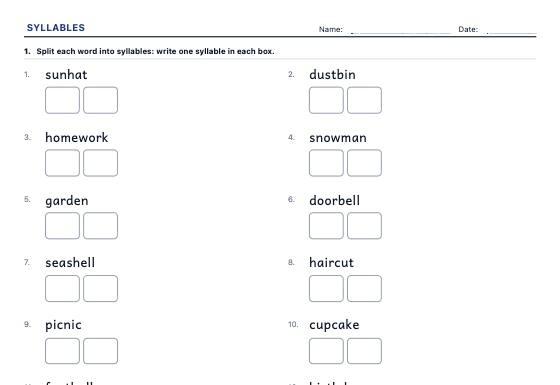
Real words to split into syllables, clap and count, build from their syllables, sort by number of syllables and find the stressed syllable, from compound words to long words.
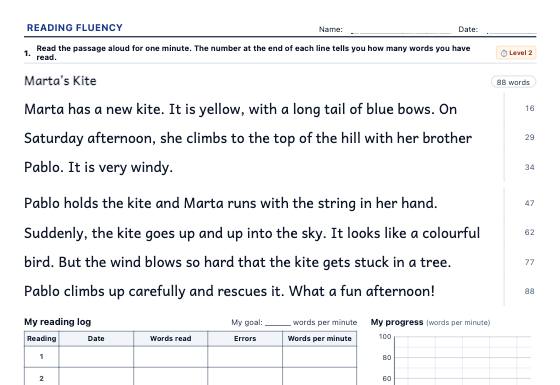
Word lists and timed passages, all original, to read aloud, with a running word count on every line, a words per minute log and a progress graph.
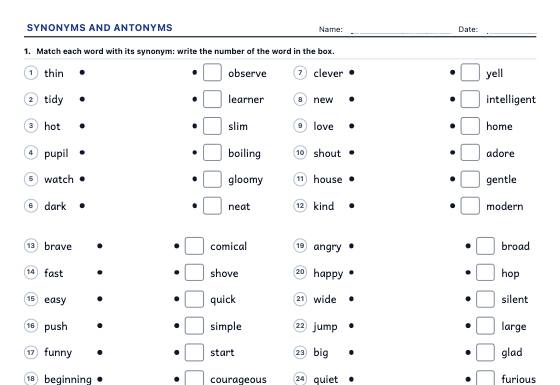
Match pairs, circle the synonym or antonym, write the opposite, replace the word in a sentence and sort pairs, with a levelled dictionary of English synonyms and antonyms.
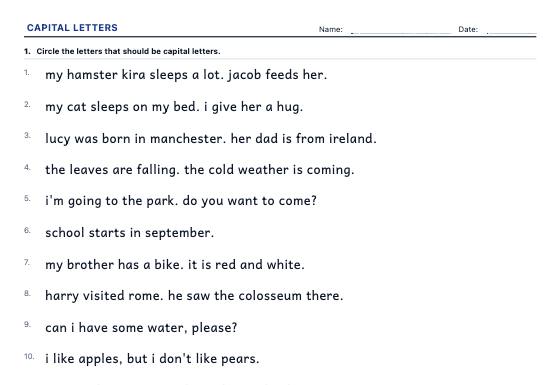
Sentences to circle the capital letters in, copy correctly and correct, and words to sort: sentence starts, the word I, names of people and places, days, months and languages.
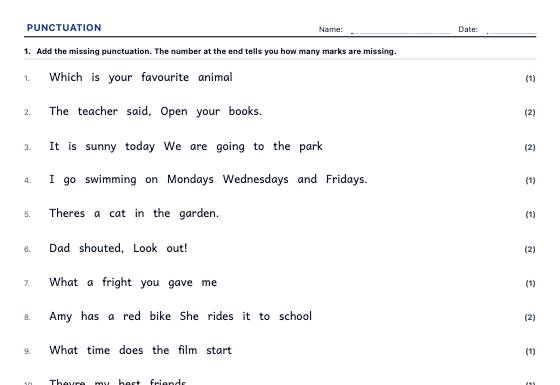
Sentences without their marks to add full stops, commas, question and exclamation marks, apostrophes, inverted commas, colons and semicolons, each with one right answer.
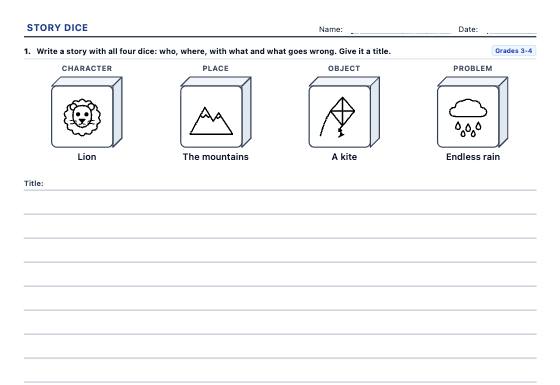
Drawn story dice, story starters and PISA-style creative thinking tasks: many different ideas, an original idea, improve an idea, complete a drawing and solve problems, with a teacher guide and rubric.
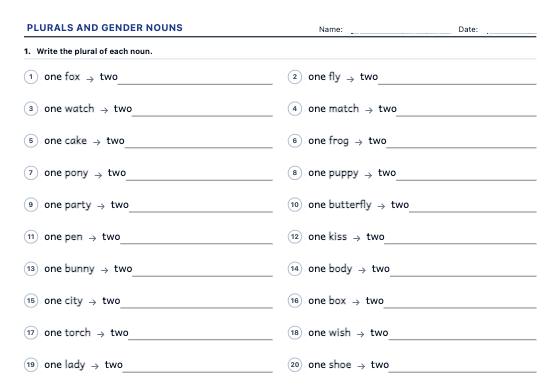
Write plurals and singulars (-s, -es, -ies, -ves and irregular), masculine and feminine nouns, and phrases with this, that, these and those, from the spelling rules.
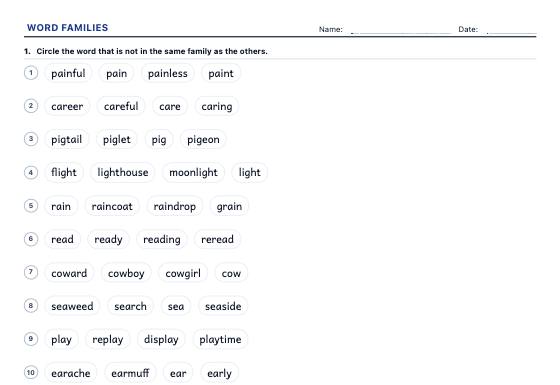
Odd one out, sort into families, write the family, split and build words with prefixes and suffixes and choose their meaning, with a levelled bank of English word families and affixes.
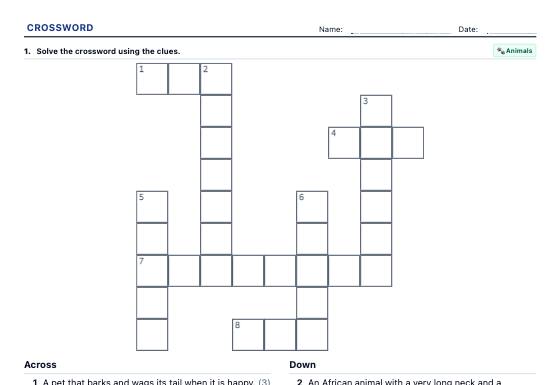
Topic vocabulary crosswords with Across and Down clues written for English, three levels and a well-built grid every time.
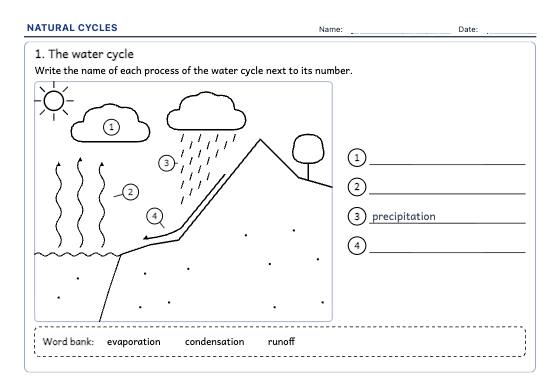
Worksheets to label and sequence the water cycle and the life cycles of a plant, the butterfly, the frog and the chicken, with our own drawings, a word bank and an answer key.
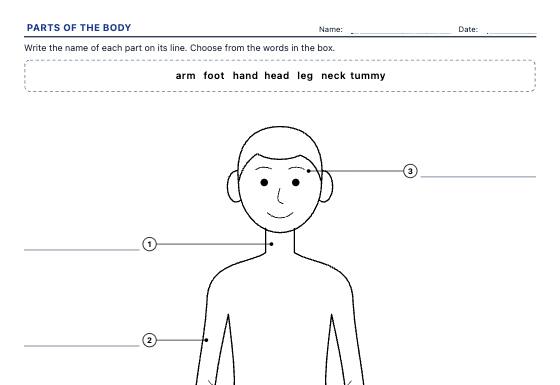
Human body diagrams to label with our own line art: parts of the body and face, skeleton, muscles, internal organs and the digestive, respiratory and urinary systems, in three levels with an optional word bank.
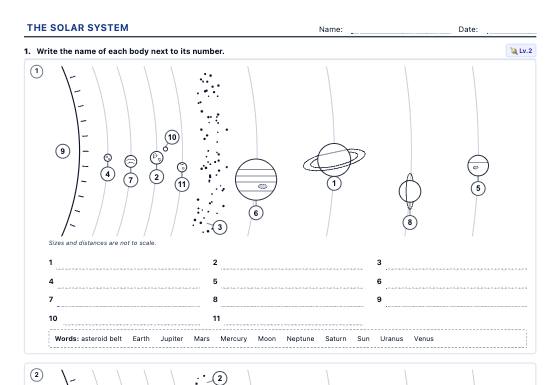
Worksheets to label and order the planets, answer questions from real NASA data and understand day and night, the seasons, the phases of the Moon and eclipses, with our own drawings and an answer key.
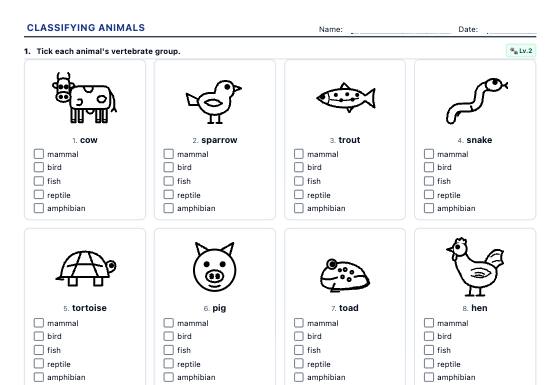
Worksheets to classify animals with our own drawings: vertebrates and invertebrates, groups, diet, reproduction, body covering and breathing, animal fact files and dichotomous keys, with an answer key.
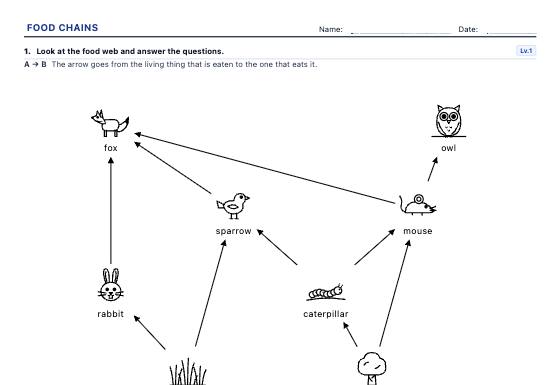
Food chain worksheets from five drawn ecosystems: order the chain, producers and consumers, trophic levels, reading a food web, what happens if a living thing disappears and the energy pyramid, with an answer key.
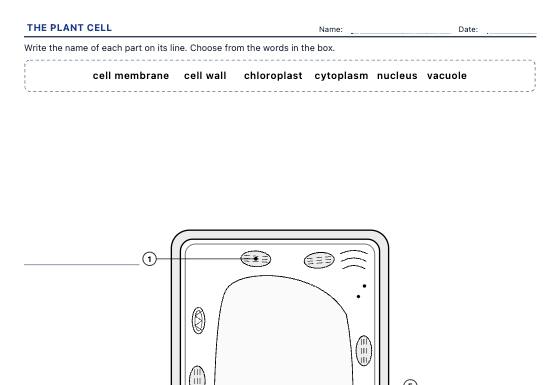
Diagrams to label with our own line art: the animal and plant cell, the microscope, the parts of a plant and a flower, seed germination and photosynthesis, in three levels, with an optional word bank and an answer key.
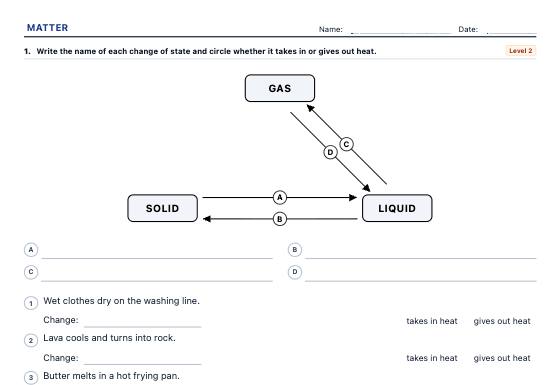
A4 worksheets on matter: properties of materials, states and the particle model, changes of state, heating and cooling curves, pure substances and mixtures and separation methods, in three levels with an answer key.
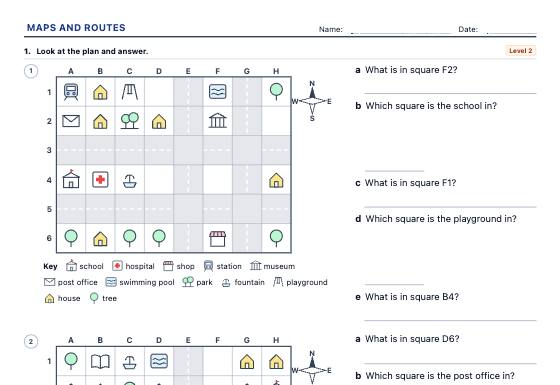
Map skills worksheets on random town plans with our own symbols: compass directions, grid references (B3), following and writing routes, left and right from someone else's point of view and the key, in three levels with an answer key.
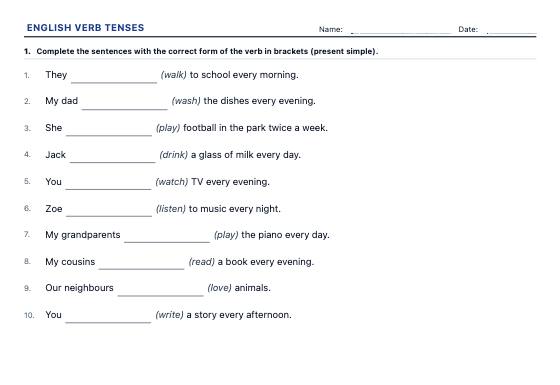
Sentences to fill in with the verb, turn into negatives and questions or choose the right tense, with the present simple, past simple, present continuous and past continuous and an answer key.
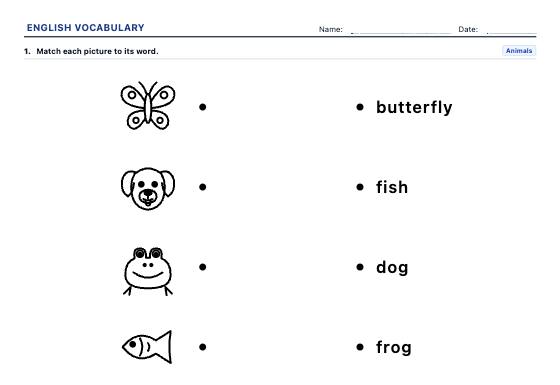
English vocabulary worksheets with pictures to colour: match words and pictures, label the pictures and picture word searches, by topic and with an answer key.
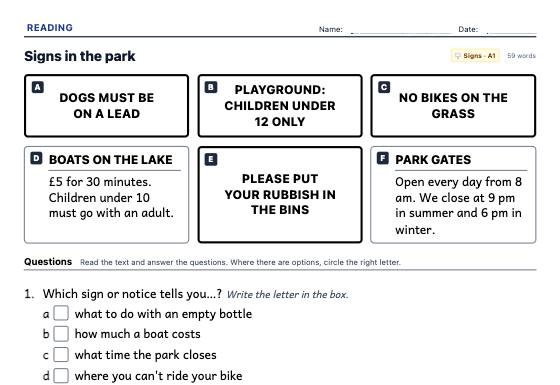
Original English texts levelled by the CEFR: signs and notices, messages and emails, adverts, articles and stories, with Cambridge-style questions and an answer key.
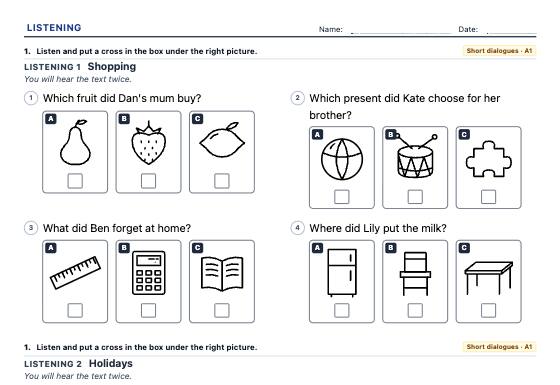
Original English scripts levelled by the CEFR, from Pre-A1 to B1, for the teacher to read aloud: tick the right picture, match, true or false and complete the notes, with the answers in the script.
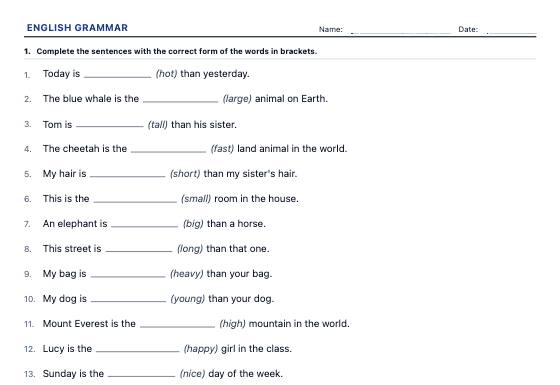
English sentences to fill in, choose the correct option, find the mistake or rewrite: there is, pronouns, possessives, plurals, some and any, comparatives, prepositions, can, must and should, conditionals, the passive, reported speech and relative clauses, three levels per point, with an answer key.
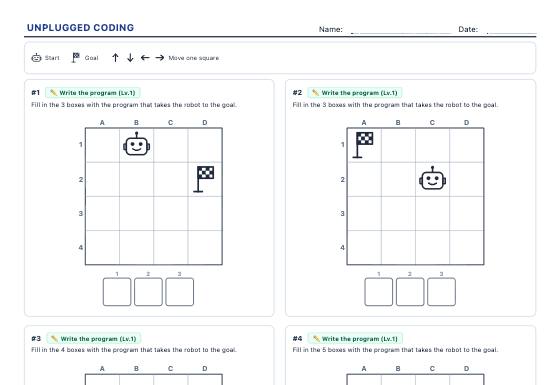
Screen-free coding challenges: write the arrow code that takes the robot to the goal, run a given program or find the bug, with loops at higher levels.
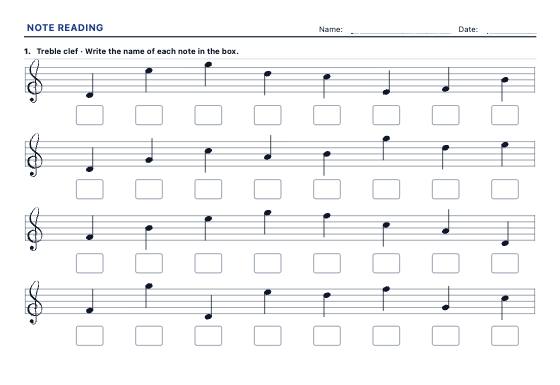
Staff worksheets to name notes, write them and recognise note values, in treble and bass clef, with ledger lines at higher levels.
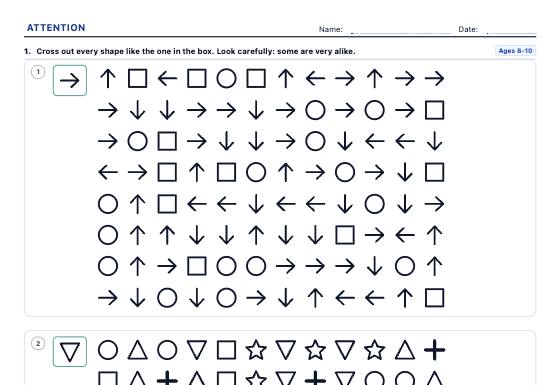
Selective and sustained attention worksheets: cross out shapes, numbers and letters, symbol coding, find the identical row and follow a rule path, ages 5 to 14, with answers.
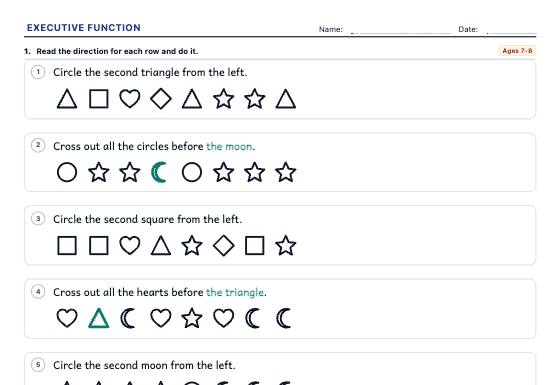
Executive function with shapes: remember where each shape was, follow directions, put the steps of a task in order and circle only what the rule says, ages 5 to 12, with answers.
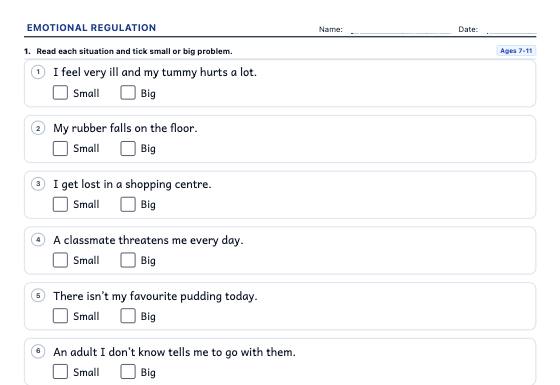
Emotional regulation: big or small problem, a feelings thermometer, where I feel it, a calm-down menu and my plan for anger, fear, sadness or worry, ages 5 to 14.
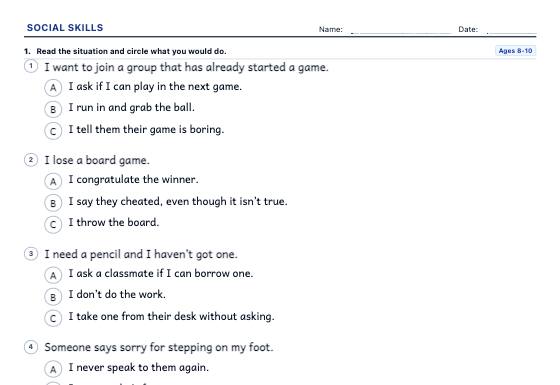
Social skills: what would you do with three options, what each one thinks and feels, conversation steps, solving a conflict and personalised social narratives, ages 5 to 14, with answers.
Grade 3 is when maths moves beyond adding and subtracting. Children learn their times tables in full, meet division as sharing and grouping, and see their first fractions as parts of a whole. Measurement becomes more precise and they start reading charts and tables. In language, writing becomes longer and more structured, punctuation more varied, and reading starts to cover facts about animals, the human body or space. These worksheets help children consolidate each new step with clear, repeatable practice.
Once the tables are known, the multiplication and division worksheets move to written methods on a squared grid. Fraction model sheets use bars, circles and sets to show halves, thirds and quarters, and rounding and estimating helps check whether an answer makes sense.
Converting metres to centimetres or litres to millilitres becomes clear on the metric units worksheets. With statistical charts children read and draw pictograms and bar charts from surveys, then answer questions about the data.
The guided writing worksheets break a text into planning, writing and self-check, for stories, descriptions and letters. Punctuation worksheets practise full stops, commas in lists and question marks in real sentences, one rule at a time.
Grade 3 worksheets also cover topics from science: label the parts of the body, order life cycles or name the planets with the solar system worksheets. Mixing one science page with a maths and a writing page makes a varied week of practice.