Substitution
Make the easiest unknown the subject (one with a coefficient of 1 when there is one) and substitute it into the other equation, with its brackets and, where needed, its denominator.
Systems of two equations in two unknowns, or simultaneous equations, are the first step into algebra with several unknowns: students solve them by substitution and elimination, then by drawing the two lines, and learn to tell when a system has no solution or infinitely many. This free systems of equations worksheet generator builds A4 worksheets of systems made from their solution, with an answer key worked step by step in the method you choose.
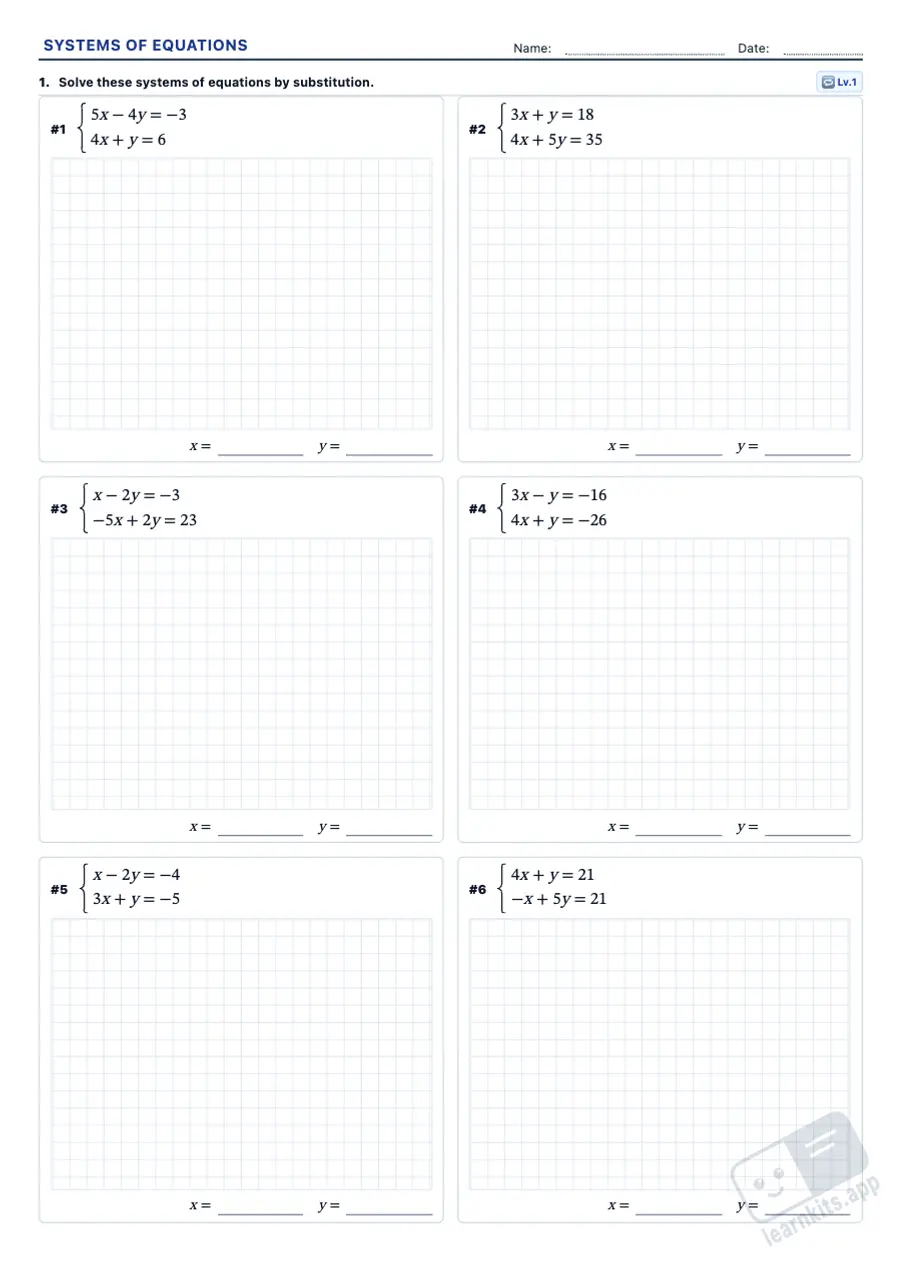 Student worksheet
 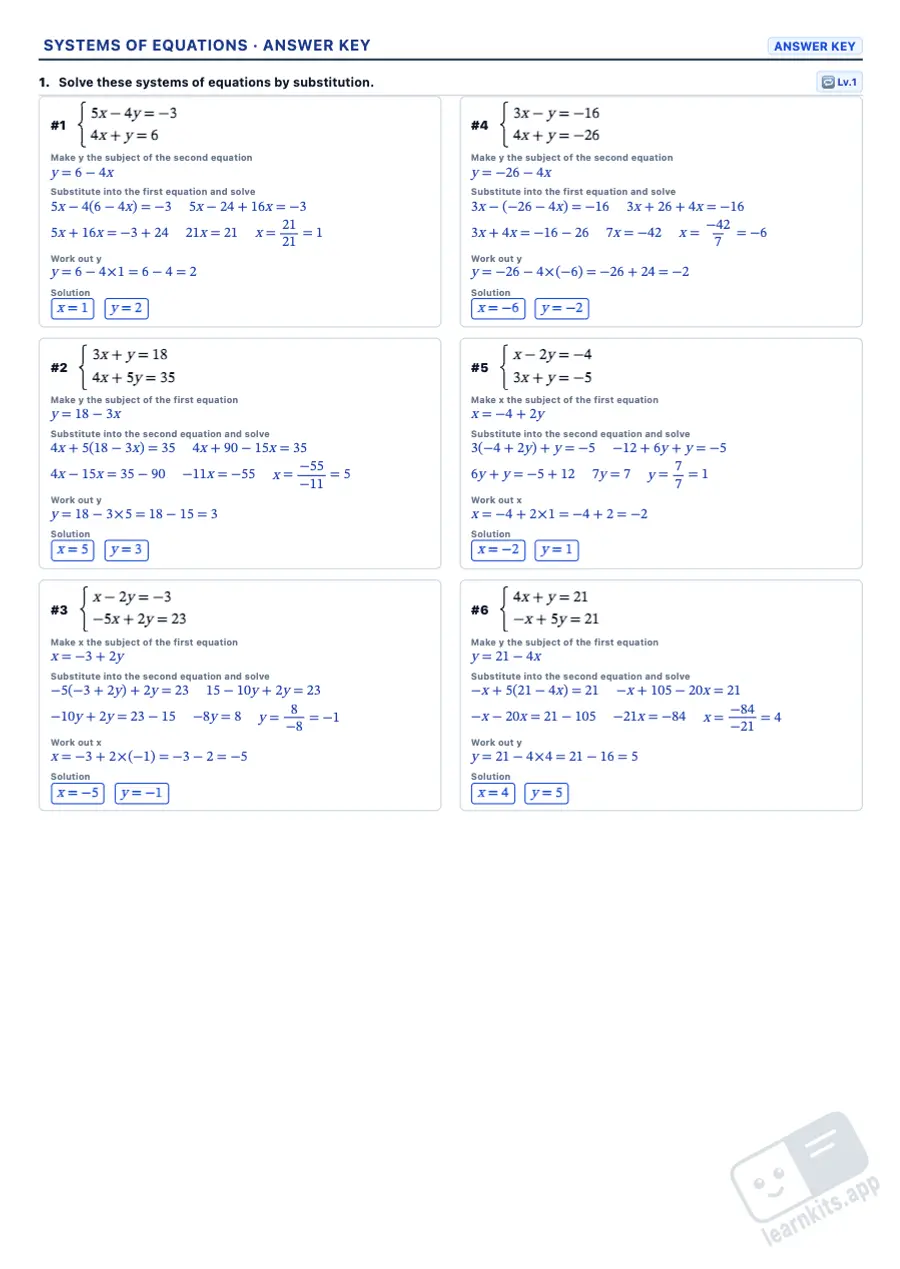 Answer key
 Make the easiest unknown the subject (one with a coefficient of 1 when there is one) and substitute it into the other equation, with its brackets and, where needed, its denominator.
Make the same unknown the subject of both equations, set the two expressions equal and solve the linear equation that results. It is how Spanish schools teach the comparison method.
Multiply the equations so that one unknown has opposite coefficients, then add them and it disappears. The answer key sets out the sum in columns.
Tables of values with x values that give whole-number y values, both lines on axes from −6 to 6 and the crossing point. At level 3, parallel lines and the same line too.
One solution, infinitely many or none from a/a′, b/b′ and c/c′, also after simplifying the equations, and the value of the parameter k.
Heads and legs, banknotes, tickets, perimeters, ages, digits and mixtures: the answer key names the unknowns, sets up the system, solves it and answers the question.
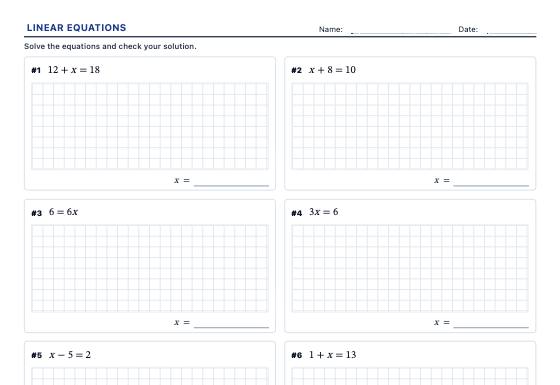
One-step and two-step linear equations, x on both sides, brackets and fractions, with whole, negative or fraction solutions and a step-by-step answer key with the check.
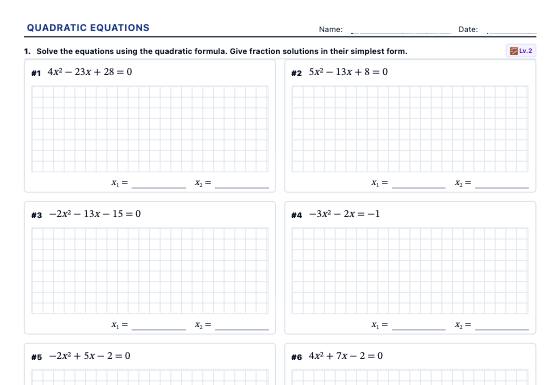
Incomplete quadratics and the quadratic formula, equations with brackets and fractions to rearrange, the number of solutions from the discriminant and the equation from its roots, with a step-by-step answer key.
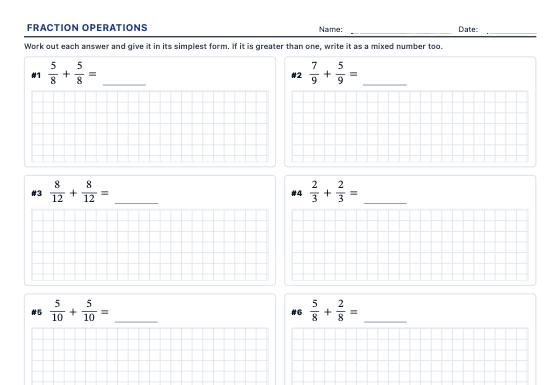
Worksheets on adding, subtracting, multiplying and dividing fractions, with mixed numbers and negative fractions, and a step-by-step answer key with the LCM, simplifying and mixed numbers.