Proportion tables
Complete direct proportion tables with a whole or decimal constant and, in Grade 8, inverse proportion tables where the product stays the same.
Proportion is one of the maths tools used most outside school: comparing prices, scaling a recipe, working out a journey time or sharing money fairly. This free ratio and proportion worksheet generator builds A4 worksheets on proportion tables, direct and inverse proportion, compound proportion and sharing in a ratio, with real-life word problems, realistic numbers and exact answers, plus a step-by-step answer key.
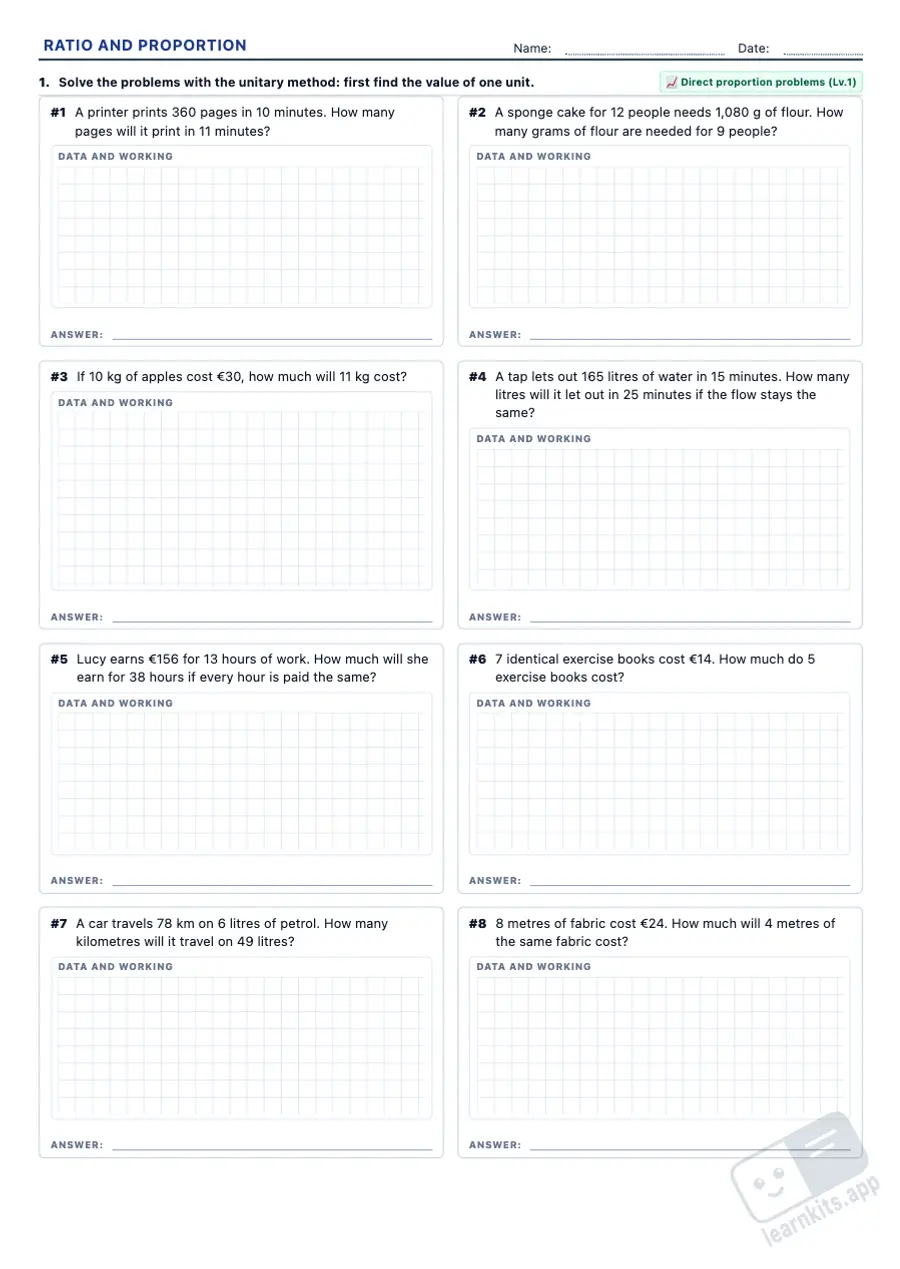 Student worksheet
 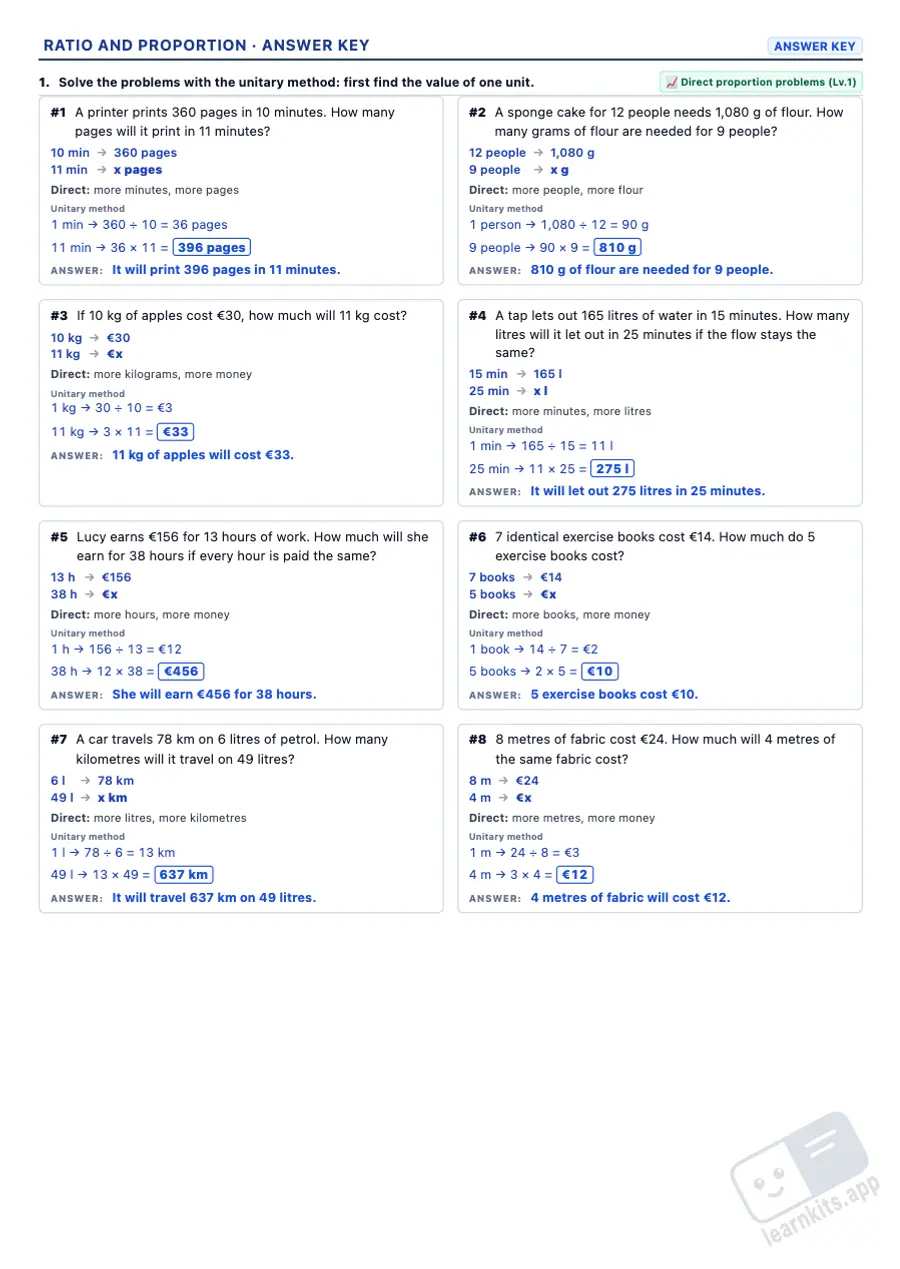 Answer key
 Complete direct proportion tables with a whole or decimal constant and, in Grade 8, inverse proportion tables where the product stays the same.
Compare quotients and products to decide whether two quantities are in direct or inverse proportion, with traps such as quantities that grow together without being proportional.
From the unitary method to the rule of three, with contexts such as prices, recipes, fuel use, workers and days or speed and time. The “Direct or inverse?” type mixes them.
Sharing an amount in direct proportion between two or three people and, in Grade 8, in inverse proportion using the reciprocals and the LCM. See also the fraction operations worksheets.
Problems with three quantities where pupils decide whether each relation is direct or inverse before setting up a single proportion.
The data laid out, the kind of proportion and why, the unitary method or the rule of three, and the full answer. For more problems, try the maths word problems.
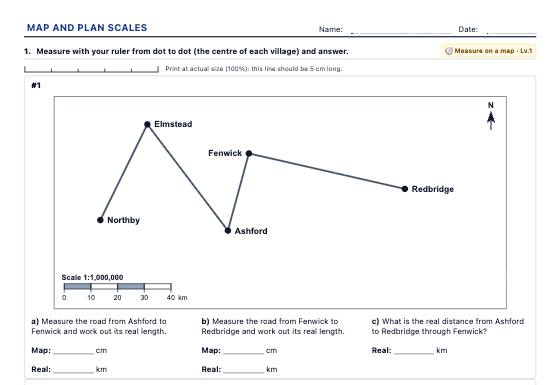
Ratio scale and scale bar worksheets: real and map distances, finding the scale, and village maps and floor plans printed at true size to measure with a ruler.
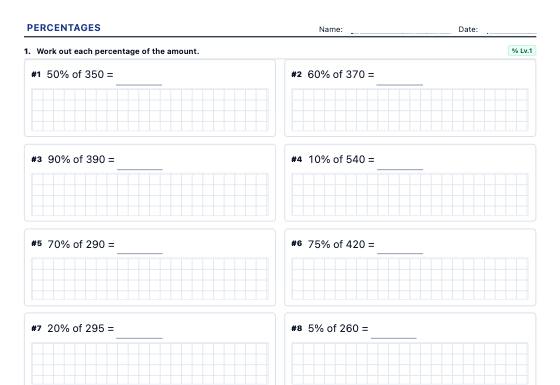
Percentage of an amount, one amount as a percentage of another, increases and decreases with the multiplier, successive and reverse percentages, percentages, fractions and decimals and word problems, with a step-by-step answer key.
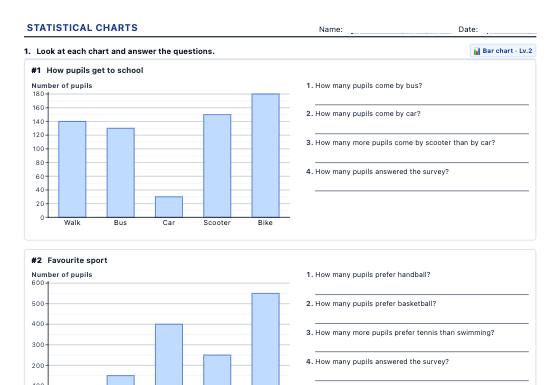
Pictograms, bar charts, line graphs and pie charts to read and to draw, and frequency tables with mode, mean and median, with new data every time and an answer key.