Chess in schools builds attention, spatial sense and reasoning: before moving, pupils have to look at what every piece attacks. This free chess worksheet generator for kids builds A4 worksheets from Grade 1 to Grade 8: board coordinates, how the pieces move, check or not, mate in one and mate in two, with an answer key. Positions are never written by hand: a legal-move generator makes them and checks that every puzzle has exactly one solution.
A4, to print or save as PDF; new exercises every time
Price
Free, no sign-up
Available in
Catalan, Spanish, English
Student worksheet
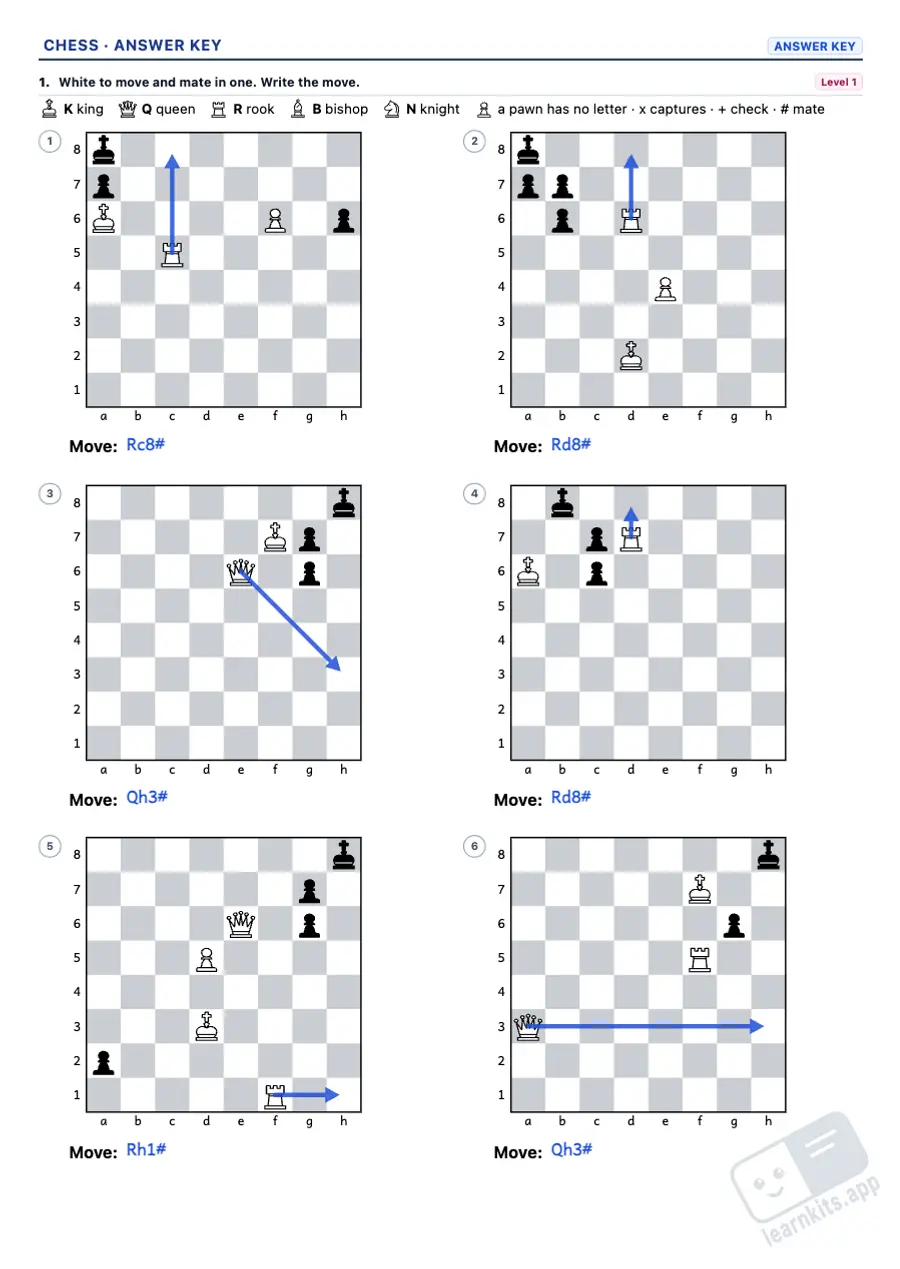
Answer key
Sample made with LearnKits. Every worksheet is new: choose the topic, level and amount and print it for free.
Coordinates
Reading and finding squares (e4, b7) and writing pieces with their letter: the basis for writing moves down.
How the pieces move
Every square a piece can go to, alone or among pieces that block it or that it can capture.
Check or not?
Who attacks the king, lines blocked by a piece in between, and the difference between check, mate and stalemate.
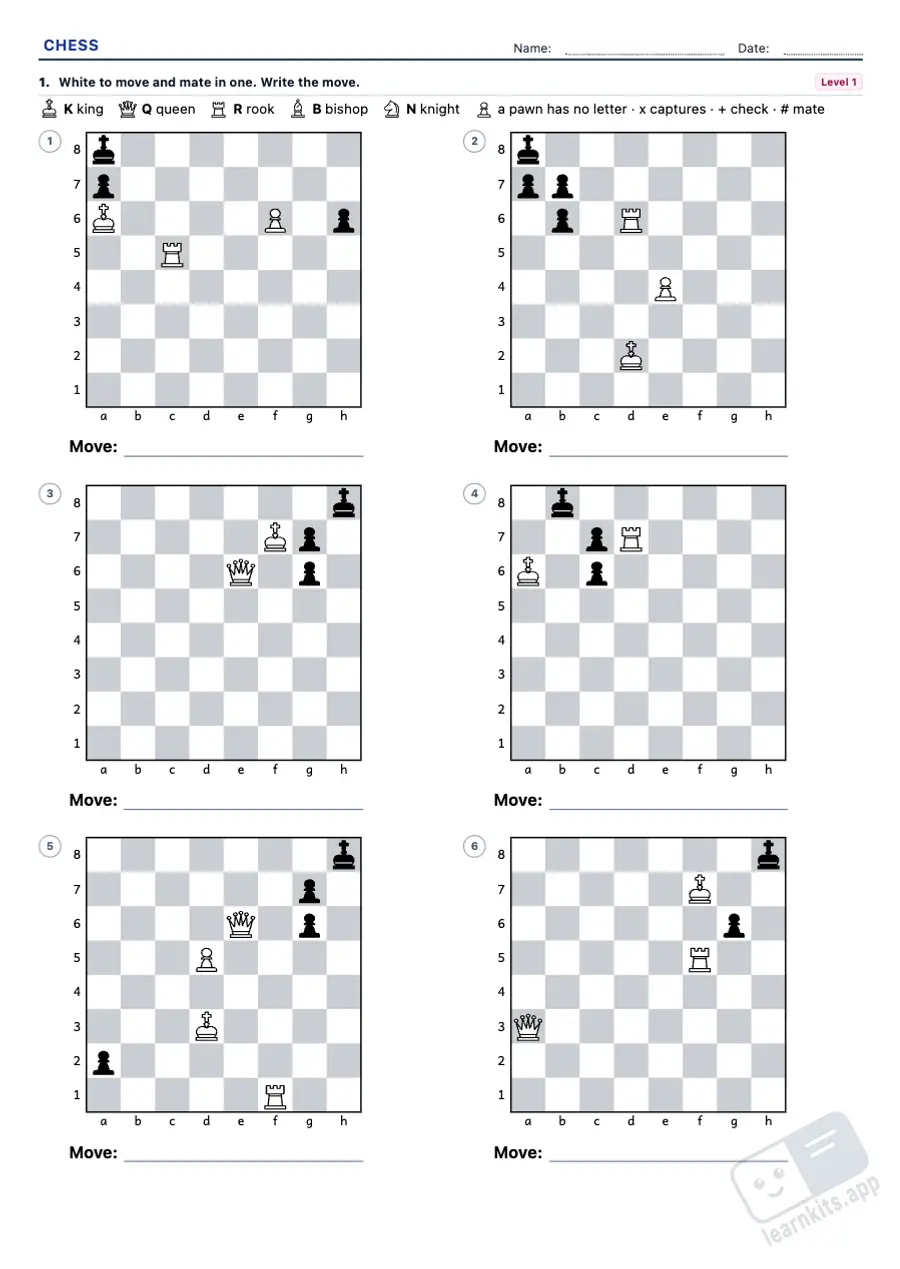
Mate in one
Mate in one puzzles with exactly one solution, from queen and rooks to positions full of pieces.
Mate in two
A forced check, several replies or a quiet move: the answer key shows every reply with its mate.
English notation
K king, Q queen, R rook, B bishop and N knight, with x for a capture, + for check and # for mate.
Frequently asked questions about the chess worksheets
Which grades are these chess worksheets for?
Grade 1 to Grade 8. Coordinates and piece moves suit Grades 1 to 3; check or not, Grades 3 to 5; mate in one, Grades 4 to 6; and mate in two, Grade 6 to Grade 8. They work at any age for children who are starting to play.
Does every puzzle have exactly one solution?
Yes. A legal-move generator makes and checks every position: a mate in one is used only when exactly one move mates, and a mate in two only when one first move alone mates against every reply (and there is no mate in one). At level 1 of mate in two, Black's reply is forced and the mate is unique too.
Are the positions legal?
Yes: each side has its king, the kings never touch, the side not to move is not in check and no pawn stands on the first or last rank. There is no doubt about castling or en passant either: kings are never on e1 or e8, and no pawn on the diagram can be taken en passant.
Which notation do they use?
Algebraic notation in English: K king, Q queen, R rook, B bishop and N knight; a pawn has no letter. A square is its file (a-h) and rank (1-8), x means a capture, + check and # mate; for example, Qh7#. Every worksheet prints the legend of the letters.
What is in the answer key?
The squares written or drawn, each piece's moves marked with dots and its captures circled, the answer to check or not with the piece giving check, and the mating move with an arrow on the board. For mate in two, every reply by Black with its mate.
Can I print them in black and white?
Yes. The board and pieces are our own drawings made for printing: dark squares in light grey, white pieces in outline and black pieces filled in.
Why play chess in class?
Because it makes pupils look before they act, picture moves and check them. Coordinates practise finding your way on a grid, like coordinate axes, and mate puzzles are logical reasoning pupils can explain out loud.
Shape pattern worksheets: what comes next, continue the pattern, what is missing and spot the mistake, with AB, AAB, ABC, AABB… patterns of shape, size, fill, direction or colour, and growing patterns.
4 × 4, 6 × 6 and 9 × 9 sudoku from easy to hard and KenKen (maths sudoku) with addition, subtraction, multiplication and division, each with exactly one solution and an answer key.
Reasoning test style worksheets: number, letter and figure series, 3 × 3 matrices, analogies and odd one out, in four levels, each item with exactly one answer and its rule on the answer key.
This feature is not yet available. We are actively building advanced tools for schools, tutoring centers, and teachers.
Notice: All current worksheet generators and printable materials on LearnKits are and will remain 100% free and open. Pro will be an optional enhancement for school institutions.
Features in development:
No Watermark: Print worksheets and answer keys without the LearnKits mark.
Cloud Collections: Access and organize your worksheets from anywhere.
School Branding: Add your school crest and custom header notes.
Direct PDF Export: One-click vector PDF downloads without print popups.
Thank you! We will notify you first as soon as LearnKits Pro becomes available.
Analytics and advertising cookies
We use Google Analytics to learn which resources are used and improve them, and Google AdSense to show ads that keep LearnKits free. If you accept, ads may be personalised; if you reject, they are non-personalised. You can change your choice at any time from the page footer. Cookie policy
 Student worksheet
  Answer key