Teaching guide: sudoku and KenKen in the classroom
Sudoku and KenKen are pure logic with numbers: every square is filled for a reason, and one slip stops the grid from working out. This free printable sudoku and KenKen generator builds A4 worksheets from Grade 1 to secondary school, from 4 × 4 to 9 × 9, with a full answer key. Every grid is checked by a solver to have exactly one solution, and the difficulty comes from the reasoning it needs, not just from the number of clues.
A4, to print or save as PDF; new exercises every time
Price
Free, no sign-up
Available in
Catalan, Spanish, English
Student worksheet
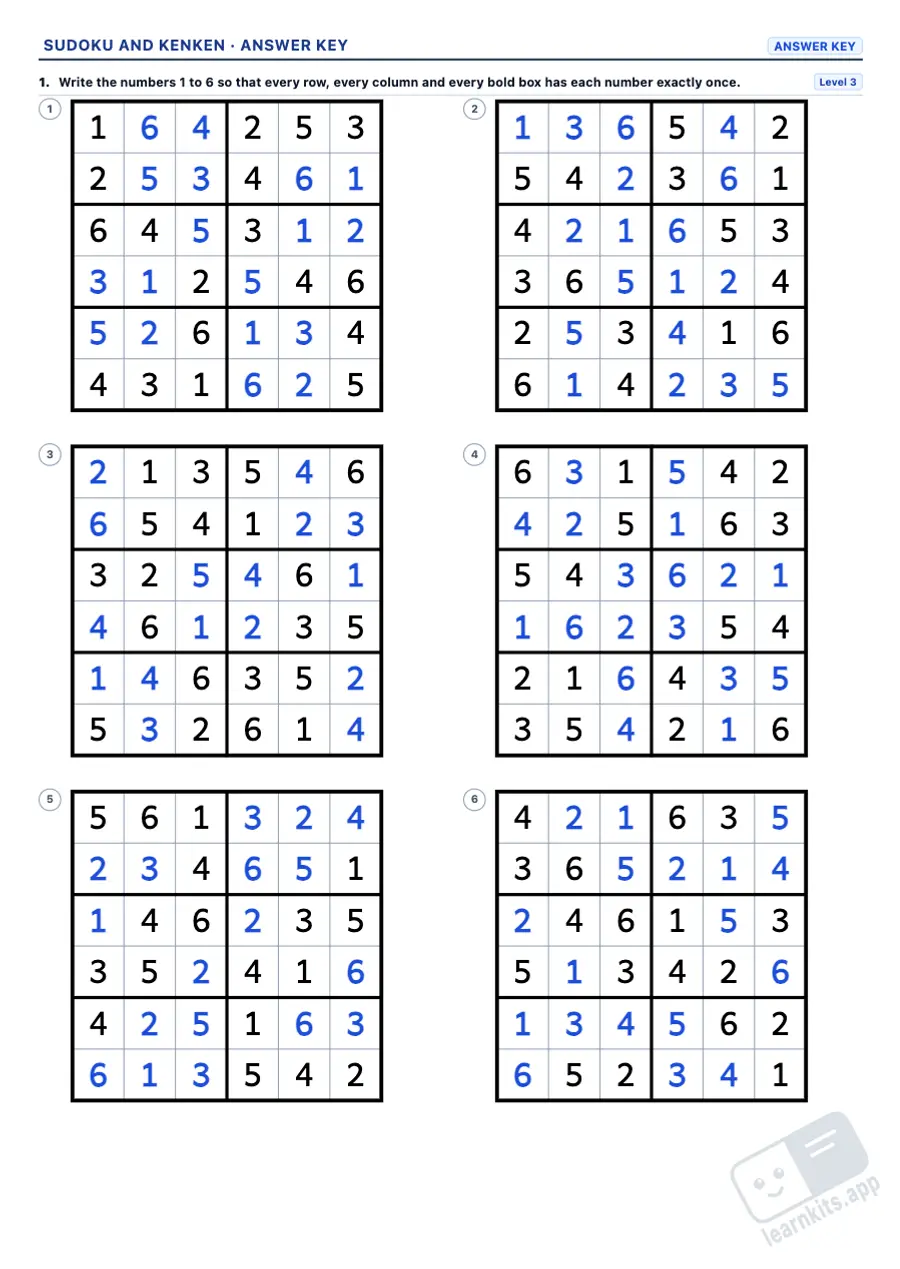
Answer key
Sample made with LearnKits. Every worksheet is new: choose the topic, level and amount and print it for free.
4 × 4 sudoku
Numbers 1 to 4 and 2 × 2 boxes: a first sudoku for Grades 1 and 2, with big squares to write in.
6 × 6 sudoku
Numbers 1 to 6 in 2 × 3 boxes: the step between mini sudoku and the classic grid, for Grades 3 to 5.
9 × 9 sudoku
The classic sudoku, easy, medium and hard: from finding where each number goes to pairs and locked numbers.
Real difficulty
Each sudoku is solved with the reasoning of its level (where a number goes, which number fits a square, pairs), and the hard ones truly need it.
Addition and subtraction KenKen
3 × 3 and 4 × 4 grids where every cage gives a sum or a difference: mental maths with a reason to check.
All four operations
5 × 5 and 6 × 6 with multiplication and exact division, or your own: choose the size, the operations and the cages.
Frequently asked questions about sudoku and KenKen
Which grades are these sudoku puzzles for?
Grade 1 to secondary school (Years 2 to 11). 4 × 4 sudoku suits Grades 1 to 3, 6 × 6 Grades 3 to 5, and 9 × 9 Grade 5 upwards (the hard level is for secondary). KenKen starts in Grade 2 with 3 × 3 addition grids and reaches secondary school with 6 × 6 grids and all four operations.
Does every sudoku have exactly one solution?
Yes. Every grid is checked by a solver that tries every possibility and is only used when its solution is unique. It can also always be solved by reasoning, with no guessing: the easy levels only need pupils to find where each number can go, the medium ones also which number a square can take, and the hard level needs pairs or numbers locked in one row or box.
What is KenKen and how do you solve it?
It is a maths sudoku (also called calcudoku or mathdoku): every row and column holds the numbers from 1 to the size of the grid with none repeated, and the bold cages give a target and an operation. For example, 7+ in a two-square cage of a 4 × 4 grid means 3 and 4. Start with the one-square cages and with cages that can only be filled one way. KenKen® is a registered trademark of Nextoy, LLC; this generator is not affiliated with it.
Can I make my own KenKen puzzles?
Yes. Choose Custom at the level step and pick the grid size (3 × 3 to 6 × 6), the operations (addition only, addition and subtraction, with multiplication, or all four) and how many squares a cage may have. With Random, each grid gets a different mix within the limits you set.
How do subtraction and division cages work?
Subtraction and division only appear in two-square cages: the target is the larger number minus the smaller, or the larger divided by the smaller (always exact), whichever square each is in. Addition and multiplication cages can be bigger, and a number may repeat inside a cage as long as it is not in the same row or column.
What is in the answer key?
Every grid filled in: the numbers pupils had to write in blue and the clues in black, with the same cages and boxes.
Why do sudoku in class?
Because every number has to be justified: pupils look carefully, rule out possibilities and check. It is logical reasoning they can say out loud (this cannot be a 3 because there is already one in the row) and, with KenKen, mental maths too: sums, differences, times tables and division.
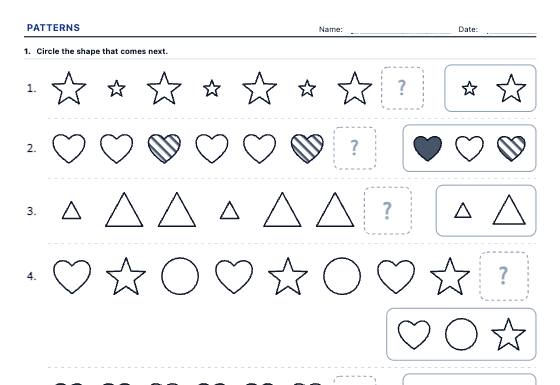
Shape pattern worksheets: what comes next, continue the pattern, what is missing and spot the mistake, with AB, AAB, ABC, AABB… patterns of shape, size, fill, direction or colour, and growing patterns.
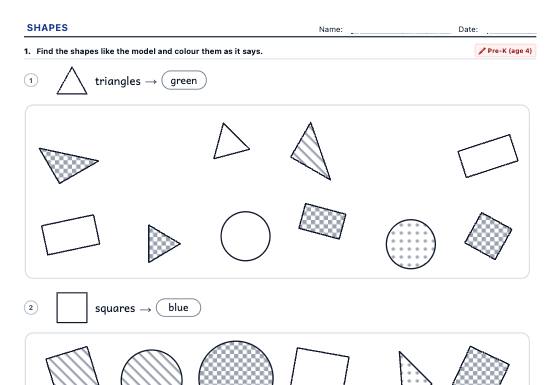
Shapes worksheets: colour the ones like the model, count them in a table, match them to their names, trace them and find them in a picture, from circles, squares and triangles to pentagons and first 3D shapes.
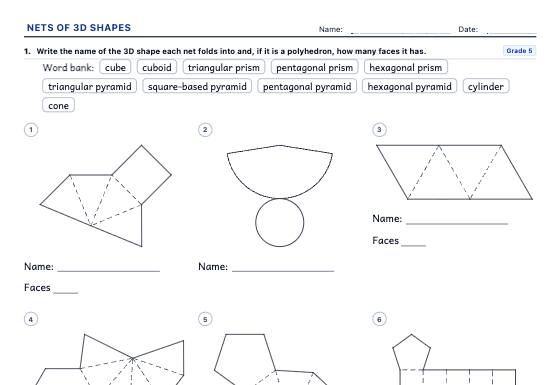
Printable nets to cut out and fold prisms, pyramids, cylinders and cones, nets to name, shapes that fold into a cube, opposite faces of a dice and surface area from a net.
This feature is not yet available. We are actively building advanced tools for schools, tutoring centers, and teachers.
Notice: All current worksheet generators and printable materials on LearnKits are and will remain 100% free and open. Pro will be an optional enhancement for school institutions.
Features in development:
No Watermark: Print worksheets and answer keys without the LearnKits mark.
Cloud Collections: Access and organize your worksheets from anywhere.
School Branding: Add your school crest and custom header notes.
Direct PDF Export: One-click vector PDF downloads without print popups.
Thank you! We will notify you first as soon as LearnKits Pro becomes available.
Analytics and advertising cookies
We use Google Analytics to learn which resources are used and improve them, and Google AdSense to show ads that keep LearnKits free. If you accept, ads may be personalised; if you reject, they are non-personalised. You can change your choice at any time from the page footer. Cookie policy
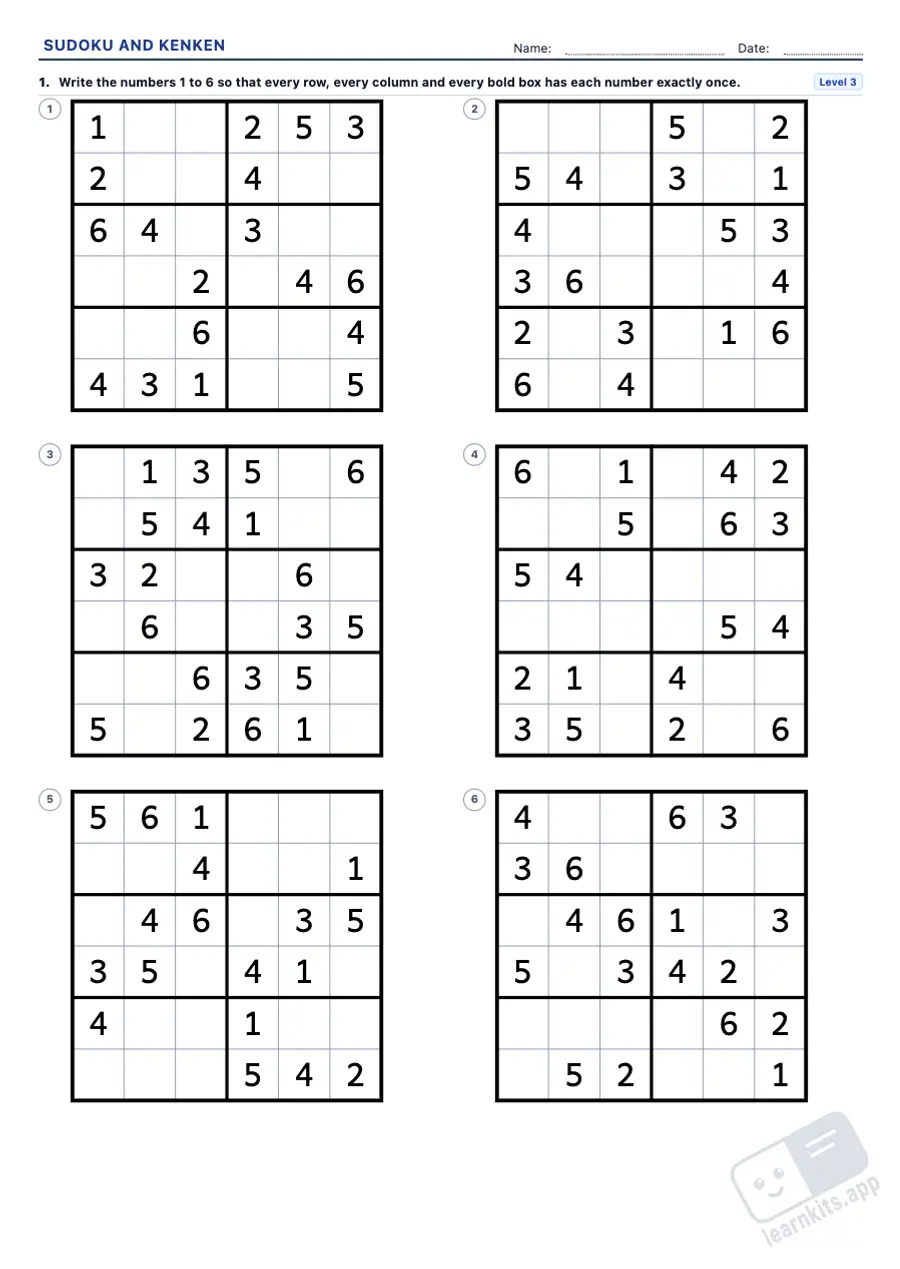 Student worksheet
  Answer key