Cut out and fold
Large nets of all 11 shapes with grey glue tabs, solid lines to cut and dashed lines to fold. Every pair of edges that are glued together has exactly one tab.
The net of a 3D shape is what you get when you open its faces out flat: cut it out and fold it, and it makes the shape again. Working with nets builds spatial reasoning, helps pupils tell prisms, pyramids and curved shapes apart and shows where surface area comes from. This free nets of 3D shapes generator makes A4 worksheets for Grades 4 to 8: large printable nets to cut out and fold, nets to name, shapes that do or do not fold into a cube, opposite faces of a dice and surface area, with an answer key.
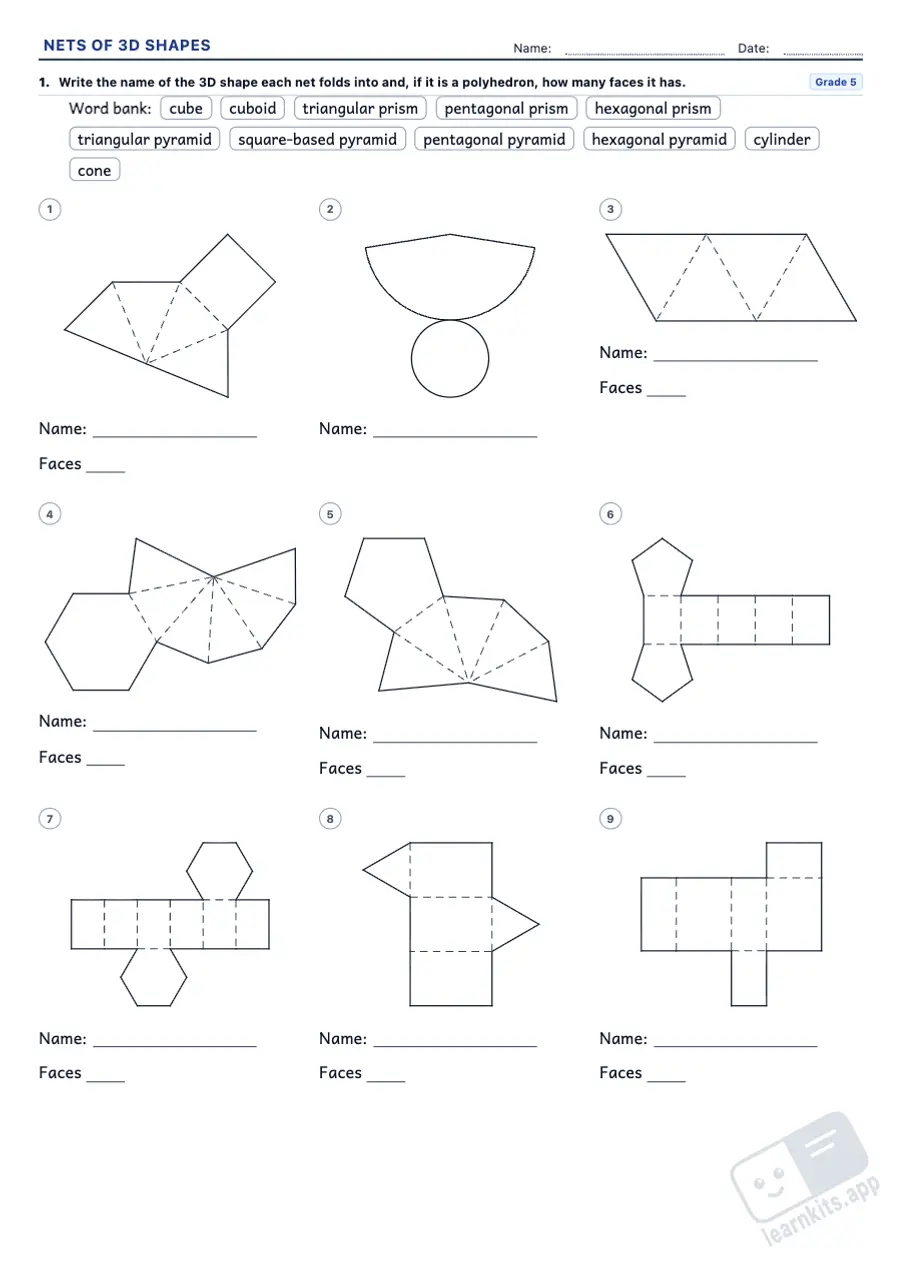 Student worksheet
 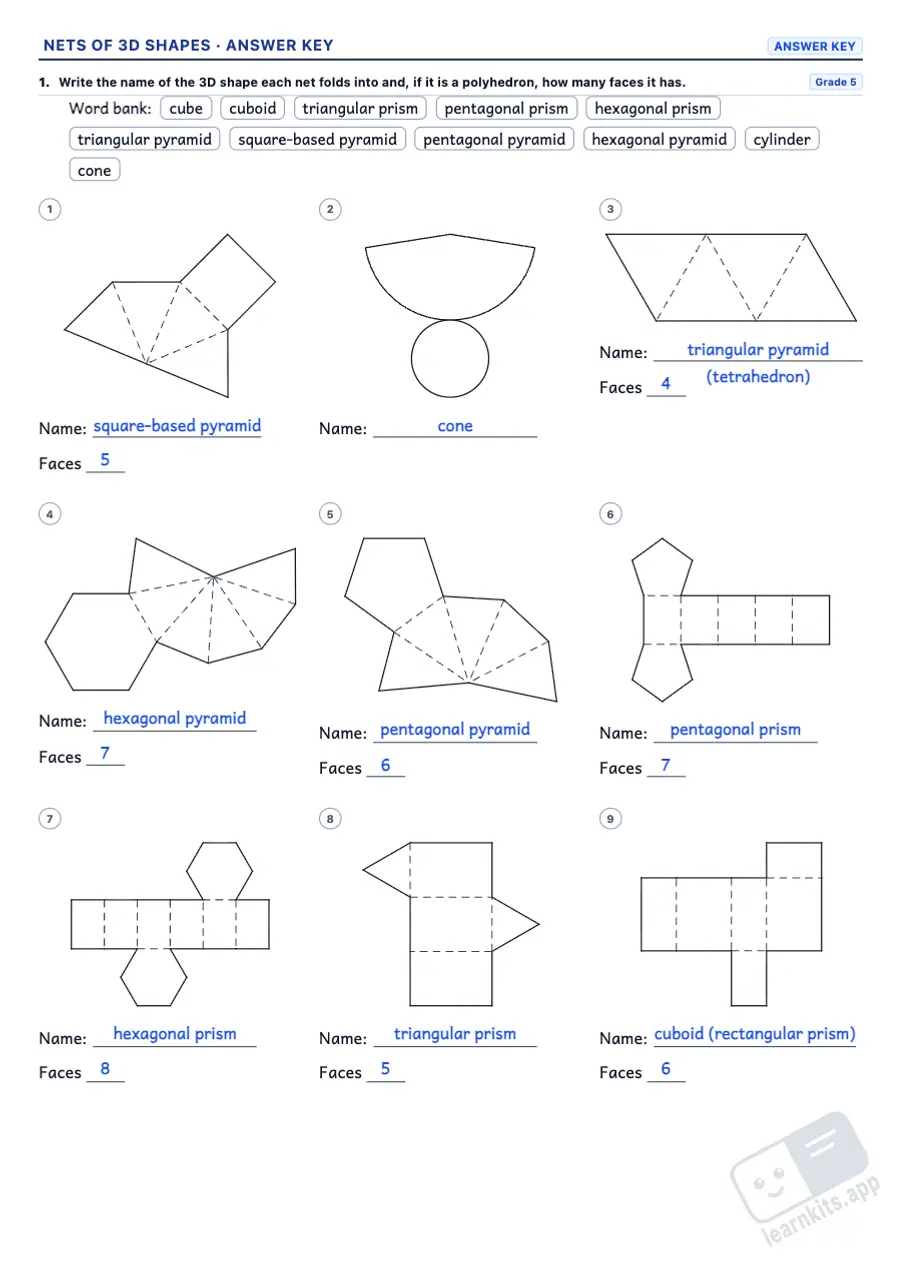 Answer key
 Large nets of all 11 shapes with grey glue tabs, solid lines to cut and dashed lines to fold. Every pair of edges that are glued together has exactly one tab.
Prisms, pyramids, cylinders and cones opened out in different ways. In Grade 5 pupils also count the faces, and in Grade 6 the faces, edges and vertices to check Euler's formula.
A cube has 11 different nets. Pupils decide which shapes made of six squares fold into a cube; in Grade 6, which shapes of five squares make an open box.
An opened-out dice with missing numbers (opposite faces add up to 7) or letters on the faces: pupils picture the folded cube to see which face ends up opposite which.
From the cube and cuboid in Grade 6 to the cylinder and cone in Grade 8: the net shows every face with its measurements and the answer key adds up the area of each part.
Every net is worked out by really opening the shape: faces have their exact shape and size, never overlap, and fold back into the shape when cut out.
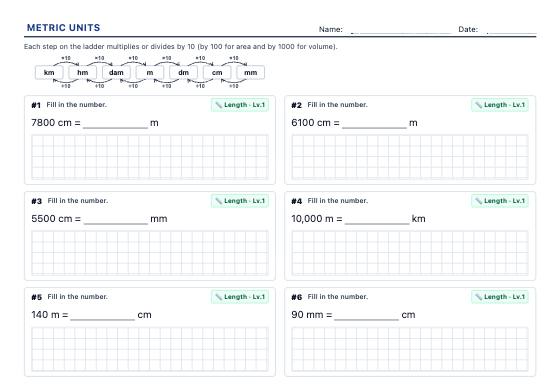
Metric conversion worksheets: length, mass, capacity, area and volume, with mixed units, comparing and ordering, and an answer key showing how the decimal point moves.
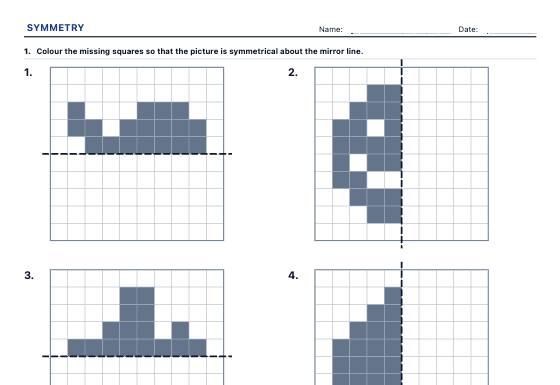
Symmetry worksheets on a grid: complete the symmetrical half of a picture, reflect a shape in a mirror line, decide whether a line is a line of symmetry and draw every line of symmetry of a shape, with an answer key.
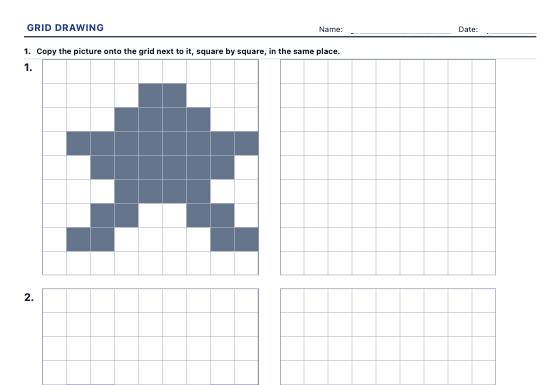
Grid drawing worksheets: copy a picture square by square, follow an arrow code along the grid lines, write the code of a path and colour mystery pictures from coordinates, with an answer key.