Units like PISA’s
One real stimulus and three or four questions of rising difficulty that go round the modelling cycle: formulate, employ and interpret.
PISA and national assessments do not ask for bare sums: they show a real situation (a price list, a timetable, a map, a chart) and ask pupils to use it to decide, calculate and justify. This free PISA-style maths problems generator builds units like the released PISA items, with new numbers every time, for grades 4 to 10, and a marking guide with full, partial and no credit.
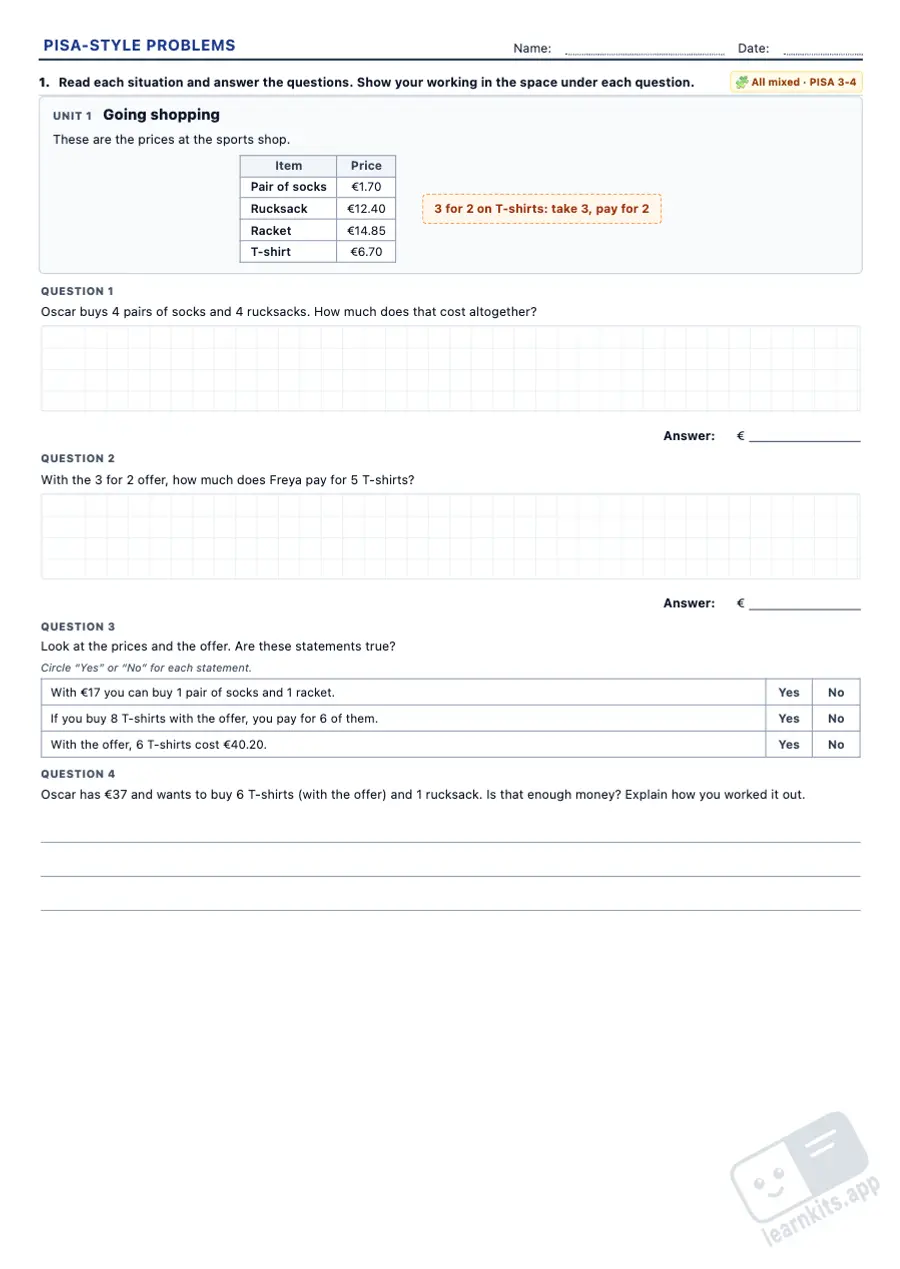 Student worksheet
 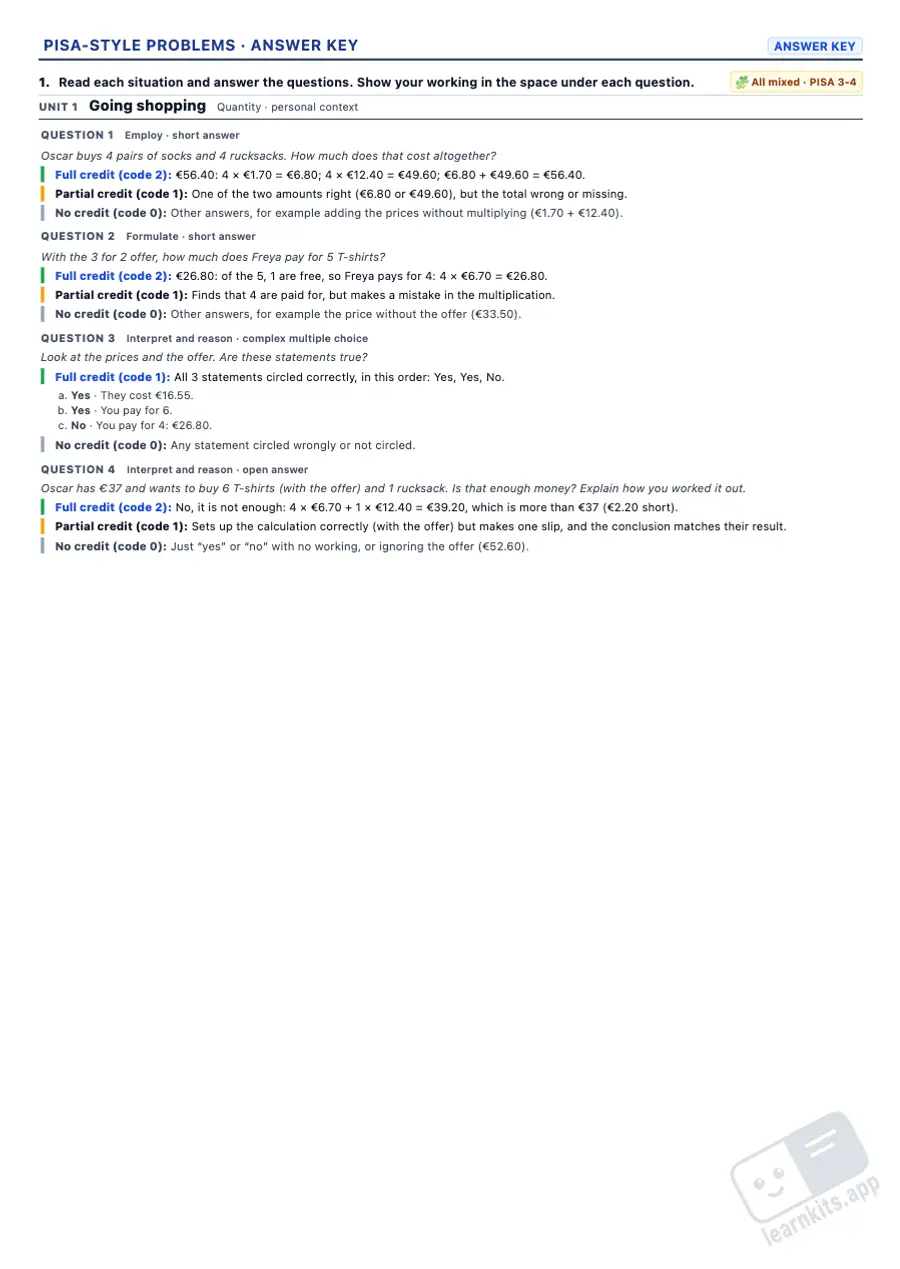 Answer key
 One real stimulus and three or four questions of rising difficulty that go round the modelling cycle: formulate, employ and interpret.
Quantity, uncertainty and data, change and relationships, and space and shape, on their own or mixed as in a real paper.
Multiple choice, complex multiple choice (yes or no), short numeric answers and open answers to argue a point.
Floor plans and maps printed at true size to measure with a ruler, and bar charts and line graphs to read and interpret.
PISA levels 1-2 for grades 4–6, levels 3-4 for grades 7–8 and levels 5-6 for grades 9–10.
For each question: the process, the format and what earns full, partial or no credit, with the answer worked out from the printed values.
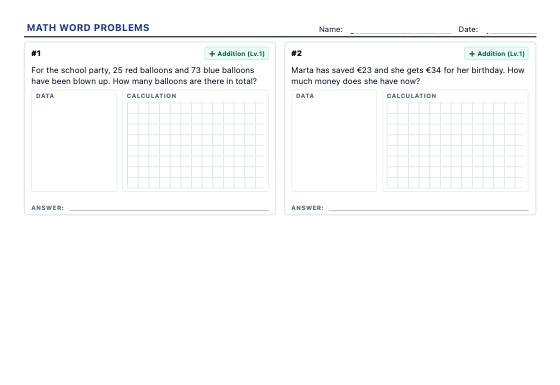
Printable real-world math word problems with dedicated sections for given data, workspace calculation grid, and sentence answer formulation.
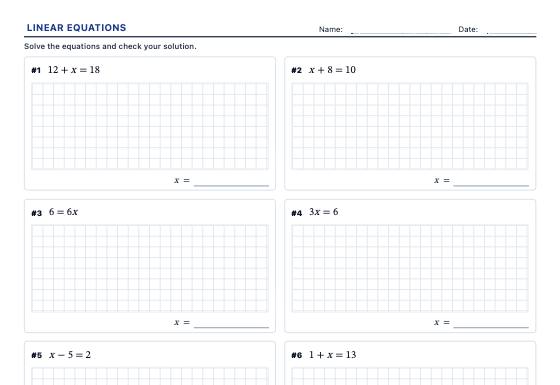
One-step and two-step linear equations, x on both sides, brackets and fractions, with whole, negative or fraction solutions and a step-by-step answer key with the check.
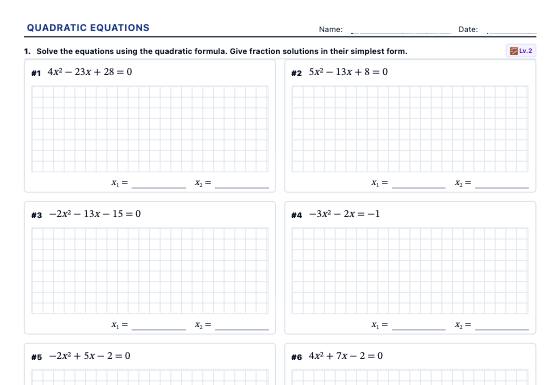
Incomplete quadratics and the quadratic formula, equations with brackets and fractions to rearrange, the number of solutions from the discriminant and the equation from its roots, with a step-by-step answer key.