Solar System Worksheet Generator

Example ready: change it or print it as it is.

Teacher guide ↓

Teaching Guide: the Solar System and the Earth’s Movements

The solar system is one of the best-loved topics of primary science and a core part of Earth and space: the planets, the Earth and the Moon, day and night, the seasons, the phases of the Moon and eclipses. This free solar system worksheet generator makes A4 worksheets with our own drawings, real NASA data and answer keys, from Grade 3 to Grade 7.
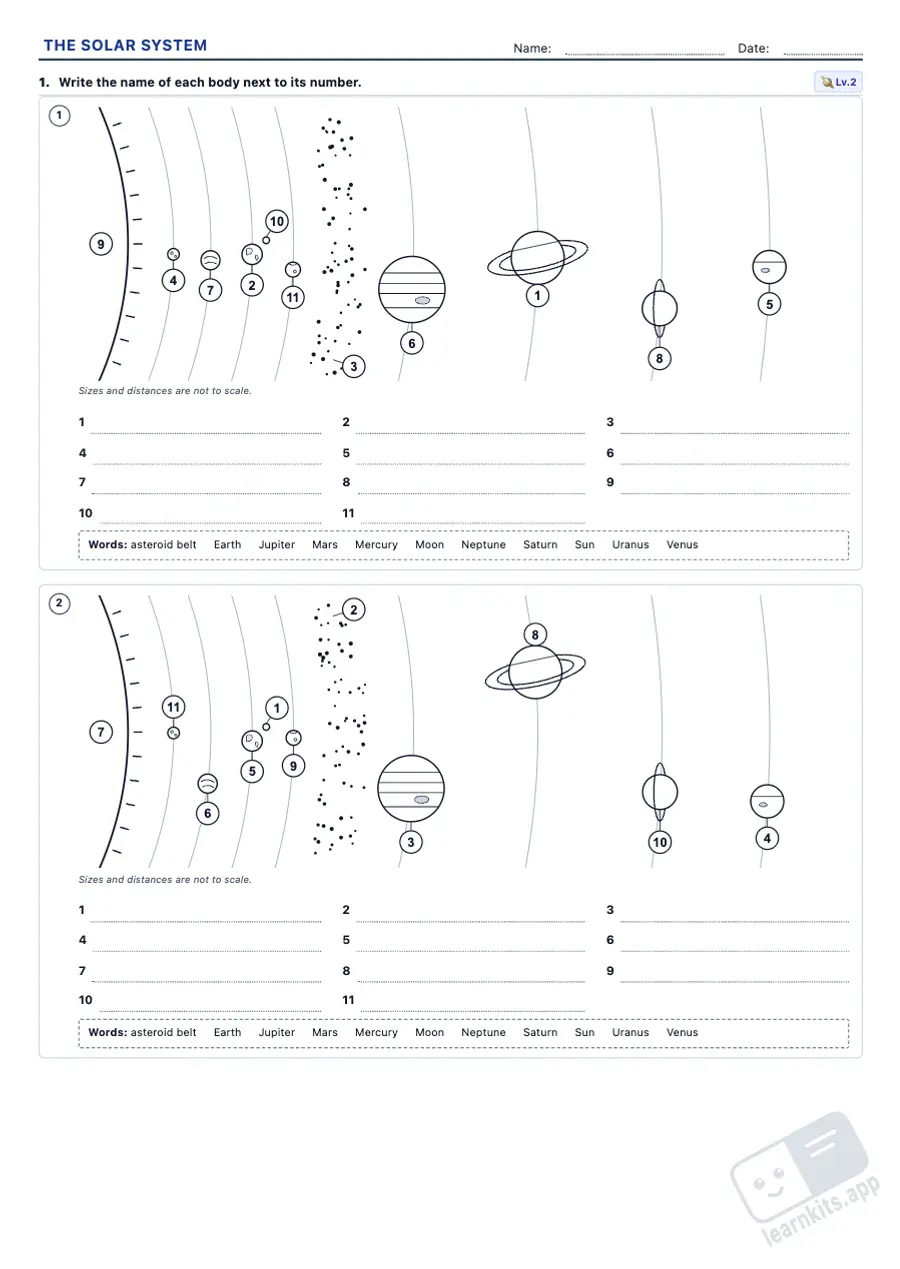
Solar System Worksheet Generator: sample printable A4 worksheet, first page of the student sheet Student worksheet
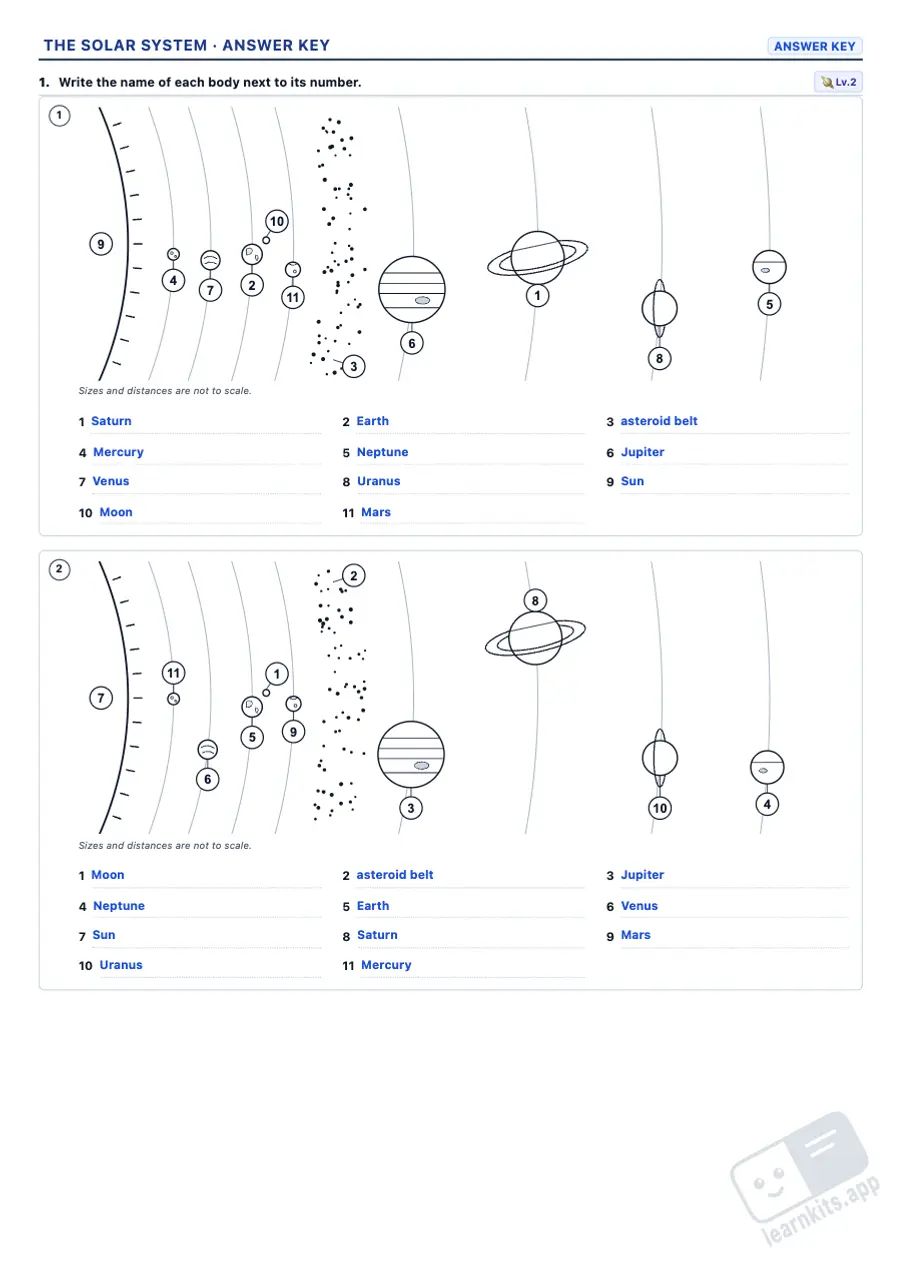
Solar System Worksheet Generator: sample answer key of the same worksheet, first page Answer key
Sample made with LearnKits. Every worksheet is new: choose the topic, level and amount and print it for free.

Label

The Sun and the eight planets, always in their real order, plus the Moon and the asteroid belt from level 2. Each worksheet places the planets at a different point of their orbits.

Put in order

By distance from the Sun, by size or, at level 3, by moons, length of year and day, temperature, gravity or density.

Real data

Tables of NASA data (diameter, distance, year, day, moons, temperature, gravity, density) and questions answered from the printed values.

Day and night

The Earth seen from above the North Pole: the lit half, sunrise and sunset, midday, midnight and solar time.

Seasons, phases and eclipses

The tilted axis and the seasons in both hemispheres, the eight phases of the Moon, and solar and lunar eclipses with the umbra and penumbra.

Answer key

The answers in colour, with the working and the reason for every data answer.
Frequently Asked Questions about the Solar System Worksheets

Where does the planet data come from?
From the NASA Planetary Fact Sheet: equatorial diameter, mean distance from the Sun (rounded to the nearest million km), length of year and day, mean temperature, gravity and density. Moons are those confirmed by NASA in March 2025 (Saturn has 274); new ones are still being found, so the table prints the year.
Why is the drawing not to scale?
If the Sun were a basketball, the Earth would be a pinhead 26 metres away and Neptune almost a kilometre away: no sheet could hold it. The drawing keeps the real order of the planets and the order of their sizes (Jupiter, Saturn, Uranus, Neptune, Earth, Venus, Mars, Mercury), and the worksheet says it is not to scale.
How do the worksheets explain the seasons?
With the tilted axis, not the distance from the Sun. The Earth’s axis always points the same way in space: when the North Pole leans towards the Sun it is summer in the Northern Hemisphere and winter in the Southern. The worksheets ask for the season at each place on the orbit, the month, the equinoxes and where the day is longest.
Do the phases of the Moon look the same everywhere?
No. The worksheets draw the Moon as seen from the Northern Hemisphere: at first quarter the lit part is on the right. In the Southern Hemisphere it looks the other way round.
What is the difference between a solar and a lunar eclipse?
In a solar eclipse the Moon passes between the Sun and the Earth (always at new moon) and its shadow falls on the Earth. In a lunar eclipse the Earth is between the Sun and the Moon (always at full moon) and the Moon moves into the Earth’s shadow. It does not happen every month because the Moon’s orbit is slightly tilted.
Which grades are they for?
Level 1 is for Grades 3–4, level 2 for Grades 5–6 and level 3 for Grade 7. They practise the Earth and space systems that PISA assesses. For more science, try the Natural Cycles Worksheet Generator and the Human Body Labelling Worksheet Generator, or browse Natural Sciences.
Can I mix several types of exercise on one worksheet?
Yes. Add as many exercises as you like of each type and level, then drag them, move them or split them with a page break. The answer key is made at the same time.
Is any data sent to a server?
No. The worksheet is made in your browser and templates are saved only in your browser’s memory.