5 cycles
The water cycle and the life cycles of a flowering plant, the butterfly (complete metamorphosis), the frog (amphibian) and the chicken (bird).
Cycles in nature are a core topic of primary science: understanding that living things and water move in cycles that start again. This free water cycle and life cycle worksheet generator makes A4 worksheets to label and sequence the stages, with our own drawings, a word bank and an answer key.
The water cycle and the life cycles of a flowering plant, the butterfly (complete metamorphosis), the frog (amphibian) and the chicken (bird).
The cycle drawn with arrows: write each stage under its picture, or each process of the water cycle (evaporation, condensation, precipitation…) next to its number.
The stages on shuffled cards to number in order and, from level 2, to name.
From the 4 main stages with a word bank and an example in Grades 2-3, to every stage with no help and the scientific terms in Grades 5-6.
Line drawings made for colouring in and for printing or photocopying in black and white, with no ink-hungry backgrounds.
The same worksheet with the names and numbers in red, to mark at a glance.
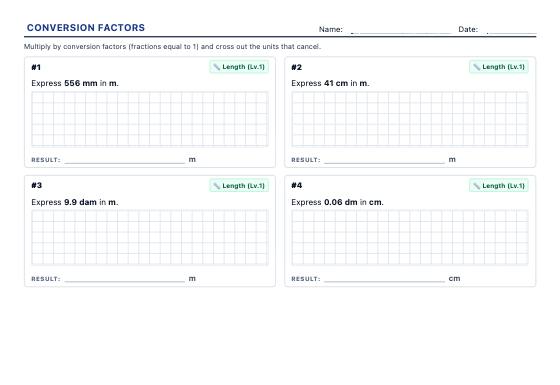
Unit conversion worksheets using chained conversion factors: length, mass, time, speed, density, area and volume, with scientific notation and a step-by-step answer key.
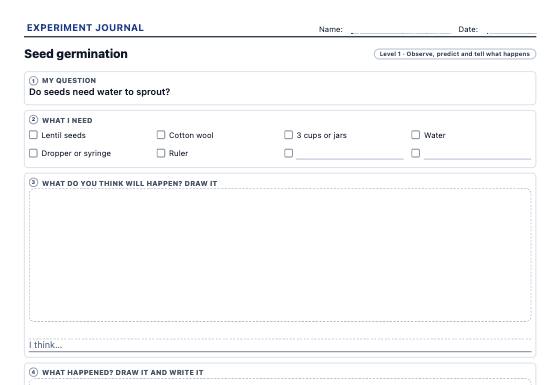
Guided sheets to record an experiment step by step with the scientific method: question, hypothesis, materials, procedure, data table, graph and conclusion, tailored to each stage.
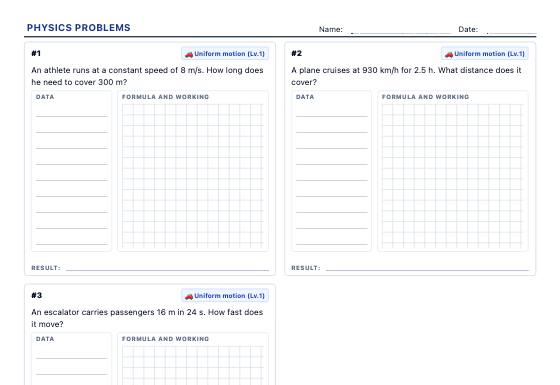
Uniform and accelerated motion, free fall, density and Ohm's law problems with realistic data and unit conversions, plus an answer key with data, formula, rearranging, substitution and result.