Emotions and feelings worksheets for kids

Example ready: change it or print it as it is.

Teacher guide ↓

Teaching guide: emotions and feelings worksheets for ages 3 to 7

Naming what we feel is the first step in emotional literacy. This free emotions worksheet generator makes A4 sheets for preschool, Reception and Years 1-2 with our own drawn faces: match the faces, choose how you would feel in everyday situations, draw a feeling, an emotion wheel to colour and cut out, and a "how do I feel today" check-in sheet.

For
Pre-K & K Pre-K 3, Pre-K 4, K · Elementary 1st, 2nd (ages 3-7)
Subject
Early Years › Emotions
Includes
Student sheet and answer key
Format
A4, to print or save as PDF; new exercises every time
Price
Free, no sign-up
Available in
Catalan, Spanish, English
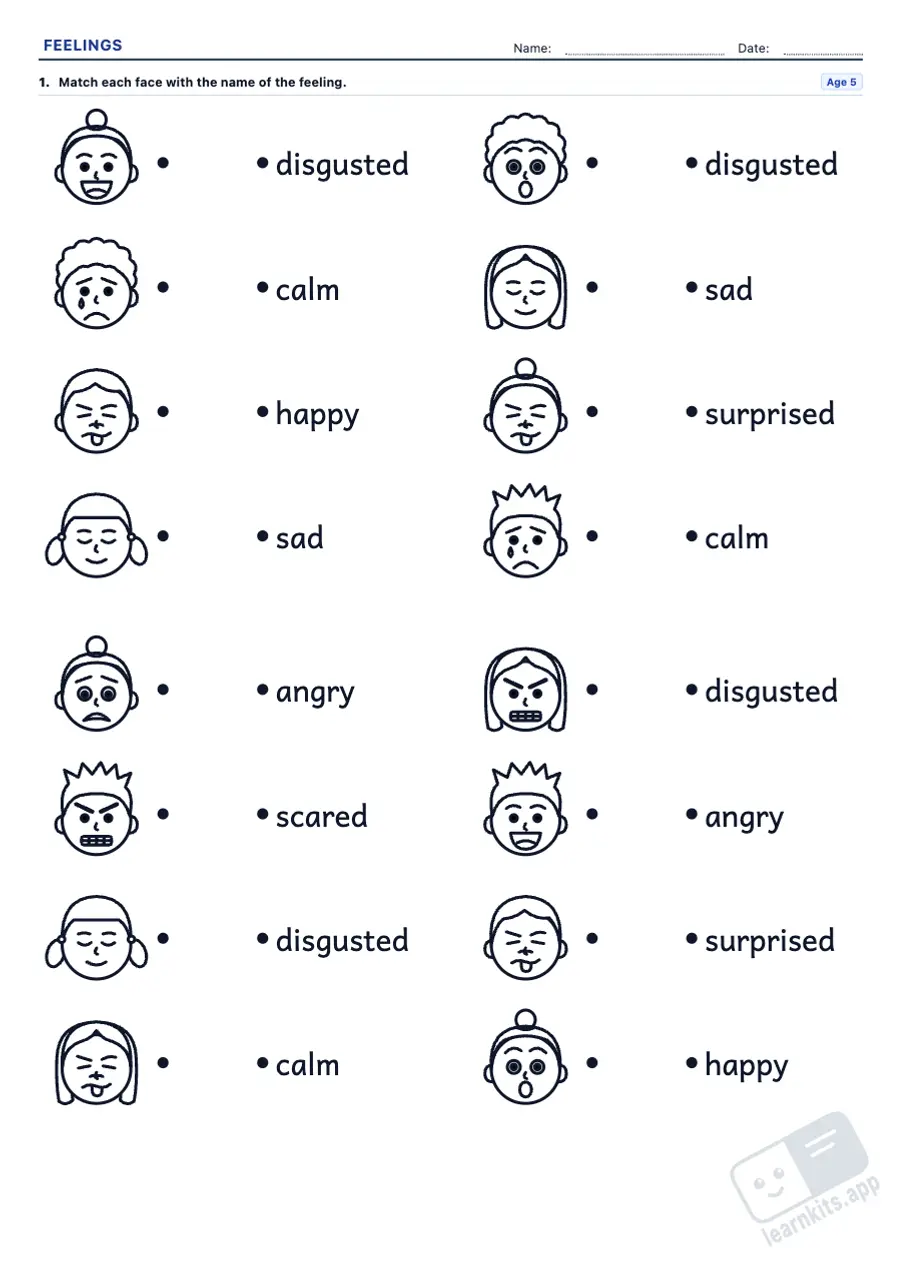
Emotions and feelings worksheets for kids: sample printable A4 worksheet, first page of the student sheet Student worksheet
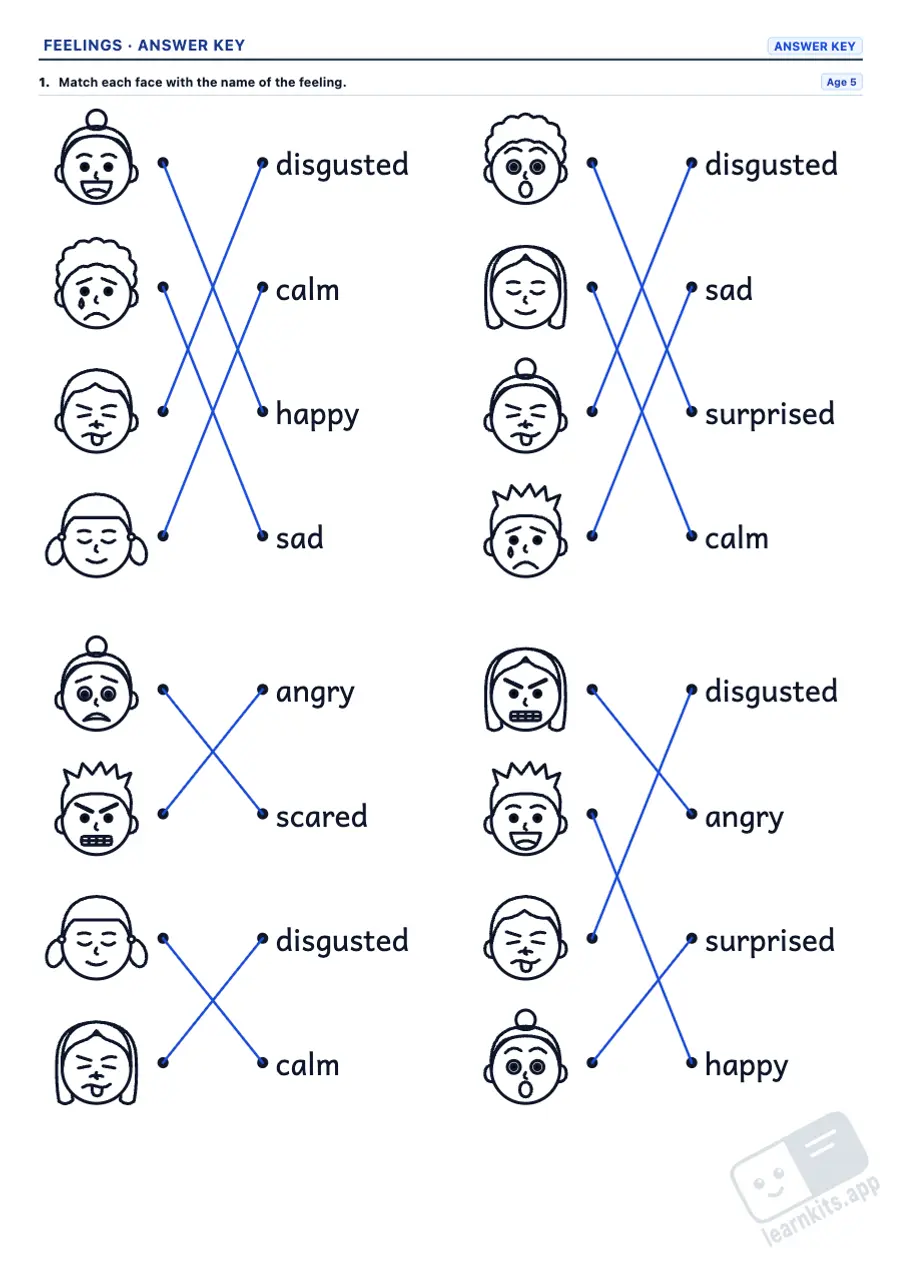
Emotions and feelings worksheets for kids: sample answer key of the same worksheet, first page Answer key
Sample made with LearnKits. Every worksheet is new: choose the topic, level and amount and print it for free.

The feelings for each age

At ages 3 and 4, the four basic feelings: happy, sad, angry and scared. At age 5, surprised, disgusted and calm are added, and at ages 6 and 7 worried, embarrassed and bored. Every feeling has a clear face that looks different from the others.
Match the faces

At ages 3 and 4, children match each face with another child who feels the same, looking at the eyebrows, eyes and mouth rather than the hair. From age 5 they match faces with words, and from age 6 one word is left over.

How would you feel?

Short everyday situations ("Your ice cream falls on the ground") with two or three faces to choose from. The faces offered are never another fair answer: surprised is never next to scared, nor worried next to sad.

Draw the face

Empty faces of different children to draw a feeling on: copying a model at ages 3 and 4, from the word at age 5, and from age 6 also writing when you feel like that.

Emotion wheel

A wheel of 4, 7 or 10 feelings to colour, cut out and put together with an arrow in the middle, so each child can show how they feel when they arrive.

How do I feel today?

A check-in sheet for circle time or PSHE: circle the feeling of the day, mark how much (a little, quite a lot, a lot) and draw or write why.

Frequently Asked Questions about the Emotions Worksheets

Which ages are they for?
Children aged 3 to 7: preschool, Reception and Years 1-2. Each age works on more feelings and moves from pictures to words, reading and writing.
Is there an answer key?
Yes, for matching the faces and for the situations, which have one answer. Drawing the face, the emotion wheel and the daily check-in are open and have none.
Can a situation have more than one answer?
A situation can make you feel more than one thing, so the faces offered avoid it: feelings that would also fit never appear next to it. The child chooses the one that fits best, and you can talk about it.
Are the pictures for colouring?
Yes. The faces are our own black and white line drawings of six different children, and both the wheel and the empty faces are for colouring.
Can I use them at circle time?
Yes. The daily check-in and the emotion wheel are made for circle time; for the routines of the day there is also the visual schedule and calendar.
Can I mix them with other early years sheets?
Yes. Add exercises from basic concepts or word and picture matching to the same sheet and print them together.