Scansion
Each line split into syllables and feet with its stresses: shall I | com-PARE | thee TO | a SUM | mer’s DAY, five iambs, iambic pentameter. The answer key gives the full scansion.
Hearing the beat of a line, finding its rhyme scheme and naming its devices are the core of poetry analysis at secondary school. This free poetic metre and literary devices worksheet generator uses public-domain poems (Shakespeare, Marlowe, Wordsworth, Keats, Byron, Dickinson, Tennyson…): choose the exercise and the level and get a new A4 worksheet with its answer key.
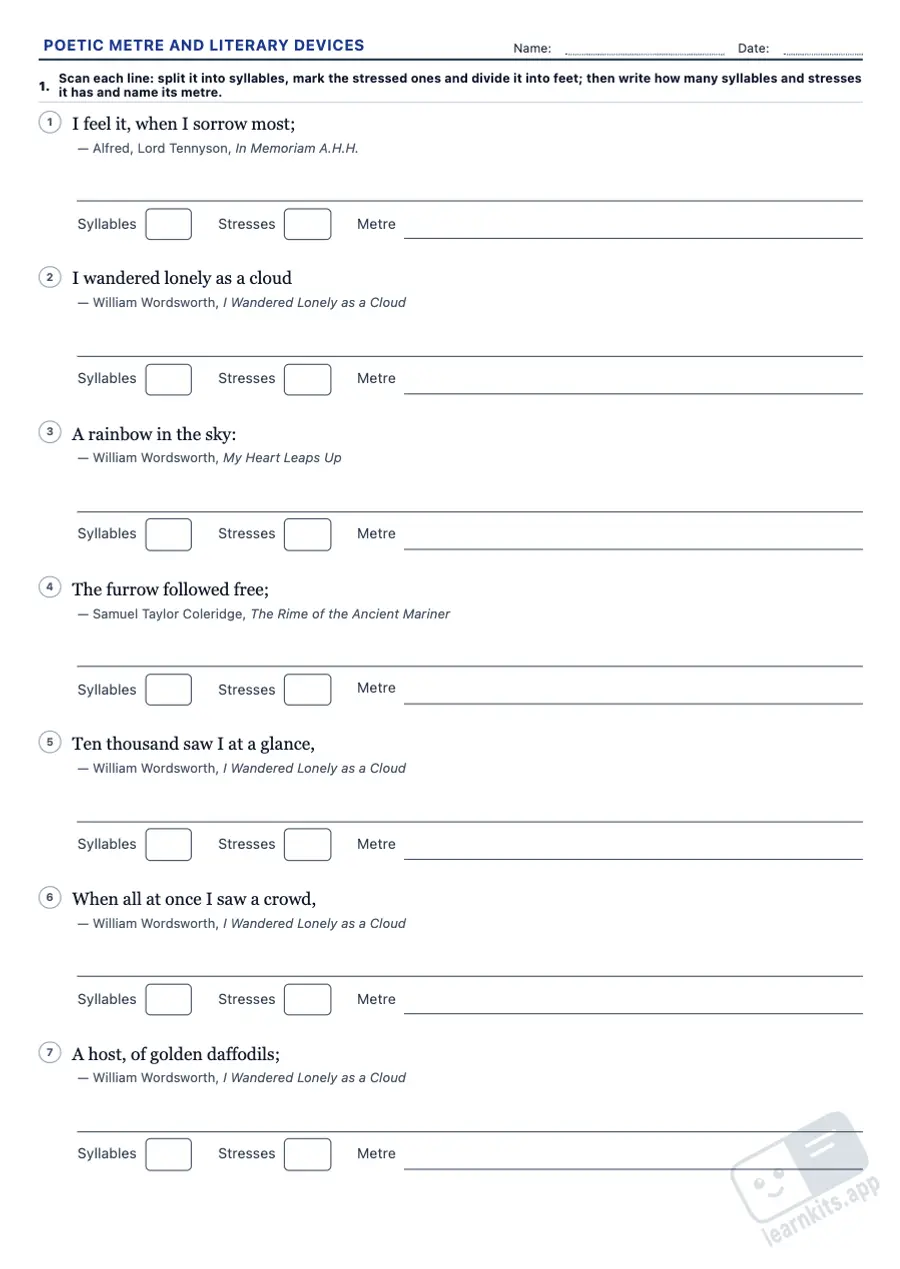 Student worksheet
 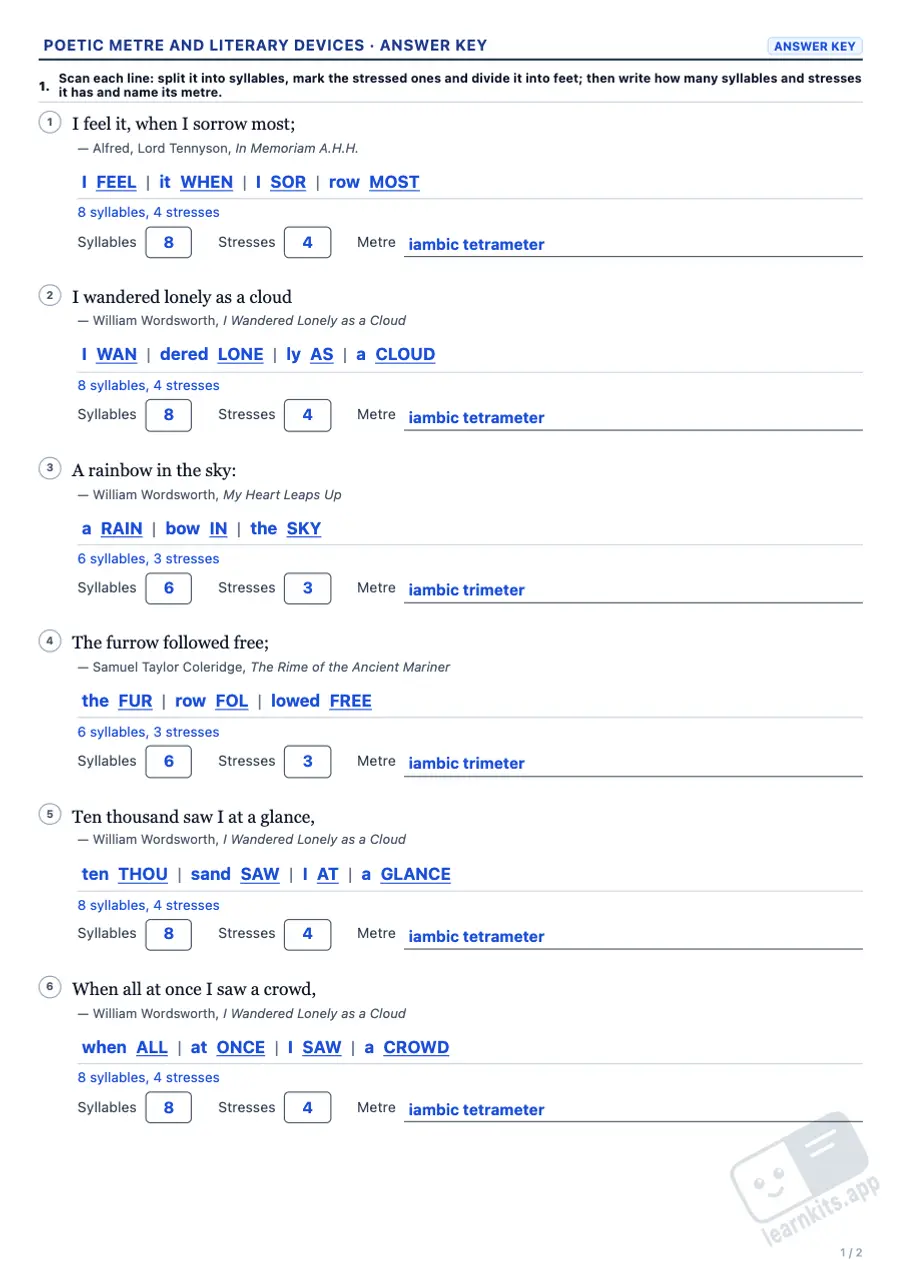 Answer key
 Each line split into syllables and feet with its stresses: shall I | com-PARE | thee TO | a SUM | mer’s DAY, five iambs, iambic pentameter. The answer key gives the full scansion.
The letter of each line of real stanzas: ABAB quatrains, AA couplets, the ABCB of a ballad stanza and the AABBA of a limerick.
Couplet, heroic couplet, quatrain, ballad stanza and limerick, told apart by their lines, metre and rhyme scheme.
Simile, metaphor, personification, hyperbole, alliteration, repetition, anaphora, rhetorical question, apostrophe, antithesis, inversion, paradox and oxymoron, each in lines where it is plain to see. Wrong options are never arguable.
Every line is scanned by hand and checked by an engine: its syllables must spell the line and its stress pattern must be a regular metre, or the line stays out of the bank.
Classic poems quoted as the standard editions print them, with the poet and the work under every extract, in British spelling.
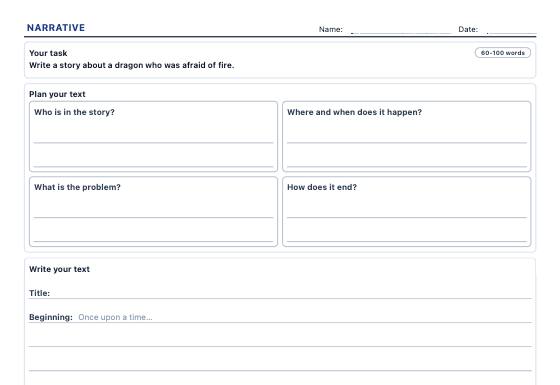
A4 writing frames for stories, descriptions, letters, news reports, opinion texts, instructions and emails: task, planning box, parts of the text, lines by age, a self-check list and a teacher guide with a rubric.
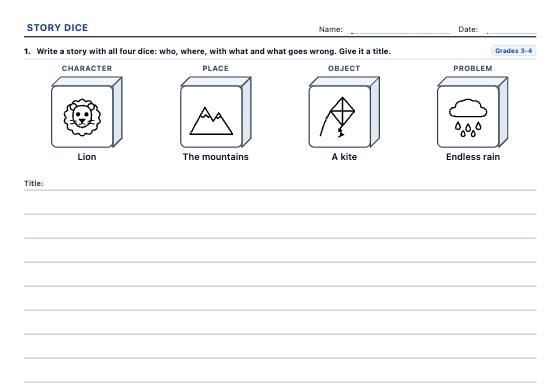
Drawn story dice, story starters and PISA-style creative thinking tasks: many different ideas, an original idea, improve an idea, complete a drawing and solve problems, with a teacher guide and rubric.
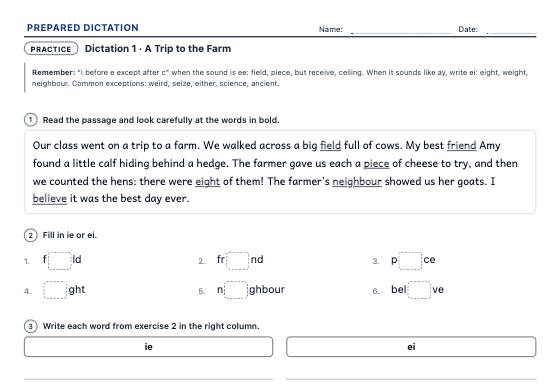
Original passages for each spelling pattern: a practice sheet with the key words to fill in and sort, a dictation sheet and the teacher's text to read aloud.