Create A4 worksheets with original reading passages levelled from Grade 1 to Grade 10: stories, non-fiction, opinion texts, multiple sources and non-continuous texts, with questions to locate, understand and evaluate, lined space to answer and a teacher answer key.
Teaching Guide: Reading Comprehension from Grade 1 to Grade 10
Reading comprehension grows by reading texts that suit the age and answering questions at different levels: what the text says (literal), what it suggests (inference), what its words mean (vocabulary) and what we make of it (evaluation). This free generator creates A4 worksheets with original passages from Grade 1 to Grade 10: stories, information texts, everyday texts and the formats of PISA and national reading tests, that is, argument and opinion texts, paired passages that disagree and non-continuous texts (timetables, tables, forms, charts and infographics). Plus an answer key you can mark with in minutes.
A4, to print or save as PDF; new exercises every time
Price
Free, no sign-up
Available in
Catalan, Spanish, English
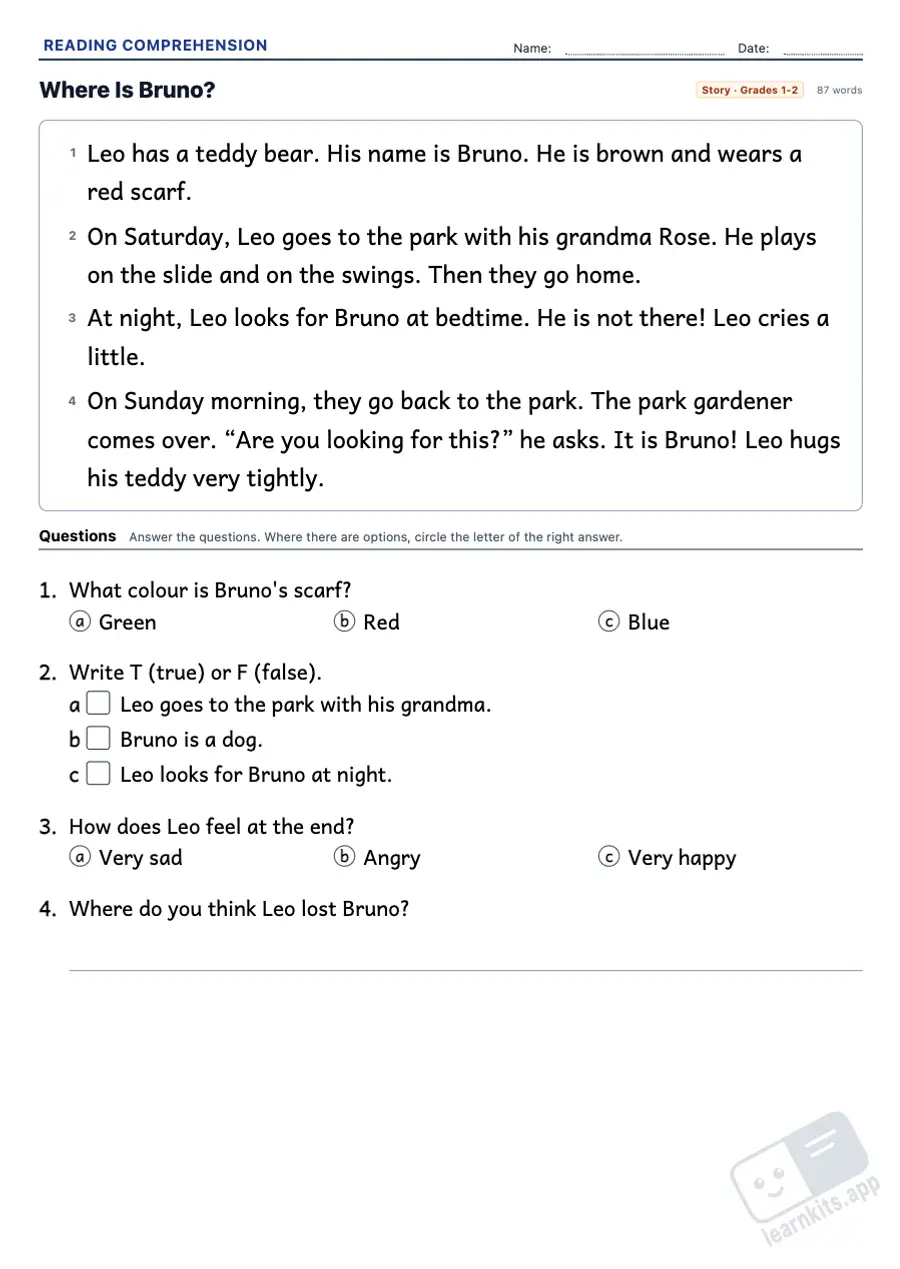
Student worksheet
Answer key
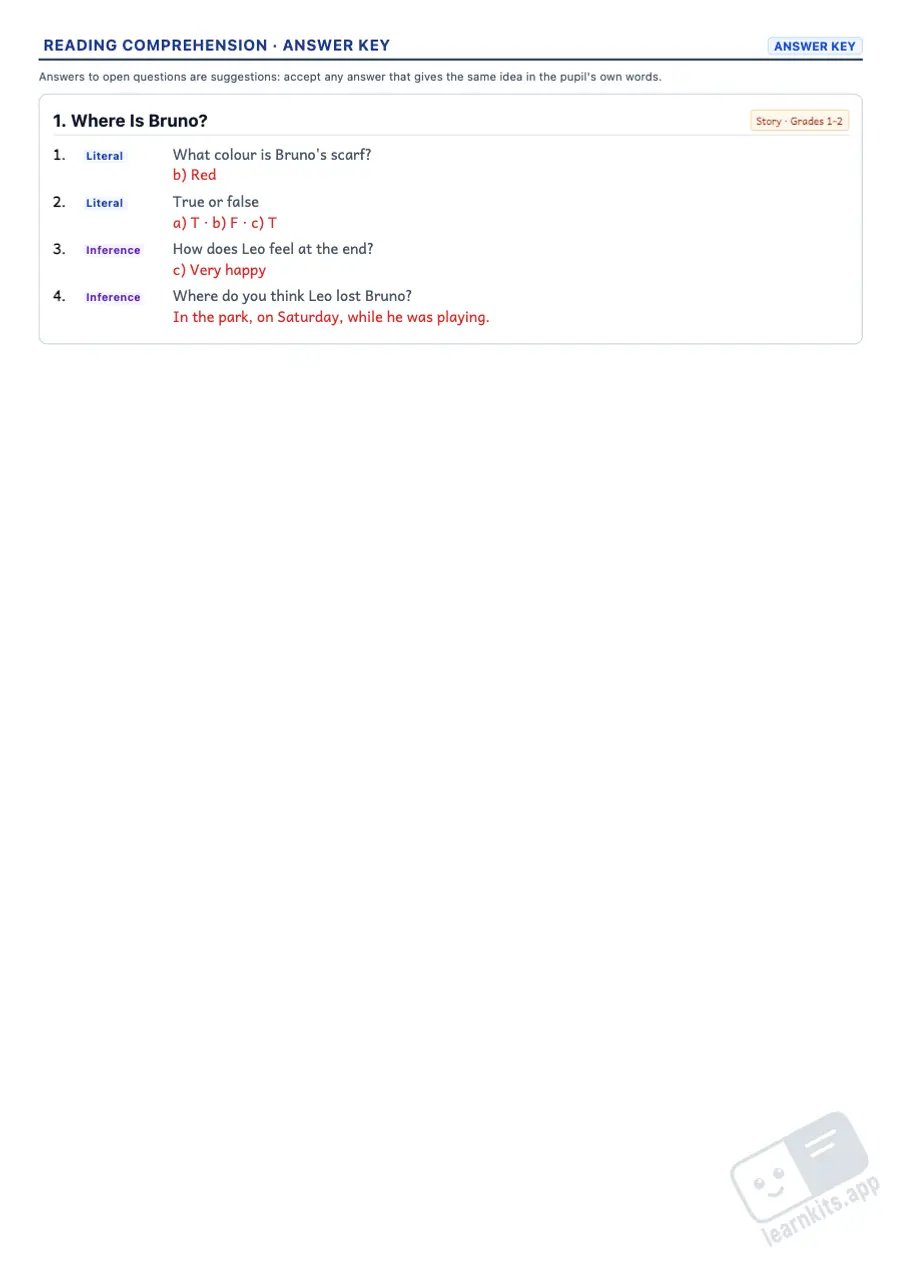
Sample made with LearnKits. Every worksheet is new: choose the topic, level and amount and print it for free.
Original passages
120 texts written for LearnKits and adapted into English, Spanish and Catalan, in six text types, four of each type per level.
The PISA reading processes
Questions to locate information (literal), to understand the text (inference and vocabulary) and to evaluate and reflect on it (fact or opinion, how reliable a source is, the writer's purpose), as multiple choice, true or false, fact or opinion and open answers.
Levelled by grade
Five levels, from Grade 1 to Grade 10, with the length of the text, the print size and the answer lines matched to each age.
Answer key
The answer to every question, the right letter of each multiple-choice question and a model answer for open questions, with the question type.
Non-continuous texts and multiple sources
Timetables, tables, forms, charts, infographics and instructions with a diagram, and two or three short texts on one topic that do not agree, to compare them and decide which source is more reliable.
Numbered paragraphs
Paragraphs can be numbered so pupils cite where the answer is, and every worksheet shuffles the order of the options so the right answer is not always the same letter.
Frequently Asked Questions about Reading Comprehension
Which grades are these passages for?
Grades 1 to 10, in five levels: Grades 1-2 (60-90 words), 3-4 (120-170), 5-6 (200-260), 7-8 (280-350) and 9-10 (370-450). If your group is ahead, go up a level.
What kinds of questions are there?
Literal questions (the answer is in the text), inference questions (pupils work it out: why something happens, how a character feels, the main idea or the writer's purpose), vocabulary questions (what a word means in that context) and evaluation questions (telling fact from opinion, judging whether an argument convinces or which source is more reliable).
Do they help prepare for PISA and reading tests?
Yes. Besides stories, information texts and everyday texts, there are the formats these tests use: argument and opinion texts, multiple sources (two or three texts on one topic that disagree) and non-continuous and mixed texts (timetables, tables, forms, charts, infographics and instructions with a diagram). The questions follow the three PISA reading processes: locate information, understand, and evaluate and reflect.
Where do the texts come from?
Every text is original, written for LearnKits and adapted into each language rather than translated word for word. Facts in the information texts are checked and suited to the age.
How can I teach reading comprehension in class?
Before reading, talk about the title and the type of text. Read it twice: once to understand it and once looking for the answers. Ask pupils to point to the paragraph where they found each literal answer and to back up their inferences with the text.
Each text type has four passages per level. No passage appears twice within one exercise, and selecting it on the sheet and clicking “New” picks others and shuffles the order of the options.
How do I print only the answer key?
Click Print and choose “Answer key”, or “Worksheet and answer key” for both. Your browser’s print dialog can also save it as a PDF.
Is any student data sent to a server?
No. Worksheets are created in your browser and no student data is stored. Templates are kept in your browser’s memory.
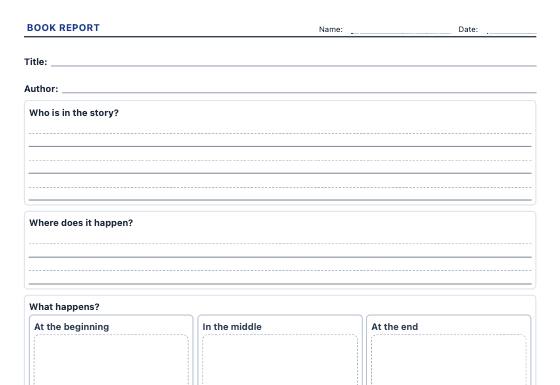
Create A4 sheets for any book: book report, character profile, story map, reading log and reading challenge passport, with line spacing and questions adapted to every stage.
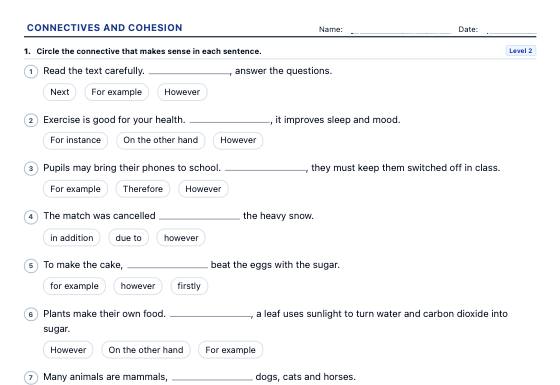
Text cohesion worksheets: choose the connective by its meaning (addition, contrast, cause, result, sequence, example, conclusion), sort connectives, put the paragraphs of a text in order and find what pronouns and synonyms refer to, with sentences written in English, in three levels with an answer key.
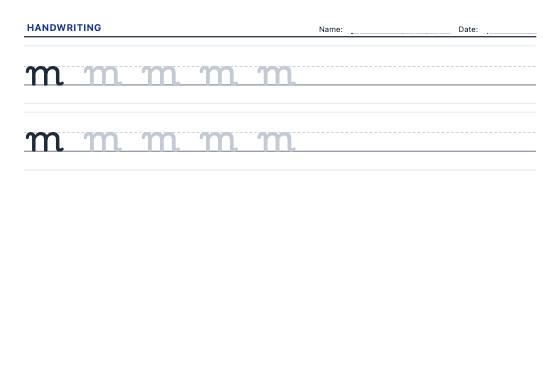
Create A4 handwriting worksheets with letters, words, sentences or your own text to trace and copy, in cursive or print, on Montessori, double, grid or single lines.
This feature is not yet available. We are actively building advanced tools for schools, tutoring centers, and teachers.
Notice: All current worksheet generators and printable materials on LearnKits are and will remain 100% free and open. Pro will be an optional enhancement for school institutions.
Features in development:
No Watermark: Print worksheets and answer keys without the LearnKits mark.
Cloud Collections: Access and organize your worksheets from anywhere.
School Branding: Add your school crest and custom header notes.
Direct PDF Export: One-click vector PDF downloads without print popups.
Thank you! We will notify you first as soon as LearnKits Pro becomes available.
Analytics cookies
We use Google Analytics to learn which resources are used and improve them, only if you accept. You can change your choice at any time from the page footer. Cookie policy