With pictures
In Grade 4 pupils see that 1/2 and 2/4 are the same amount: bars and circles split into equal parts to shade, then to compare. The pictures are black and white and print well on any printer.
Equivalent fractions are the key to everything that follows: simplifying, adding with unlike denominators, comparing and ordering. This free equivalent fractions worksheet generator builds A4 worksheets that start with bar and circle pictures and go all the way to the GCF, the LCM and cross products, with a step-by-step answer key. Once they are secure, move on to fraction operations or percentages.
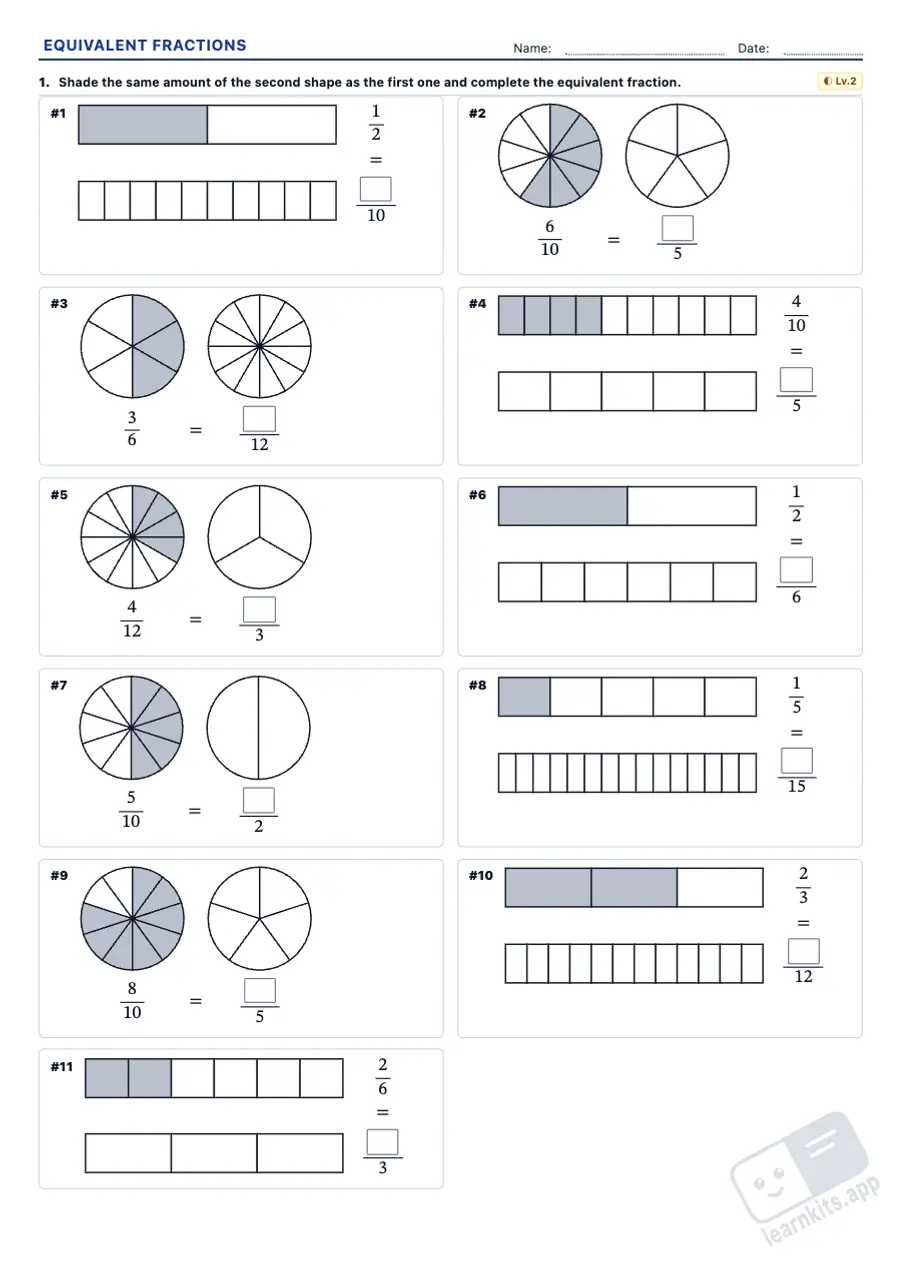 Student worksheet
 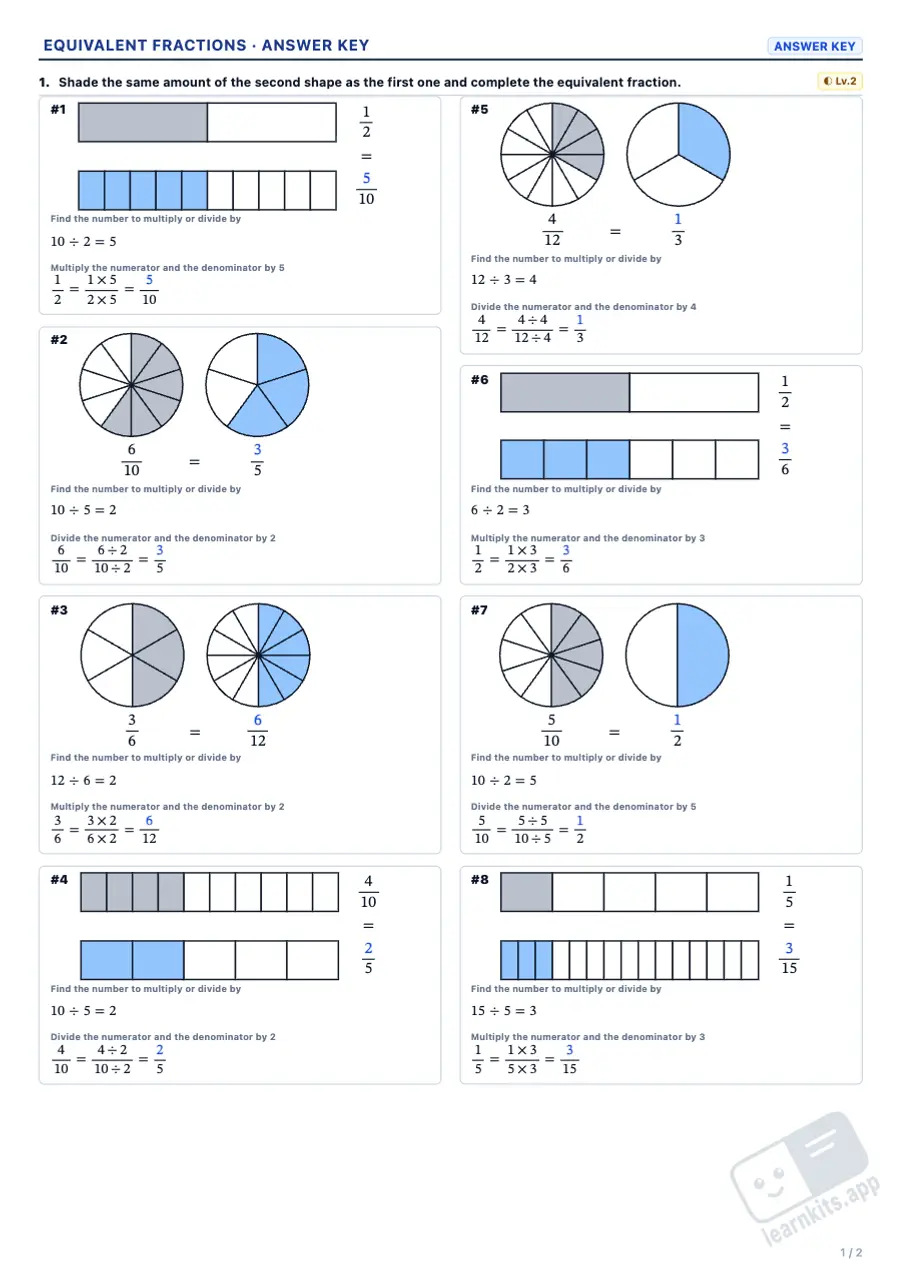 Answer key
 In Grade 4 pupils see that 1/2 and 2/4 are the same amount: bars and circles split into equal parts to shade, then to compare. The pictures are black and white and print well on any printer.
Multiply or divide both terms by the same number, writing that number first; in Grade 7, cross products when neither denominator is a multiple of the other.
A fraction and four equivalent fractions to complete. At level 3 the chain starts from a fraction that is not in simplest form, so pupils simplify and then multiply.
Three methods, one per level: dividing by 2, 3 and 5 with the divisibility rules, cancelling common prime factors and dividing once by the GCF.
Cross products to decide whether two fractions are equivalent, with traps built on common mistakes such as adding the same number to both terms (2/3 and 3/4 are not equivalent).
Rewrite fractions over a common denominator with the LCM, compare two fractions and order four. Every exercise has a step-by-step answer key: the multiplier, the cross products, the GCF or LCM and the equivalent fractions.
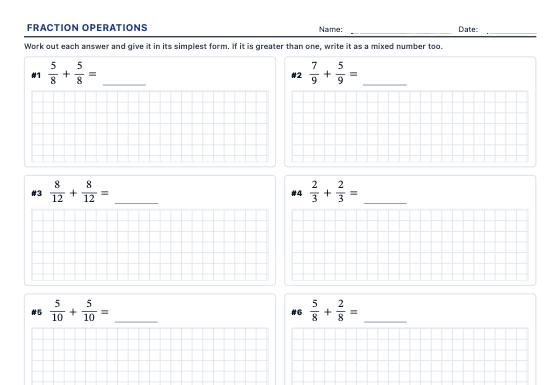
Worksheets on adding, subtracting, multiplying and dividing fractions, with mixed numbers and negative fractions, and a step-by-step answer key with the LCM, simplifying and mixed numbers.
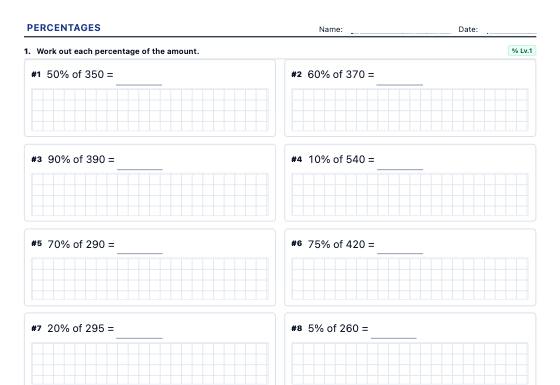
Percentage of an amount, one amount as a percentage of another, increases and decreases with the multiplier, successive and reverse percentages, percentages, fractions and decimals and word problems, with a step-by-step answer key.
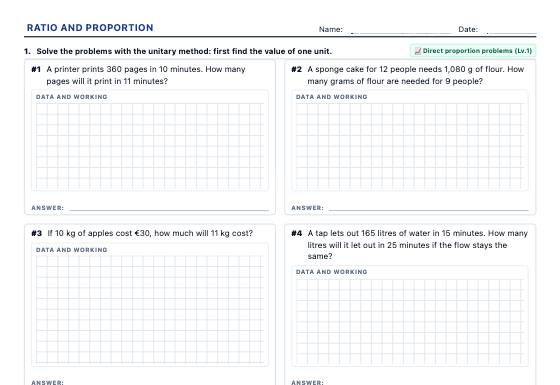
Proportion tables, direct and inverse proportion, compound proportion and sharing in a ratio, with real-life word problems and a step-by-step answer key.