Percentage of an amount
At level 1 with the equivalent fraction (75% of 220 is 220 ÷ 4 × 3); then as a decimal (240 × 0.15) and with percentages such as 12.5% or 150%.
Percentages are everywhere: sales, VAT, surveys, the news and bills. This free percentage worksheet generator builds A4 worksheets that go from a percentage of an amount with the equivalent fraction (25% is 1/4) to the multiplier method, successive percentages and reverse percentages, with a step-by-step answer key. All the arithmetic is exact, with no rounding. To practise the basics, see the fraction operations and decimal operations worksheets too.
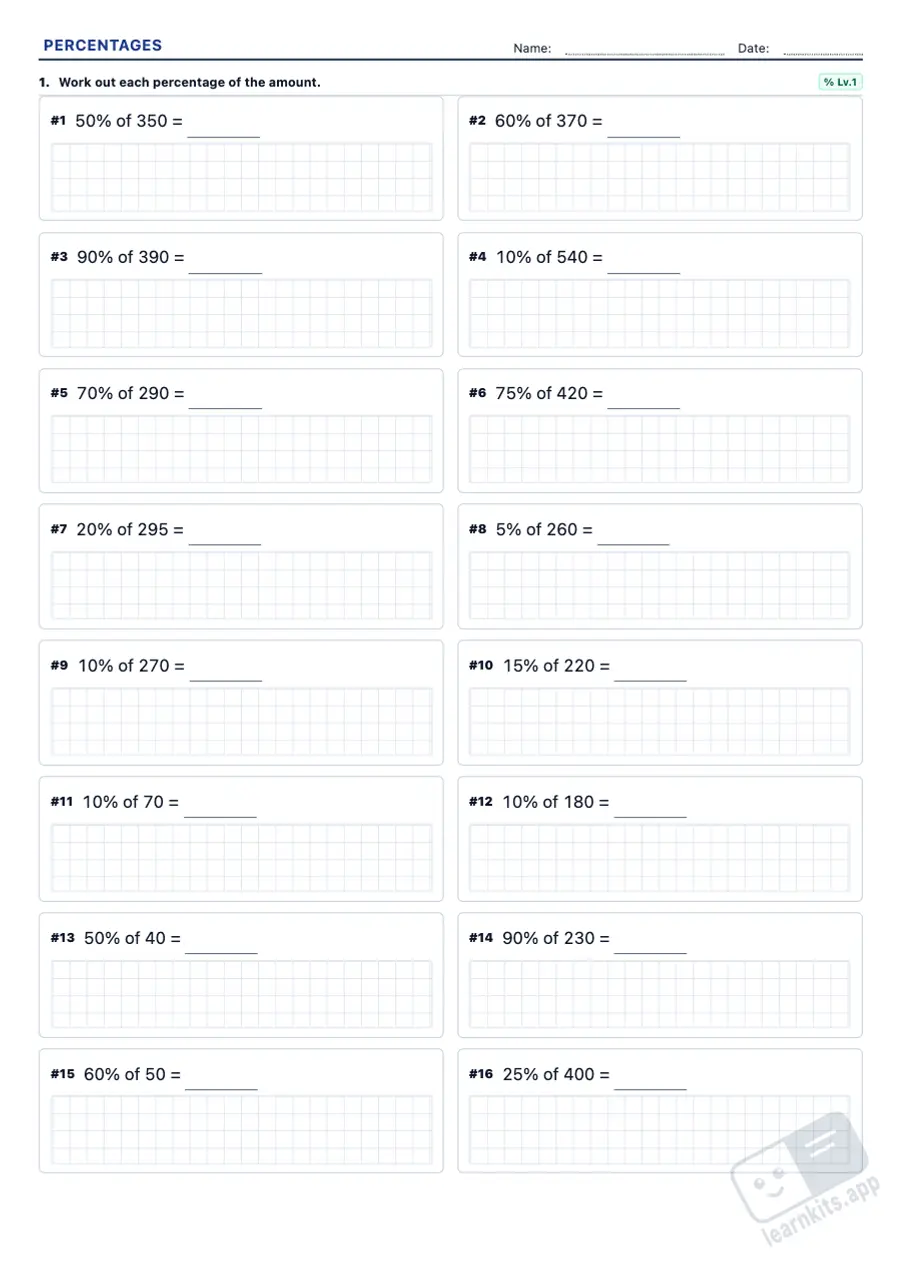 Student worksheet
 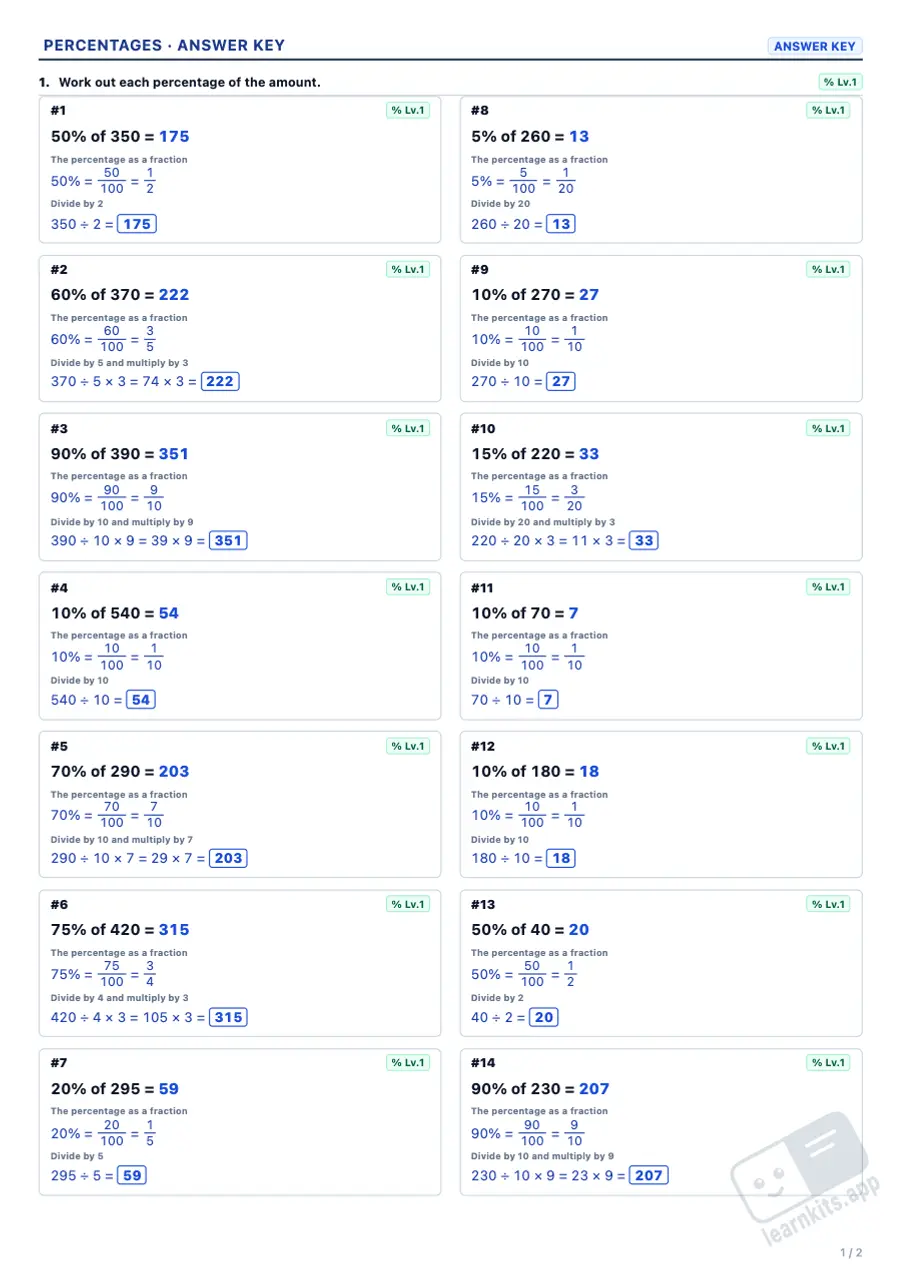 Answer key
 At level 1 with the equivalent fraction (75% of 220 is 220 ÷ 4 × 3); then as a decimal (240 × 0.15) and with percentages such as 12.5% or 150%.
First by working out the increase or discount; from level 2 with the multiplier (−15% → × 0.85) and the percentage change between two amounts.
Several changes in a row are worked out by multiplying the multipliers, which shows why a 20% rise followed by a 20% fall leaves the price 4% lower.
The price before a sale or before VAT: divide by the multiplier, and the answer key checks it.
A table linking 75%, 3/4 and 0.75, with fractions in their simplest form and, at level 3, percentages such as 12.5% = 1/8.
Every exercise solved with each step named: the fraction or decimal, the multiplier, the division and the check. Word problems in context (surveys, pay, population) give the answer with its unit.
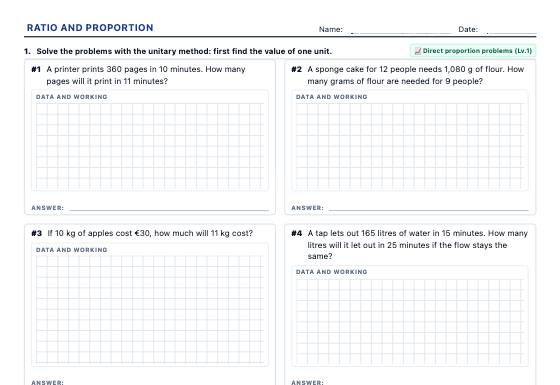
Proportion tables, direct and inverse proportion, compound proportion and sharing in a ratio, with real-life word problems and a step-by-step answer key.
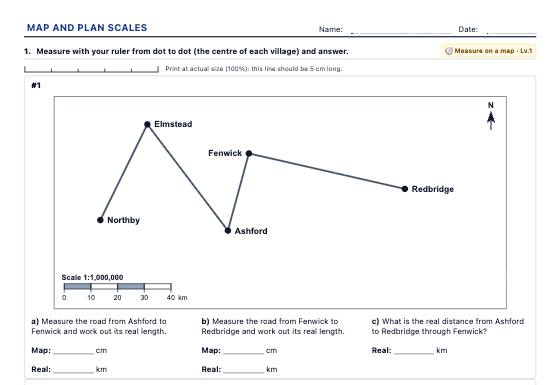
Ratio scale and scale bar worksheets: real and map distances, finding the scale, and village maps and floor plans printed at true size to measure with a ruler.
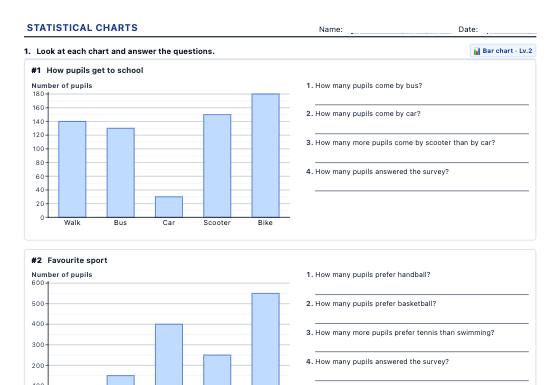
Pictograms, bar charts, line graphs and pie charts to read and to draw, and frequency tables with mode, mean and median, with new data every time and an answer key.