From squares to formulas
Start in Grade 4 by counting squares and square sides, move on to rectangles, triangles and parallelograms with base and height, and reach regular polygons and the apothem in Grade 7.
Area and perimeter are where geometry turns into measurement: counting squares, seeing why a triangle is half a rectangle and why a circle needs π. This free area and perimeter worksheet generator draws every shape to scale with its measurements, always consistent, and builds an answer key with the formula and every step.
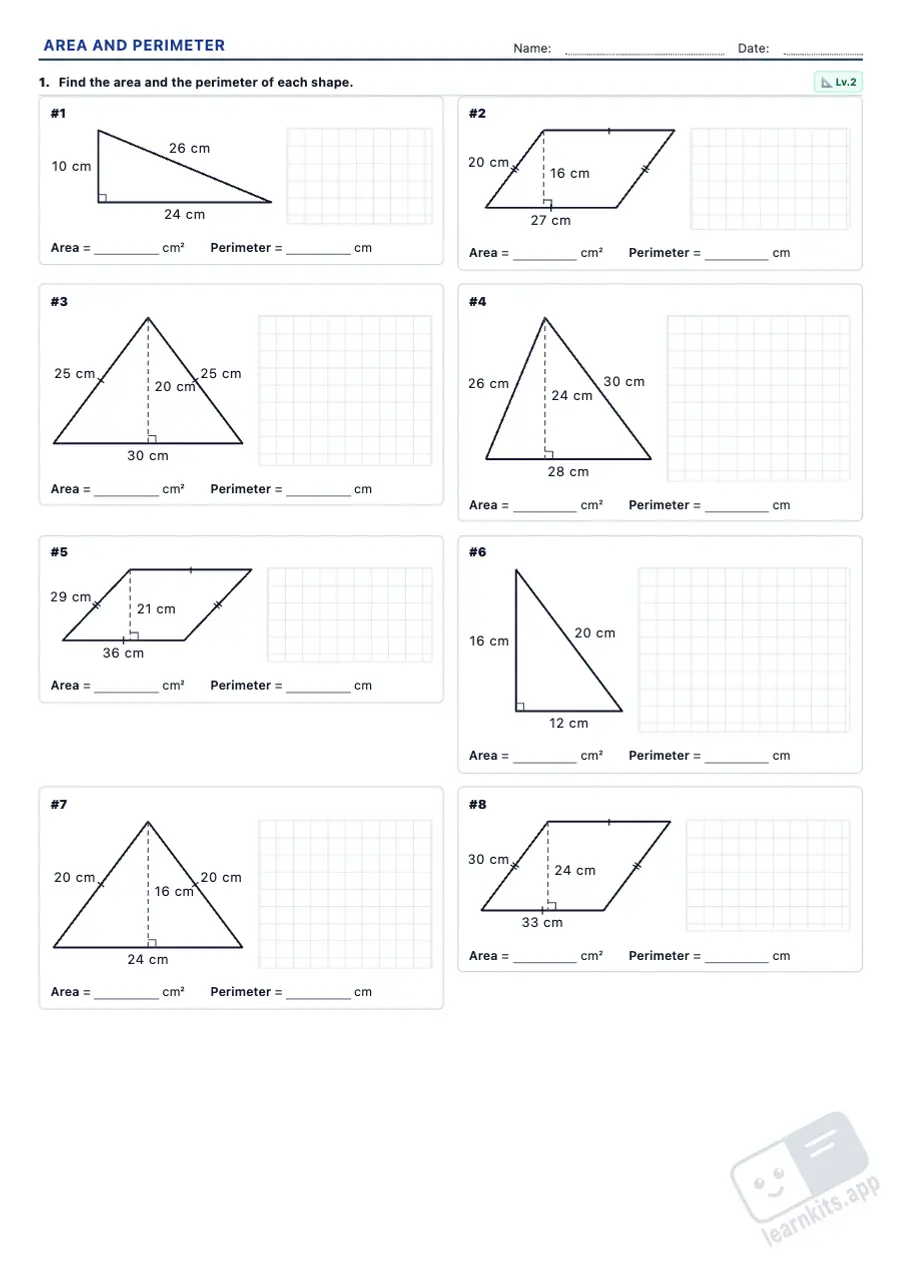 Student worksheet
 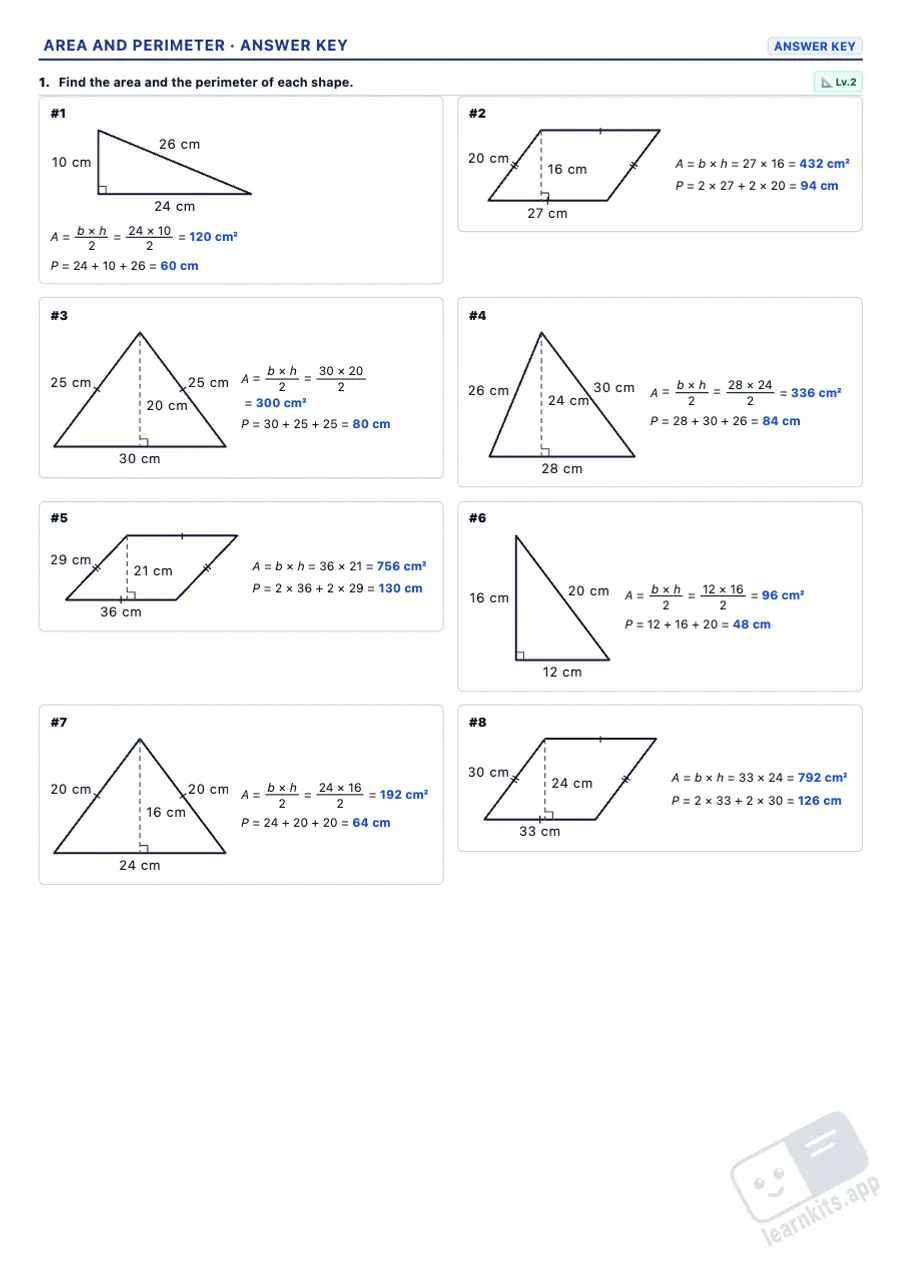 Answer key
 Start in Grade 4 by counting squares and square sides, move on to rectangles, triangles and parallelograms with base and height, and reach regular polygons and the apothem in Grade 7.
Circumference and area from the radius or the diameter, semicircles, quarter circles, sectors and rings, always with π = 3.14 so that the answers come out exactly.
L and T shapes to split into rectangles, houses, running tracks and shaded areas (a square minus a circle, a frame…), with the split drawn in the answer key.
PISA’s geometric approximation: irregular shapes on a grid or a map with a scale. Pupils count whole and part squares, and the answer key marks them and gives the range for the real area.
Working backwards: the height from the area, the side of a square from its perimeter or the radius from the circumference. Great for understanding the formulas, not just using them.
Heights and slanted sides come from Pythagorean triples, so every shape could really exist. The answer key shows the formula, the substitution and the answer with its units.
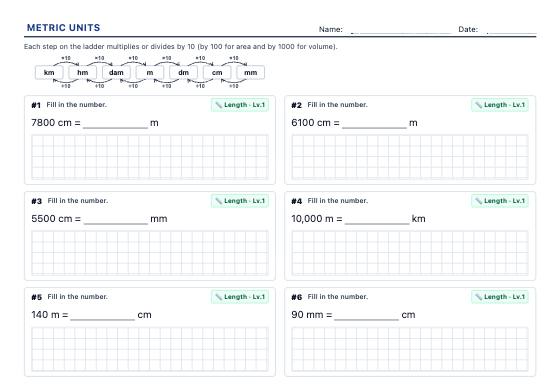
Metric conversion worksheets: length, mass, capacity, area and volume, with mixed units, comparing and ordering, and an answer key showing how the decimal point moves.
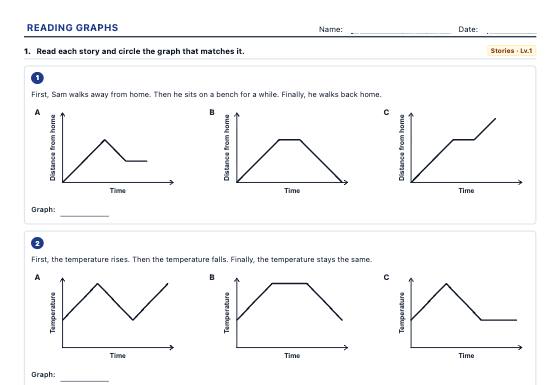
Everyday graphs to match to a story, read values and rates of change, describe trends, compare two series and spot misleading graphs, with an answer key.
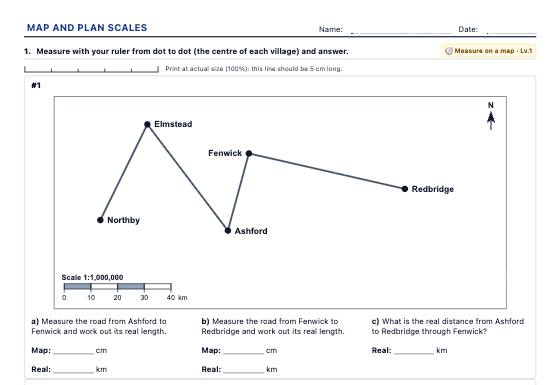
Ratio scale and scale bar worksheets: real and map distances, finding the scale, and village maps and floor plans printed at true size to measure with a ruler.