The metric ladder
Each sheet can show the ladder of the measures it practises, with ×10 one way and ÷10 the other, so pupils can see where every unit sits.
Converting units in the metric system means moving the decimal point: each step on the metric ladder multiplies or divides by 10, by 100 for area and by 1000 for volume. This free generator creates A4 worksheets on length, mass, capacity, area and volume for Grades 3 to 7, with an answer key showing the steps on the ladder, how many places the decimal point moves and which zeros are added.
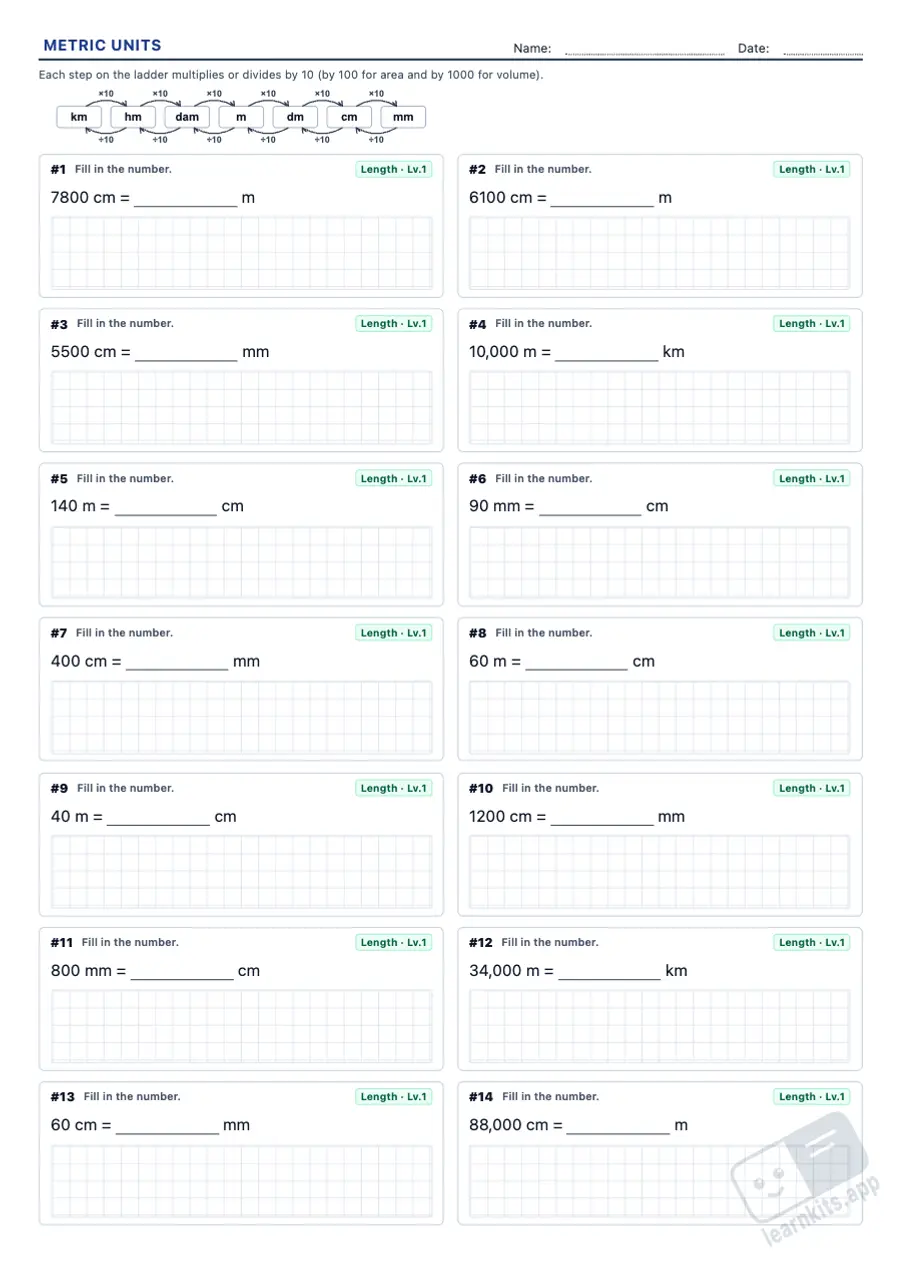 Student worksheet
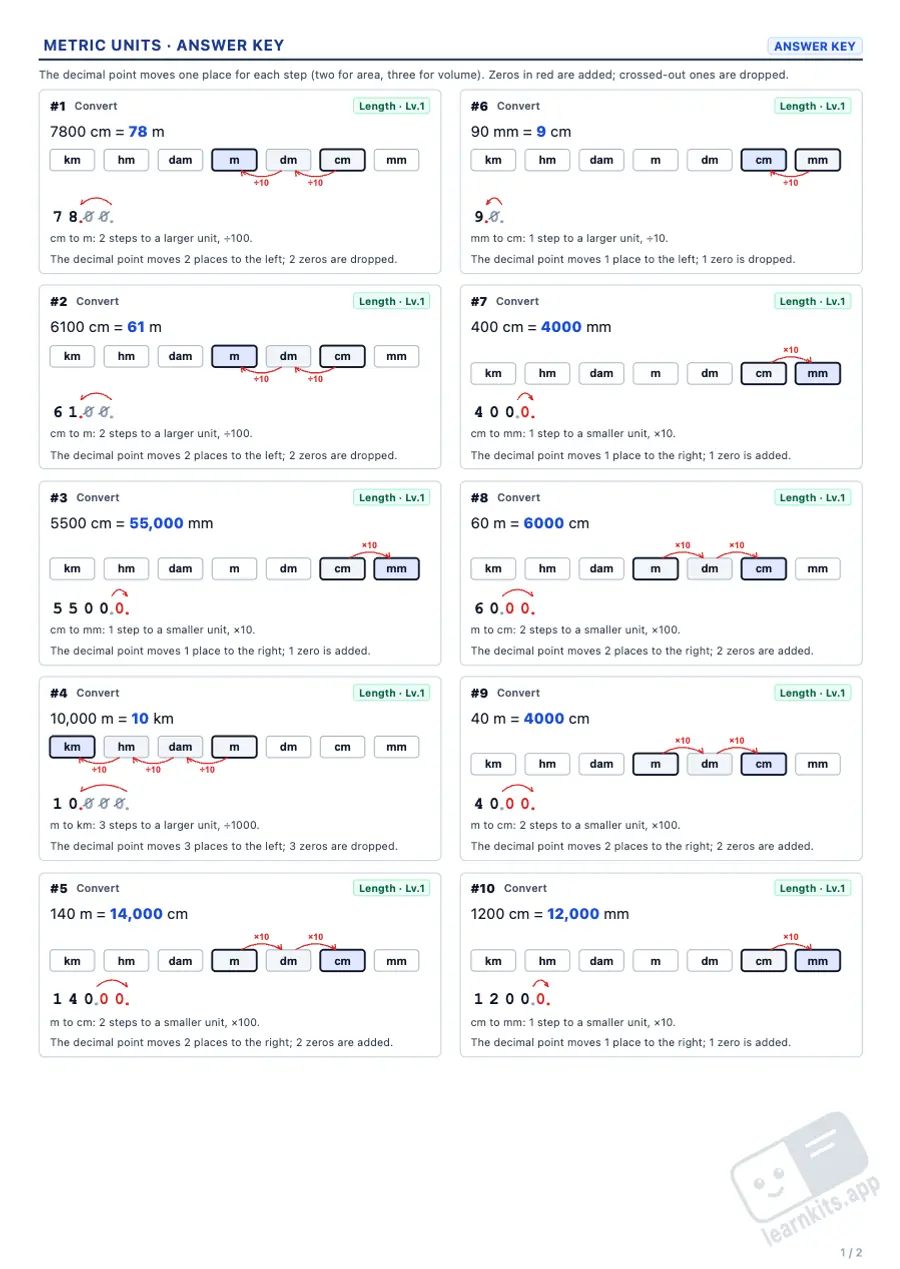 Answer key
Each sheet can show the ladder of the measures it practises, with ×10 one way and ÷10 the other, so pupils can see where every unit sits.
Convert, mixed units to one unit and back, compare, order and find the missing unit.
The area ladder (×100) with hectares, ares and centiares, the volume ladder (×1000) and the link 1 dm³ = 1 l.
The answer key draws the digits, where the decimal point was and where it ends up, with added zeros in red and dropped ones crossed out.
Every calculation uses exact decimal arithmetic, with no rounding errors, and numbers use the decimal point.
Every exercise you add brings new quantities with no repeats within it, and “New” draws others with the same settings: great for homework, practice and tests.
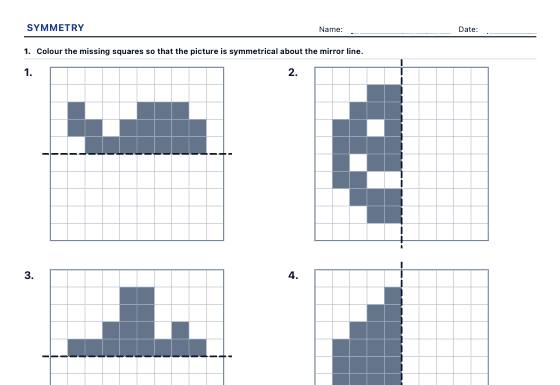
Symmetry worksheets on a grid: complete the symmetrical half of a picture, reflect a shape in a mirror line, decide whether a line is a line of symmetry and draw every line of symmetry of a shape, with an answer key.
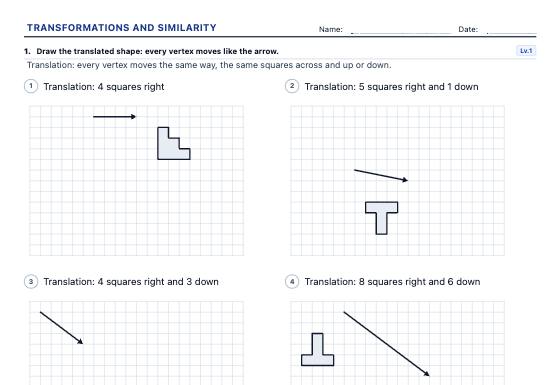
Transformations worksheets on a grid: translations, reflections, rotations, combined transformations and enlargements, similar shapes (scale factor, perimeters and areas) and Thales' theorem, with an answer key that draws every image.
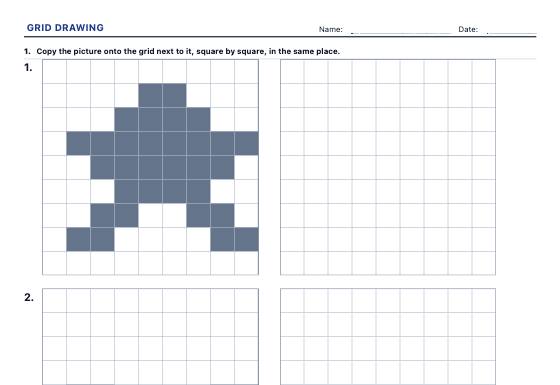
Grid drawing worksheets: copy a picture square by square, follow an arrow code along the grid lines, write the code of a path and colour mystery pictures from coordinates, with an answer key.