Counting money
Grade 1 counts €1 and €2 coins only; Grade 2 cent coins; Grade 3 notes from €5 to €50; Grade 4 all of them, with the total in euros and cents (€37.85). The tip: start with the largest piece.
Counting coins, paying a price and understanding change are skills children use every day. This free money worksheet generator builds A4 worksheets with drawn euro coins and notes (simplified, black-and-white friendly and in proportion to the real ones) to count money, pay a price, compare purses, work out the change from a purchase, solve problems with a shop's price list and convert euros to cents, from Grade 1 to Grade 4, with an answer key. The worksheets use euros, the currency of Spain and the euro area.
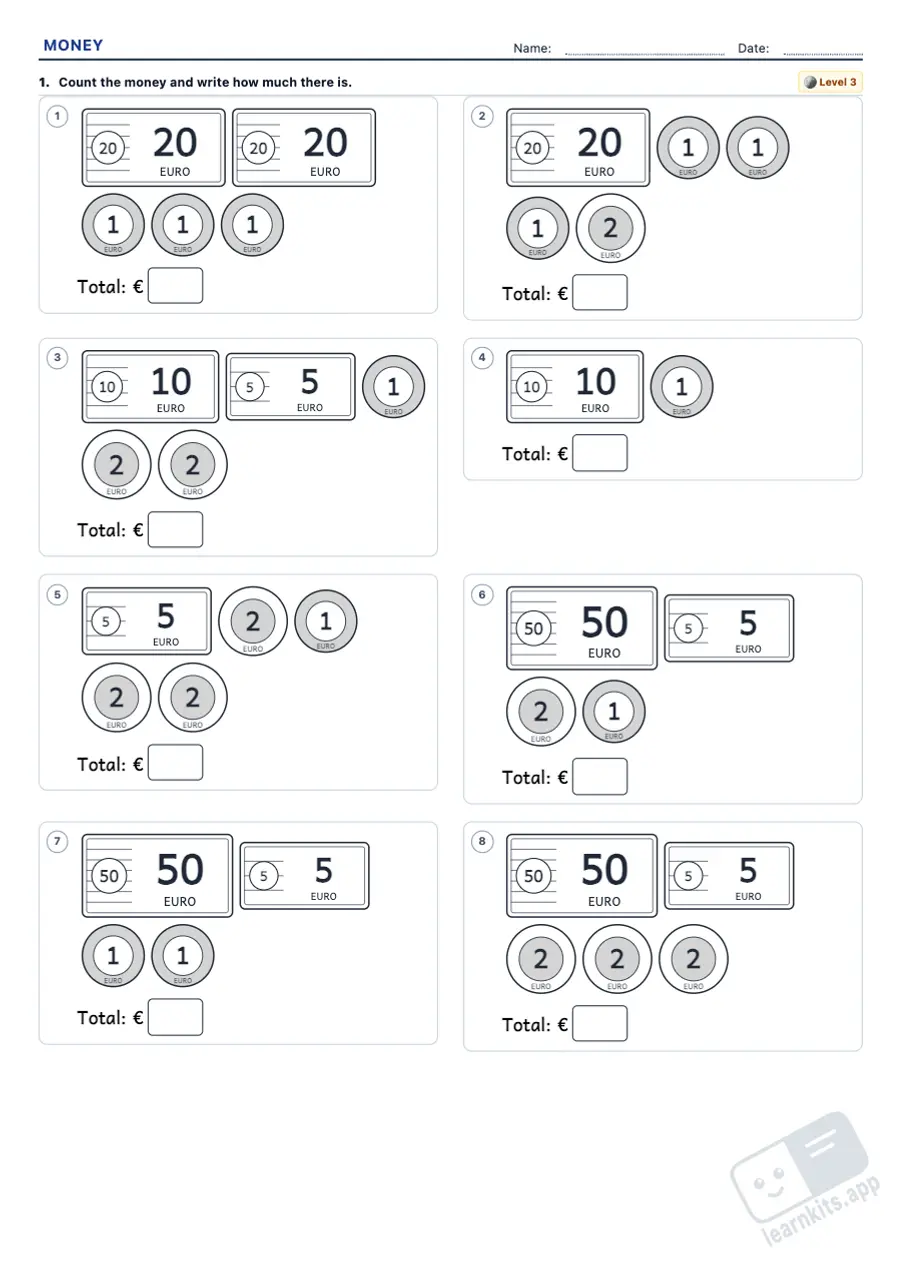 Student worksheet
 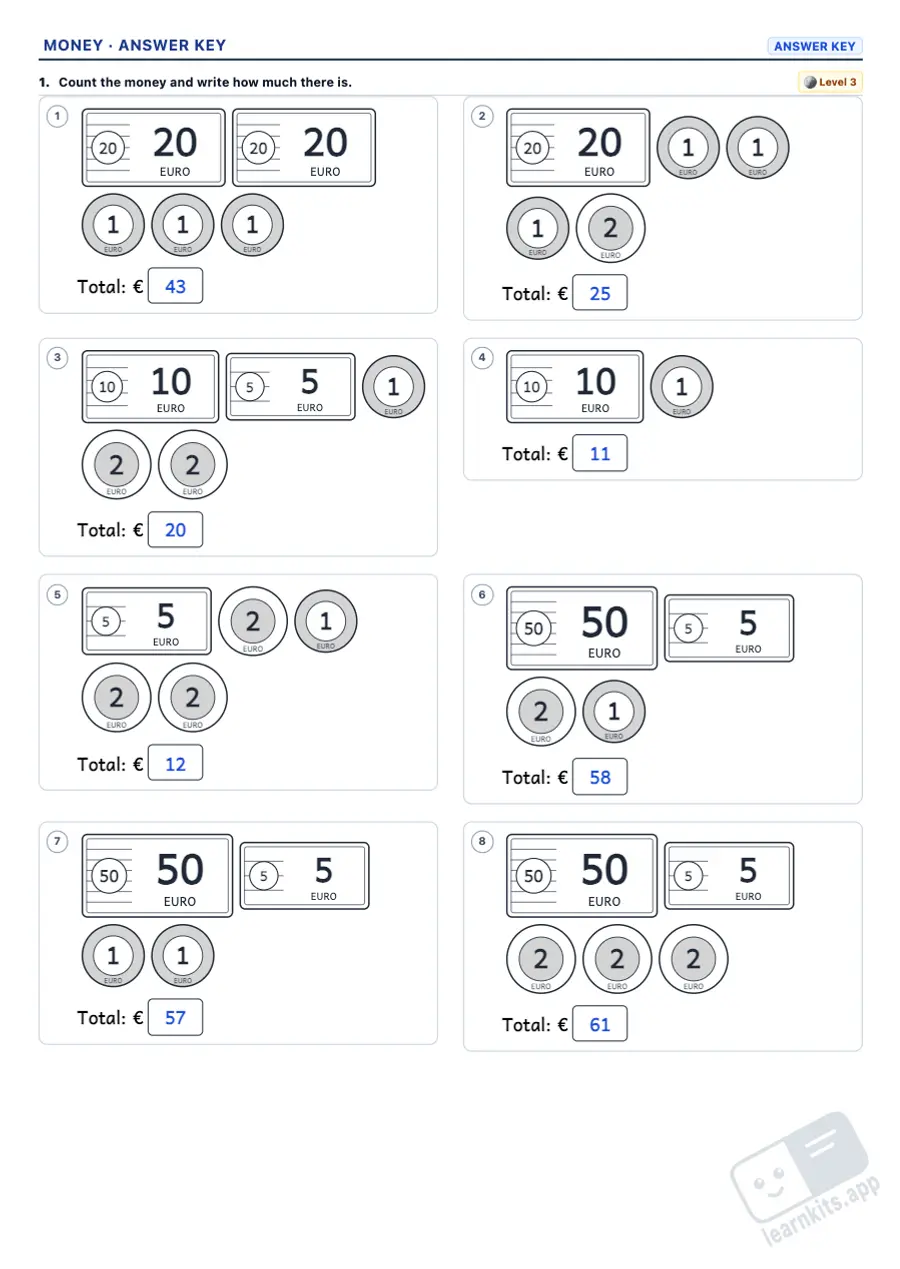 Answer key
 Grade 1 counts €1 and €2 coins only; Grade 2 cent coins; Grade 3 notes from €5 to €50; Grade 4 all of them, with the total in euros and cents (€37.85). The tip: start with the largest piece.
Circle the pieces of a purse that pay an exact price, or draw them. In Grades 3 and 4, with the fewest coins and notes, as a shopkeeper would.
Who has more money? It has to be counted: sometimes the purse with more coins holds less.
Buy from the shop, pay with a note and work out the change: €10 − €7.25 = €2.75. Then draw the change with the fewest pieces.
With the price list of a bakery, a stationery shop or a toy shop: how much it all costs, how much is left, is it enough and how much several of one thing cost.
€1 is 100 cents: €3 and 45 cents is 345 cents, and so is €3.45. A first step to the decimal point in prices.
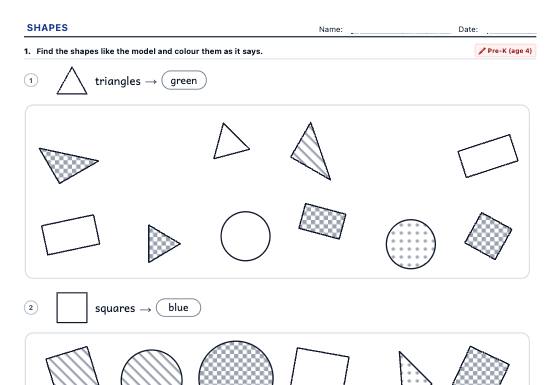
Shapes worksheets: colour the ones like the model, count them in a table, match them to their names, trace them and find them in a picture, from circles, squares and triangles to pentagons and first 3D shapes.
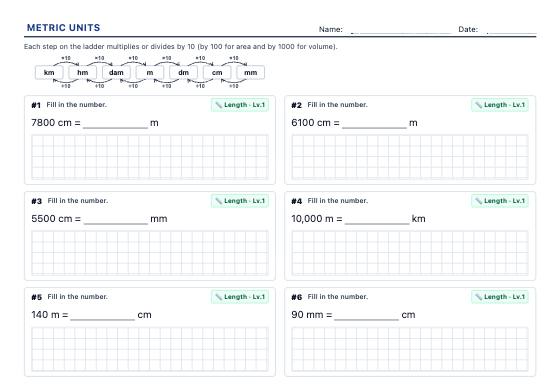
Metric conversion worksheets: length, mass, capacity, area and volume, with mixed units, comparing and ordering, and an answer key showing how the decimal point moves.
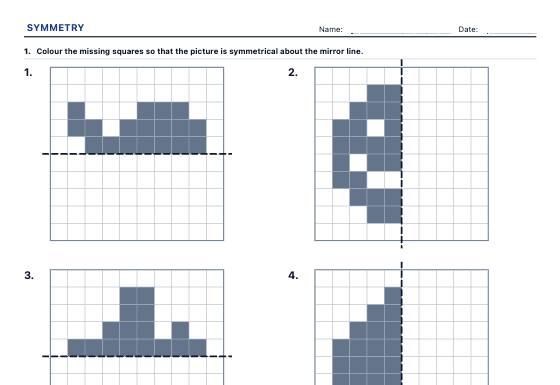
Symmetry worksheets on a grid: complete the symmetrical half of a picture, reflect a shape in a mirror line, decide whether a line is a line of symmetry and draw every line of symmetry of a shape, with an answer key.