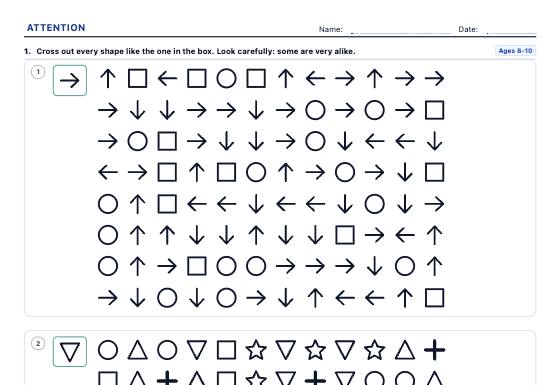
Attention and Concentration
Selective and sustained attention worksheets: cross out shapes, numbers and letters, symbol coding, find the identical row and follow a rule path, ages 5 to 14, with answers.
Practice material for attention, reading and writing, number, emotions and routines, organised by need rather than by year group. Every worksheet fits the child’s real level, is new every time and comes with its answers.
For anyone supporting a child who needs more time, a different route or targeted help.
Short worksheets for intervention sessions, at the level the child needs even when it is not their year group’s.
Material to suggest to the class teacher or the family, so practice at home follows what happens at school.
Syllable awareness, vocabulary, emotions and visual routines to round off sessions with worksheets of your own.
Short, pressure-free practice at home, following what the school or the specialist recommends.
Choose what you want to work on. Each block has its generators and a few worksheet types to start with; each one has several levels, from the simplest to the most demanding.
Selective and sustained attention, visual discrimination, planning and visual memory: find the same and the odd one out, spot the difference, mazes, grid copying, patterns and reasoning. Useful for ADHD too, always as guided practice in short sessions.
Selective and sustained attention worksheets: cross out shapes, numbers and letters, symbol coding, find the identical row and follow a rule path, ages 5 to 14, with answers.
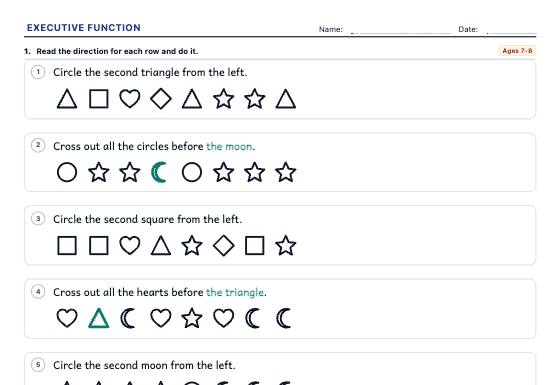
Executive function with shapes: remember where each shape was, follow directions, put the steps of a task in order and circle only what the rule says, ages 5 to 12, with answers.
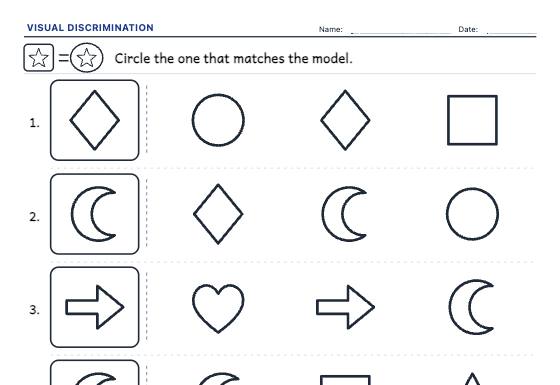
Visual discrimination worksheets for ages 3 to 5: find the one that matches the model, spot the odd one out and match the pairs, with differences in shape, pattern, orientation or small details.
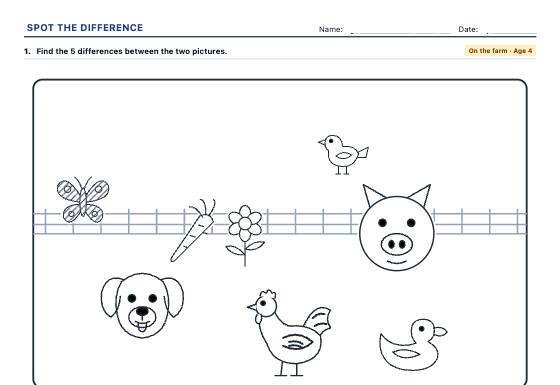
Picture pairs with 3 to 10 differences to find (something missing, swapped, smaller, striped, turned around or moved), in 9 scenes and 4 levels, with the differences circled in the answer key.
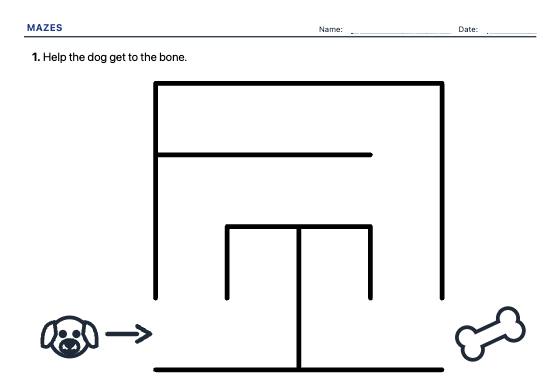
Unlimited A4 mazes, from wide paths for preschool to dense mazes for elementary, square or circular, with the solved path in the answer key.
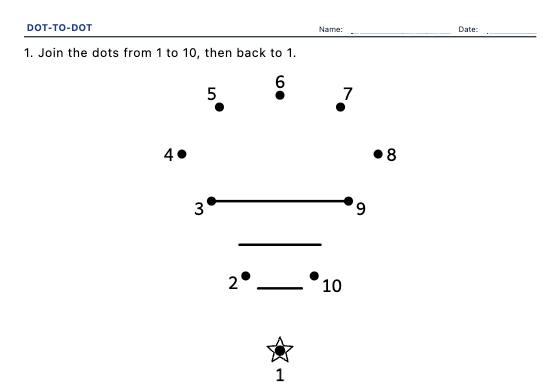
A4 worksheets to join the dots and reveal the picture: from 1-10 up to 1-100, counting in 2s, 5s and 10s or the alphabet, with over 30 pictures and the finished picture in the answer key.
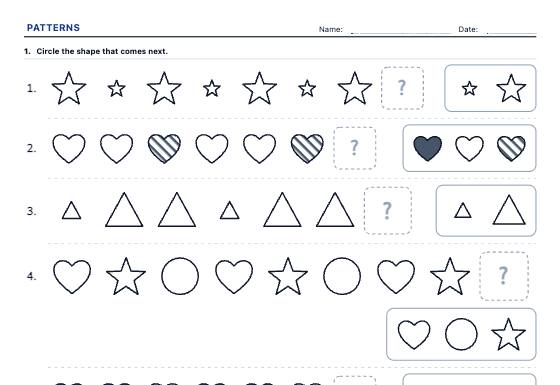
Shape pattern worksheets: what comes next, continue the pattern, what is missing and spot the mistake, with AB, AAB, ABC, AABB… patterns of shape, size, fill, direction or colour, and growing patterns.
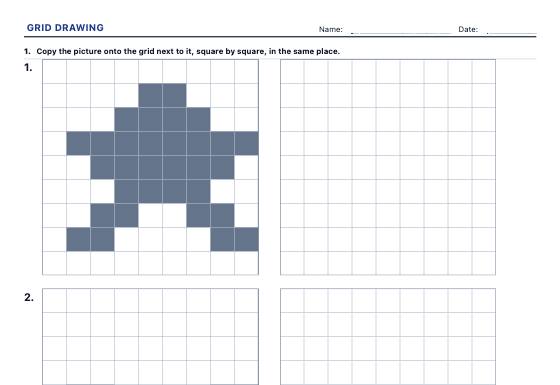
Grid drawing worksheets: copy a picture square by square, follow an arrow code along the grid lines, write the code of a path and colour mystery pictures from coordinates, with an answer key.
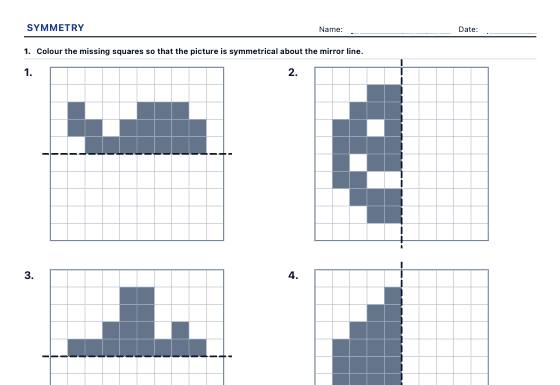
Symmetry worksheets on a grid: complete the symmetrical half of a picture, reflect a shape in a mirror line, decide whether a line is a line of symmetry and draw every line of symmetry of a shape, with an answer key.
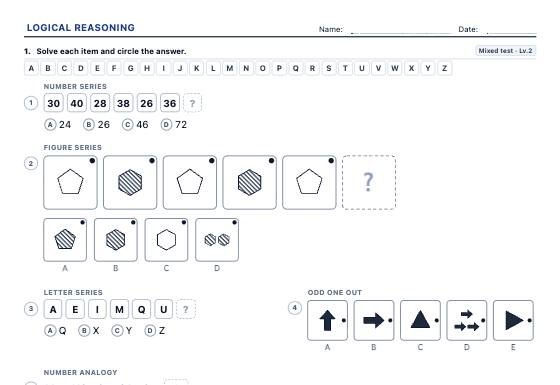
Reasoning test style worksheets: number, letter and figure series, 3 × 3 matrices, analogies and odd one out, in four levels, each item with exactly one answer and its rule on the answer key.
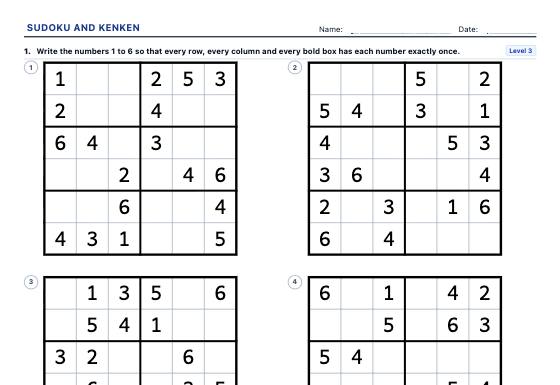
4 × 4, 6 × 6 and 9 × 9 sudoku from easy to hard and KenKen (maths sudoku) with addition, subtraction, multiplication and division, each with exactly one solution and an answer key.
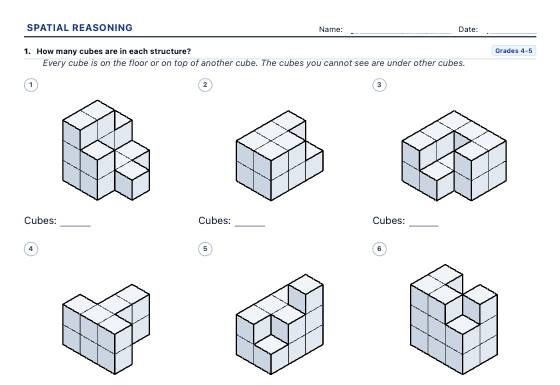
Spatial reasoning worksheets: count the cubes in a structure (hidden ones too), pick the view from the front, top or side, find the rotated shape among mirror images and fold cube nets with marked faces, with an answer key.
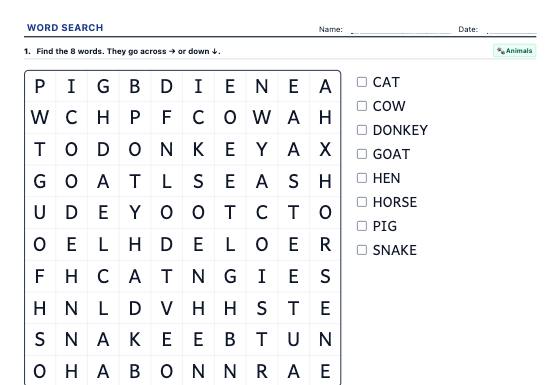
Word searches with topic vocabulary, the word list beside the grid and more directions and longer words at each level: animals, food, school, jobs, countries, feelings and more.
Syllable awareness, letters that get mixed up such as b, d, p and q, word reading and fluency with a progress log, spelling and comprehension. To practise step by step what the specialist works on.
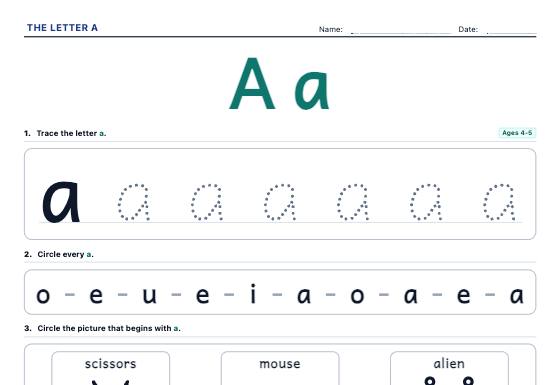
One sheet per letter or number: trace it, circle it among others, find the picture that begins with it and build the word by cutting out or writing, ages 4 to 7, with an answer key.
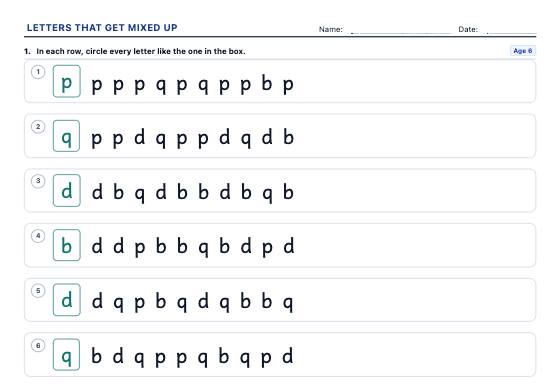
Letters that get mixed up: find b, d, p and q, complete picture words, spot backwards letters and numbers and match strings of similar letters, ages 5 to 8, with an answer key.
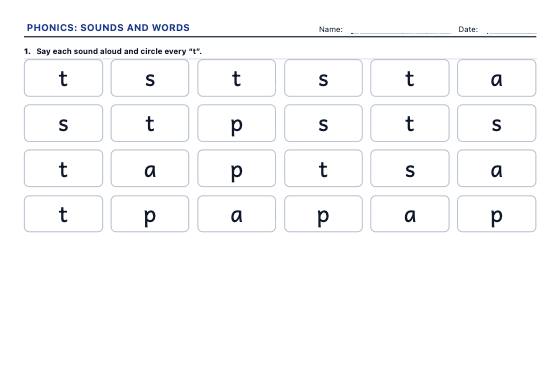
Phonics worksheets with sound buttons: read the sounds, blend them into words, fill in the missing sound and count the sounds, using only the graphemes already taught.
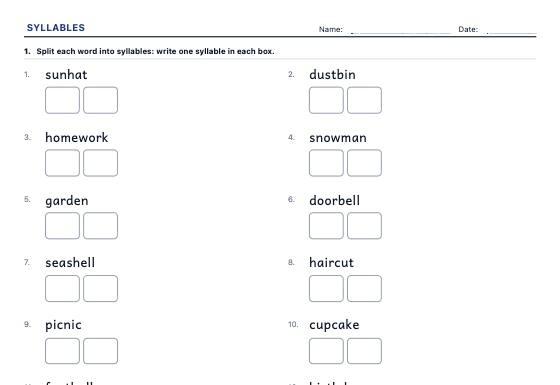
Real words to split into syllables, clap and count, build from their syllables, sort by number of syllables and find the stressed syllable, from compound words to long words.
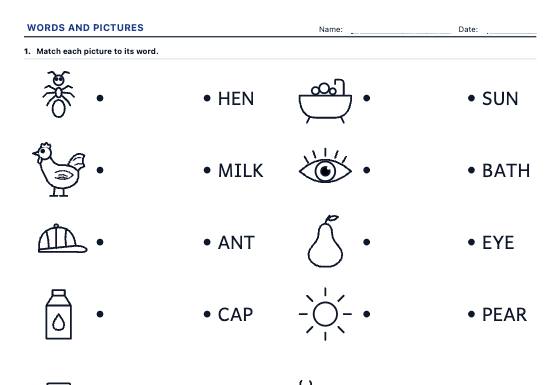
Match each picture to its word, circle it and write it, and match capital and lowercase letters and print to cursive, with over 130 pictures and English words.
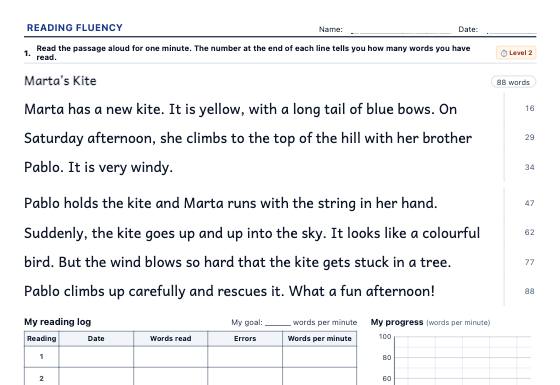
Word lists and timed passages, all original, to read aloud, with a running word count on every line, a words per minute log and a progress graph.
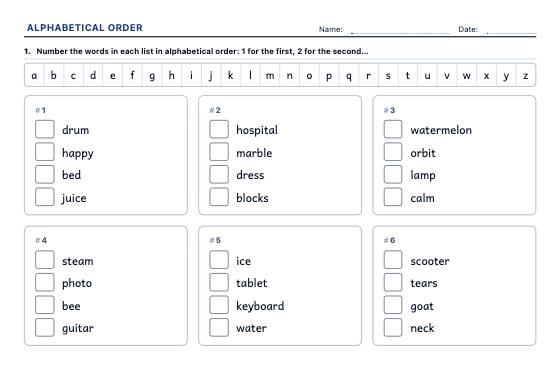
Lists of real words to put in alphabetical order by the first, second or third letter: number them, write them in order or circle the one that comes first, with the deciding letter in the answer key.
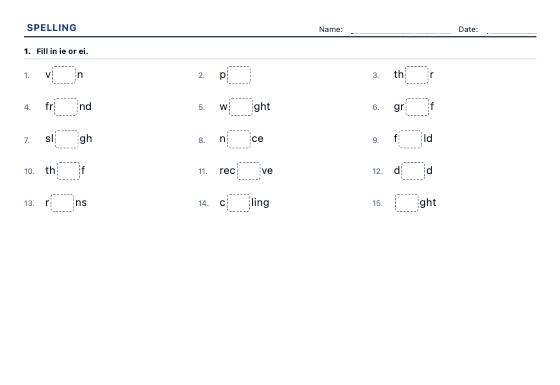
Words to fill in with the right letters, choose between two spellings or sort into columns: ie/ei, silent letters, double consonants, -tion/-sion, c/k/ck and homophones.
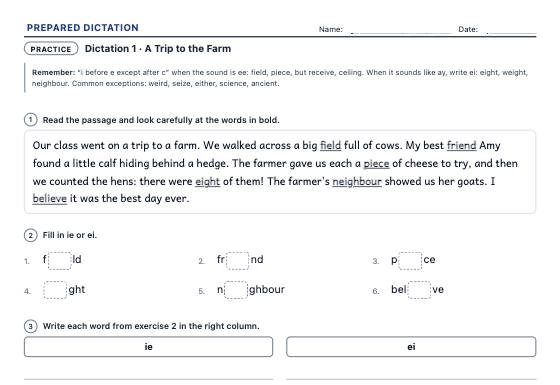
Original passages for each spelling pattern: a practice sheet with the key words to fill in and sort, a dictation sheet and the teacher's text to read aloud.
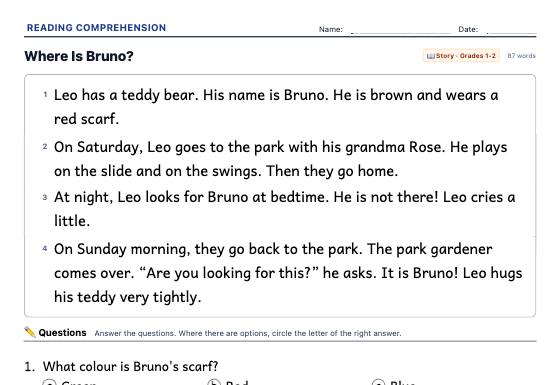
Worksheets with original passages levelled by grade (stories, information, everyday and opinion texts, multiple sources and non-continuous texts), literal, inference, vocabulary and evaluation questions and lined space to answer.
Pre-writing patterns, handwriting on guide lines and number tracing with the stroke order marked. For dysgraphia and for any child who needs more pencil practice.
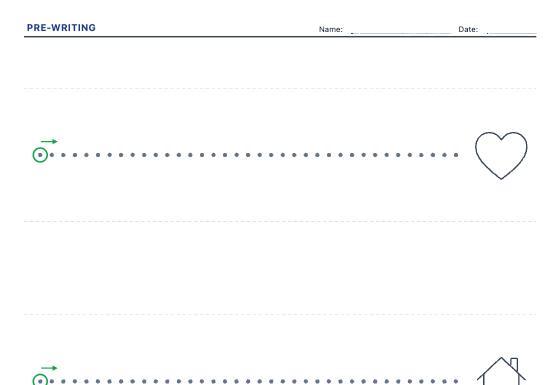
Pre-writing worksheets with dotted strokes to trace: straight lines, zigzags, waves, loops and spirals, with a start dot and graded sizes.
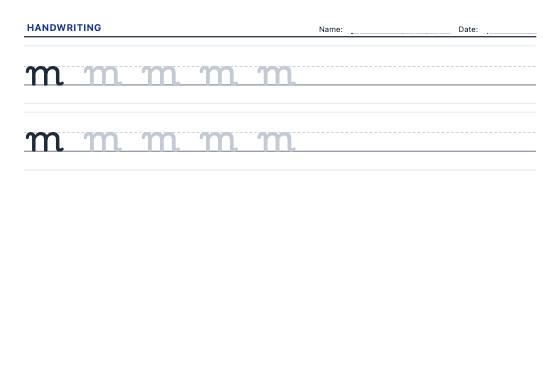
Create A4 handwriting worksheets with letters, words, sentences or your own text to trace and copy, in cursive or print, on Montessori, double, grid or single lines.
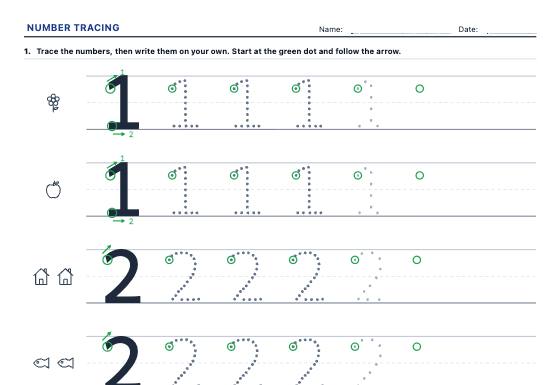
A4 sheets to learn to write the numbers 0 to 20: a model with start dots and arrows, dotted copies that fade, a picture to count and, at the small size, the number word.
Counting with ten frames, comparing quantities, the number line, base ten blocks, the hundred square and mental maths with number bonds. Visual material that shows the quantity before the symbol.
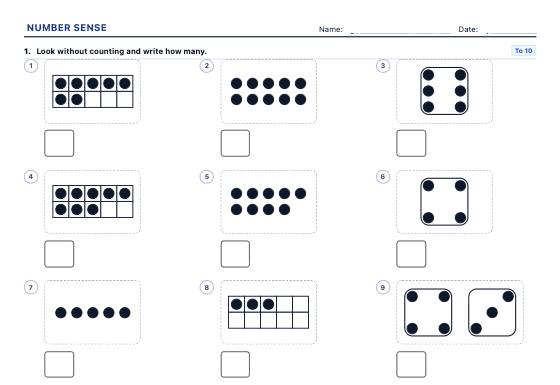
Number sense to 5, 10 and 20: how many at a glance (dice, ten frames, rows of five), amount, numeral and word, which has more, number bonds and number lines without numbers, with answers.
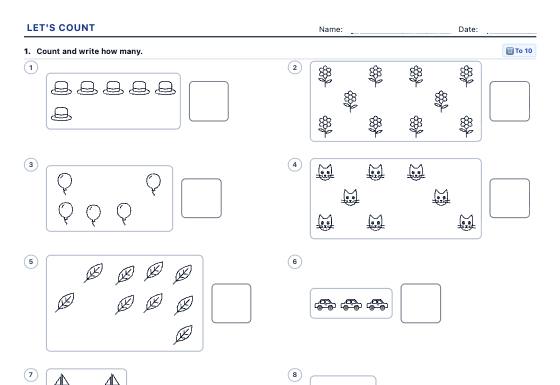
Count and write, circle the number, match each group to its number, draw and colour as many as the number shows and ten frames, with pictures to colour and an answer key.
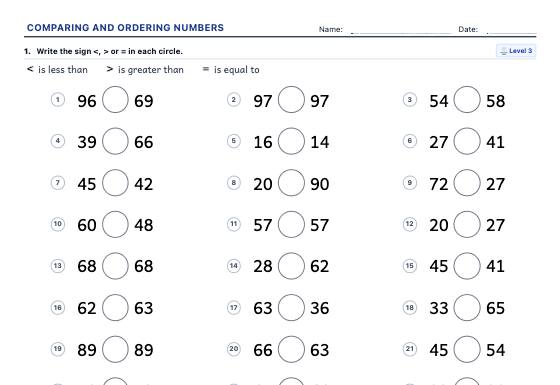
A4 worksheets to compare numbers with the signs <, > and =, compare calculations, order from smallest to greatest, find the greatest and smallest and the numbers in between, 10 to 999,999.
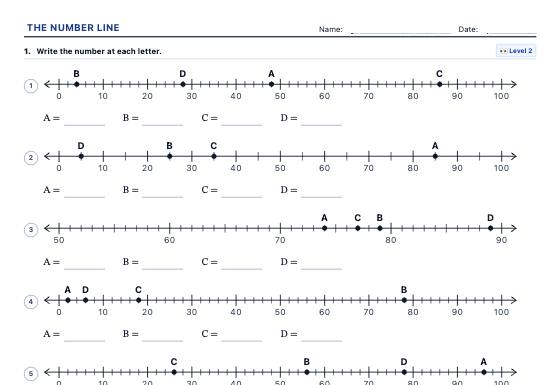
A4 number line worksheets: read and place numbers to 1000, add and subtract in jumps, multiply with equal jumps, negative numbers either side of zero and fractions on a number line.
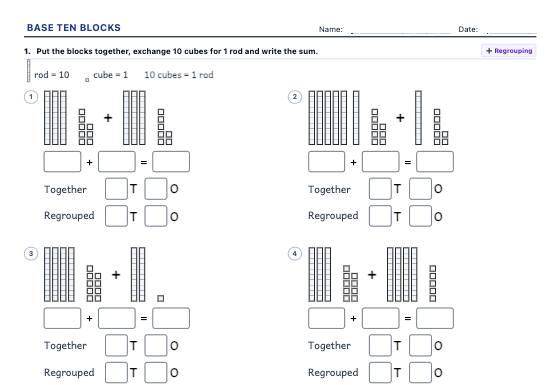
A4 base ten blocks worksheets: read and draw numbers with flats, rods and cubes, regroup, compare, add and subtract with blocks and show a number in different ways, up to 999 with an answer key.
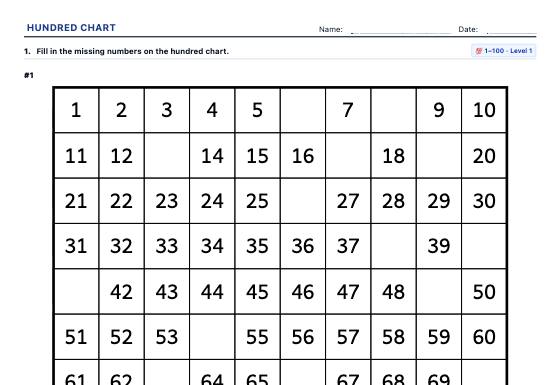
A4 hundred chart worksheets: missing numbers, chart pieces, neighbours (+1, −1, +10, −10), skip counting and colouring patterns, in three levels with an answer key.
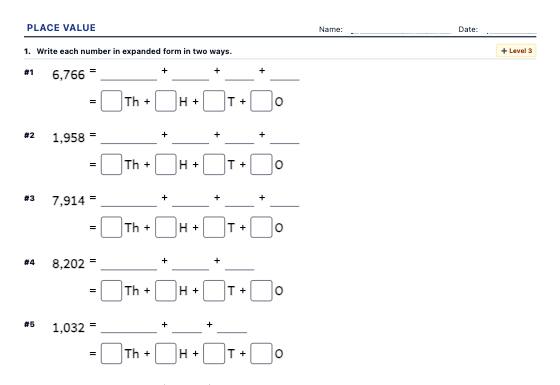
A4 place value worksheets: base ten blocks, place value charts, expanded form, building numbers, the value of a digit and numbers in words, up to 999,999 with an answer key.
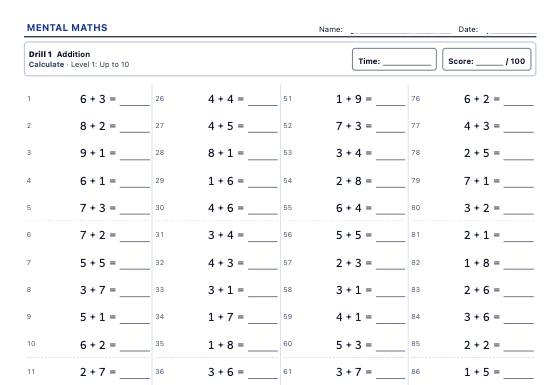
Drills of 50 to 100 quick facts in line with time and score boxes: addition, subtraction, number bonds to 10 and 100, ± 10, doubles and halves, times tables and × 10, 100 and 1000.
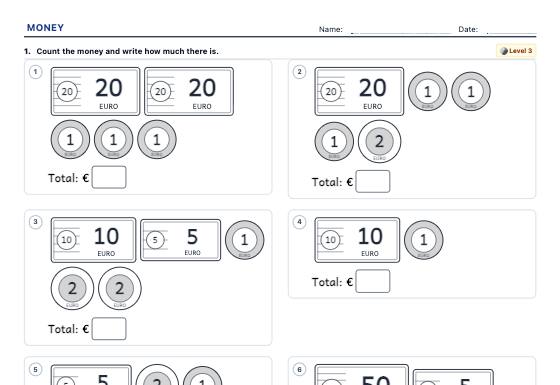
A4 worksheets with drawn euro coins and notes to count money, pay a price with the fewest pieces, compare purses, work out the change and solve shopping problems.
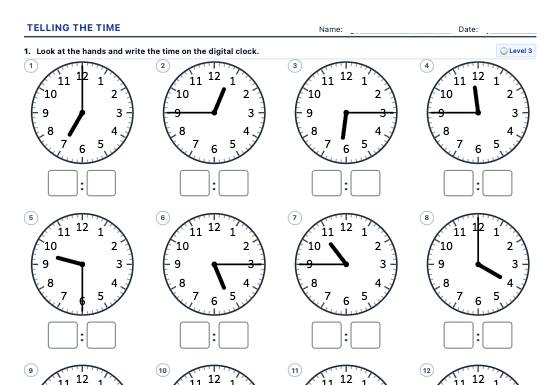
A4 worksheets for telling the time: read analogue clocks, draw the hands, the time in words (quarter past, half past, quarter to), what time it will be and the 24-hour clock.
Recognising and naming emotions in faces and situations, the emotion wheel, a daily feelings check-in, the feelings thermometer, a calm-down menu, self-esteem sheets, social skills with made-to-measure social narratives and traffic-light and self-assessment cards to say how learning is going.
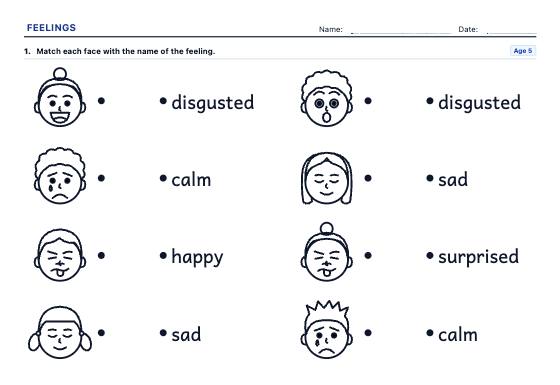
Feelings with drawn faces: match faces that feel the same or with their names, how would you feel in everyday situations, draw a feeling, an emotion wheel to colour and a daily check-in, with an answer key.
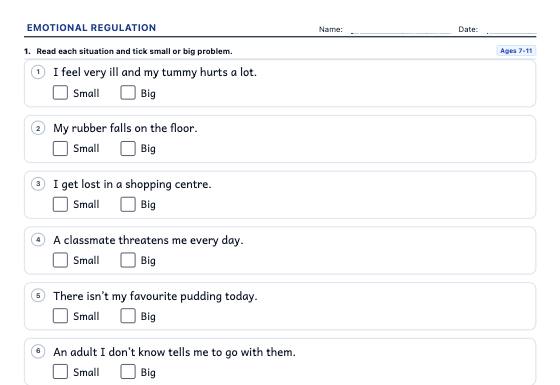
Emotional regulation: big or small problem, a feelings thermometer, where I feel it, a calm-down menu and my plan for anger, fear, sadness or worry, ages 5 to 14.
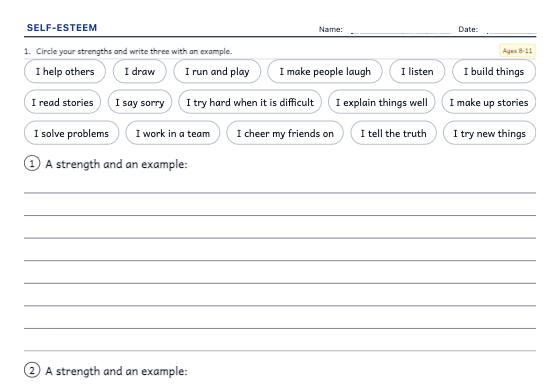
Self-esteem: all about me, my strengths, cards for classmates to say what they value, things I am proud of, kind self-talk, a gratitude journal and a goal in small steps, ages 6 to 16.
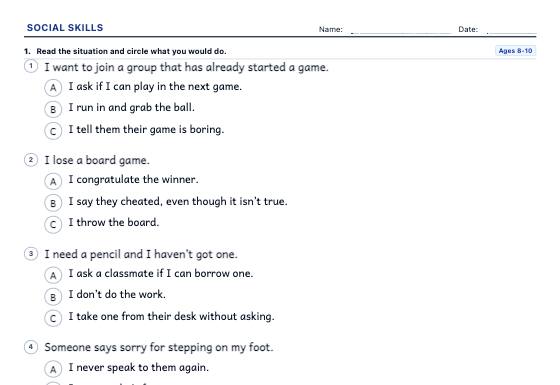
Social skills: what would you do with three options, what each one thinks and feels, conversation steps, solving a conflict and personalised social narratives, ages 5 to 14, with answers.
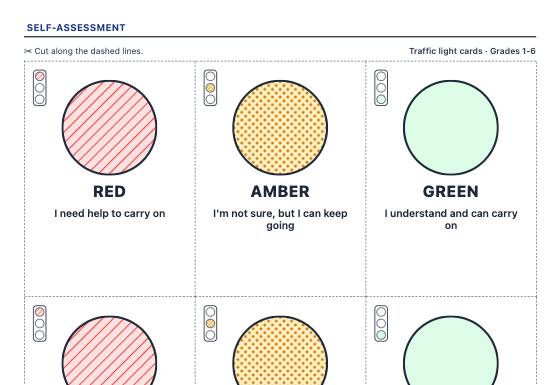
Self-assessment cards to cut out: traffic lights, a 3 or 5 face scale, exit tickets (rating, I learned and I wonder, 3-2-1), a learning target ladder, "I can" checklists with your own statements and group work.
Visual schedules with picture symbols, ordering the parts of the day, the days of the week and visual timetables to know what comes next, plus token boards, first-then boards and behaviour charts. They help any child who needs to know what happens after this.
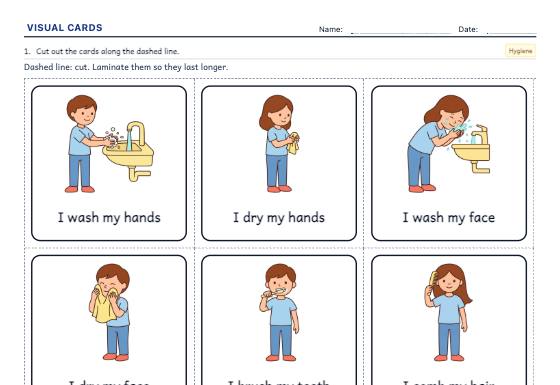
Printable visual cards by topic (hygiene, the toilet, getting dressed, eating, school and bedtime): cards to cut out, steps in order, first-then and choice boards, with a child doing each action and the sentence in the first person.
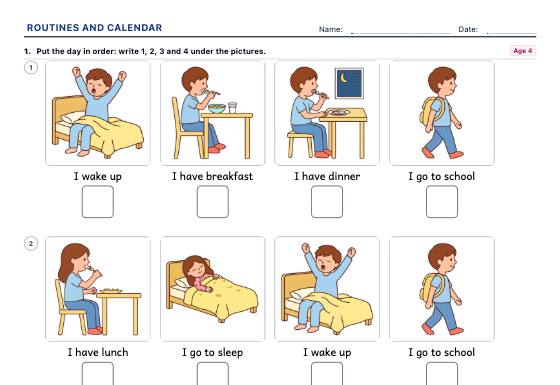
Visual schedules for morning, school, afternoon and bedtime routines, a "Today is" circle time board, the real calendar of any month, ordering the day and the days of the week.
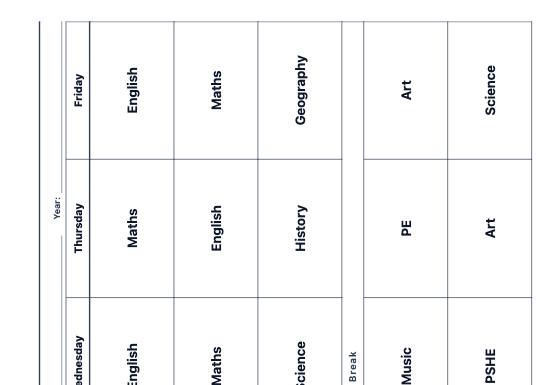
Editable weekly timetables (subjects, times, breaks and days) to put up in class, blank for pupils or visual with frames for picture symbols, and weekly and daily lesson planner sheets for the teacher.
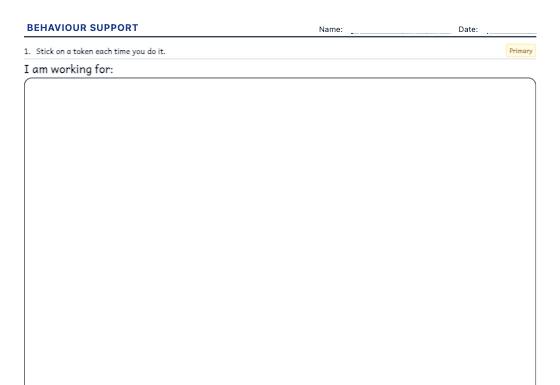
Positive behaviour support: token boards of 3, 5 or 10 tokens, reward charts, first-then boards, behaviour contracts, self-monitoring checklists and an ABC chart, with your own targets, ages 3 to 14.
Basic concepts such as in and out or big and small, putting words in order to build sentences, word families, synonyms and antonyms. To back up speech and language work.
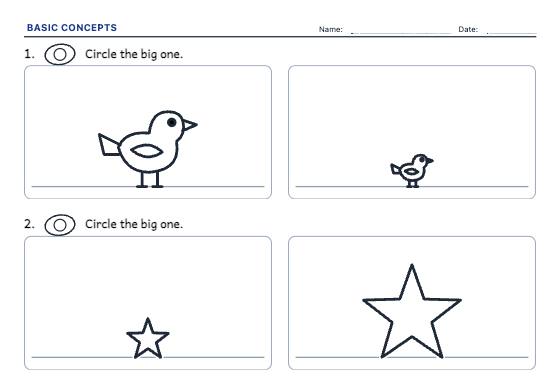
Opposites worksheets for ages 3 to 5: big and small, long and short, tall and short, on and under, inside and outside, in front and behind, near and far, many and few, full and empty. To circle, colour, cross out or draw.
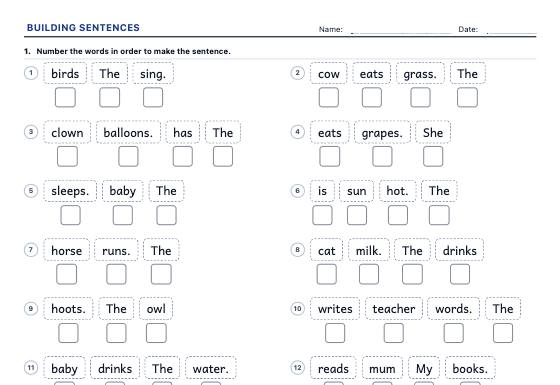
Scrambled sentences to number and unscramble the words, write the sentence with a capital letter and a full stop, pick the right order and count the words.
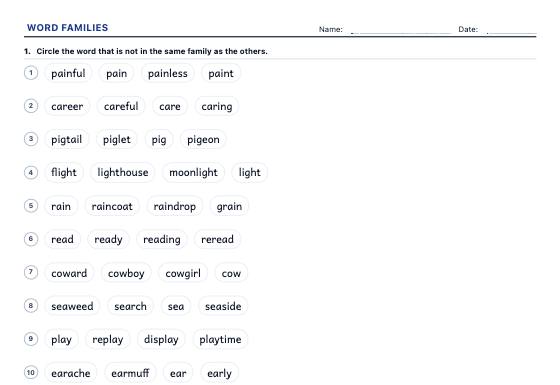
Odd one out, sort into families, write the family, split and build words with prefixes and suffixes and choose their meaning, with a levelled bank of English word families and affixes.
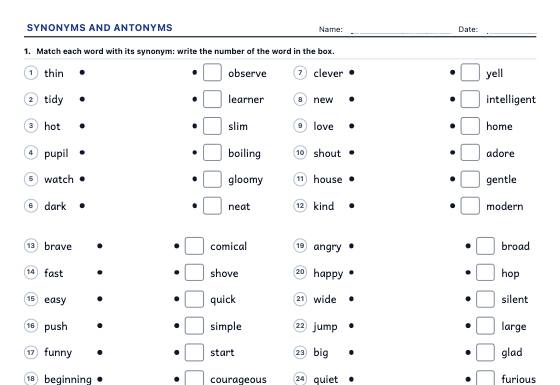
Match pairs, circle the synonym or antonym, write the opposite, replace the word in a sentence and sort pairs, with a levelled dictionary of English synonyms and antonyms.
Every LearnKits worksheet is made in the same editor, so these options work for all of them.
Every generator has difficulty levels and many have a custom level: you choose the size of the numbers, how many words or how many items.
Choose how many exercises to print and leave more room for each. With “each exercise on a new sheet”, the child sees one task at a time.
The support setting spaces out instructions and texts, puts a picture of the action on each instruction and colours the syllables. The vision setting prints larger, in black, in very legible type.
Put exercises from different generators on the same worksheet: for example a maze, some syllables and a face to name the emotion.
Save the session as a template in your browser and next week generate it again with new exercises and the same structure.
Most worksheets print their answers, which children can also use to check their own work.
Short, frequent sessions with a task the child can finish successfully.
Choose the worksheet type and the level where the child is almost always right, and move up a level when they find it easy.
Two or three different exercises of a few minutes each work better than a long sheet of one kind.
Generate the same worksheet again with other exercises. They practise the skill, not memorise the answers.
They are practice worksheets like the ones many professionals use in their sessions: syllable awareness, visual discrimination, visual schedules or emotions. They are not a treatment and do not replace a specialist’s intervention: whoever knows the child decides what to practise, how much and how.
No. They are not standardised tests, have no norms and do not imitate any test. They are for practice and, at most, for seeing how a child works. Assessment is for professionals with validated tests.
Choose the level by what they can do, not by their year group, and cut down the number of exercises. In the page settings, learning support spaces out instructions, adds a picture of the action, colours the syllables of reading texts and puts each exercise on a new sheet; the vision setting prints larger in very legible type.
Yes. Levels describe the content, not the age. A Year 5 child can work on the syllables or counting level they need, and you choose the worksheet’s title.
No. Worksheets are generated in your browser and templates are only saved there. No names or data about your pupils are sent to our servers.
Yes, every worksheet and its answers are free and no sign-up is needed. LearnKits Pro removes the watermark from the worksheets.
LearnKits provides educational practice and support material. It is not a clinical service and does not replace a professional’s diagnosis or intervention.
Choose the need, the worksheet type and the level. Print the worksheet and its answers.