Blank table to complete
Blank cells with the atomic number (or completely empty) to write in the symbol and name. The whole table is printed in landscape so the cells are large enough to write in.
Reading the periodic table is the foundation of all school chemistry. This free periodic table worksheet generator creates A4 blank tables to complete, symbol and name lists, group and period data tables, clue puzzles and metal and non-metal sorting, plus atomic structure (protons, neutrons and electrons, ions and isotopes, Bohr models, electron configuration and valence), always with an answer key. Every exercise comes out different, and you can combine several on the same worksheet.
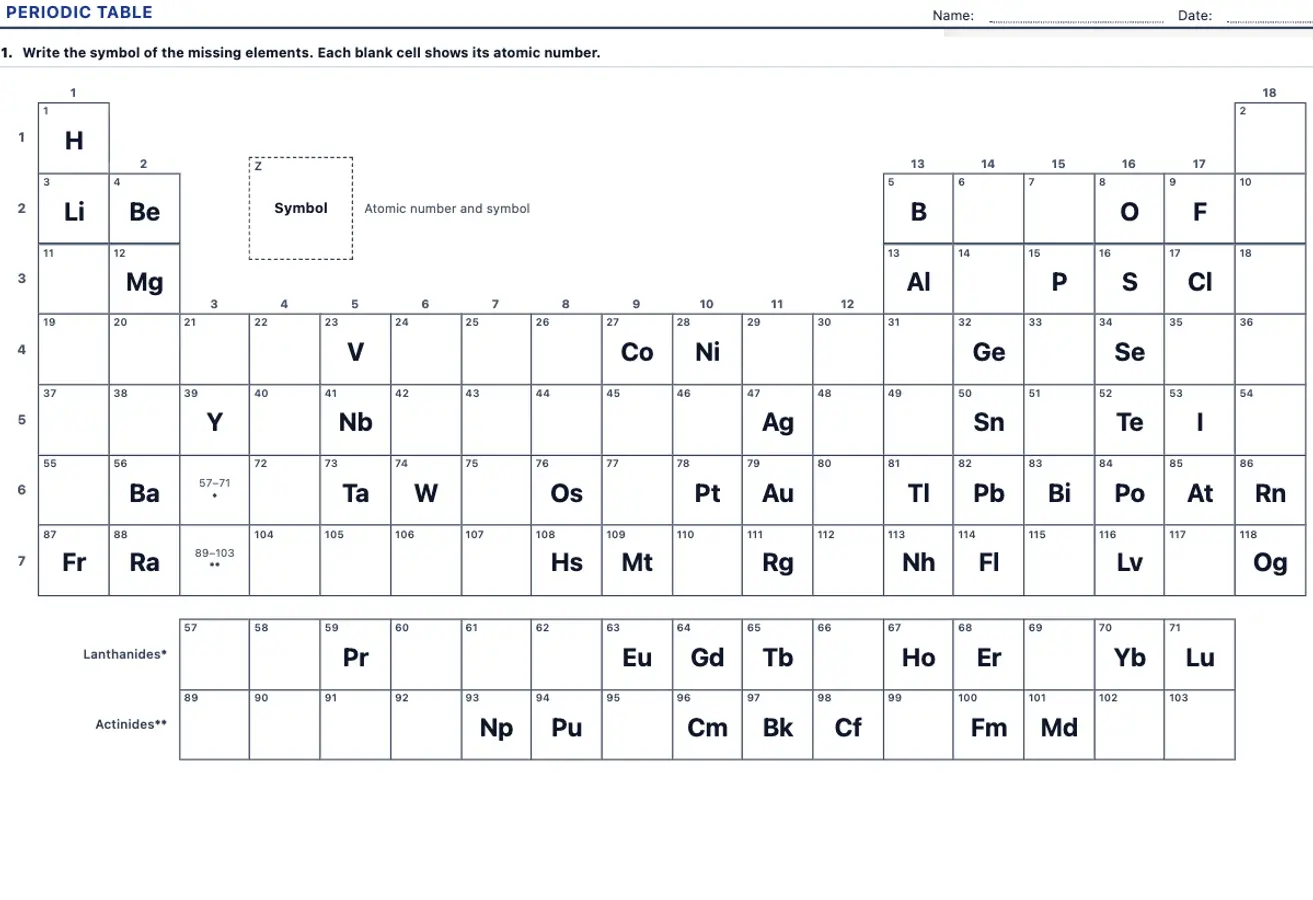 Student worksheet
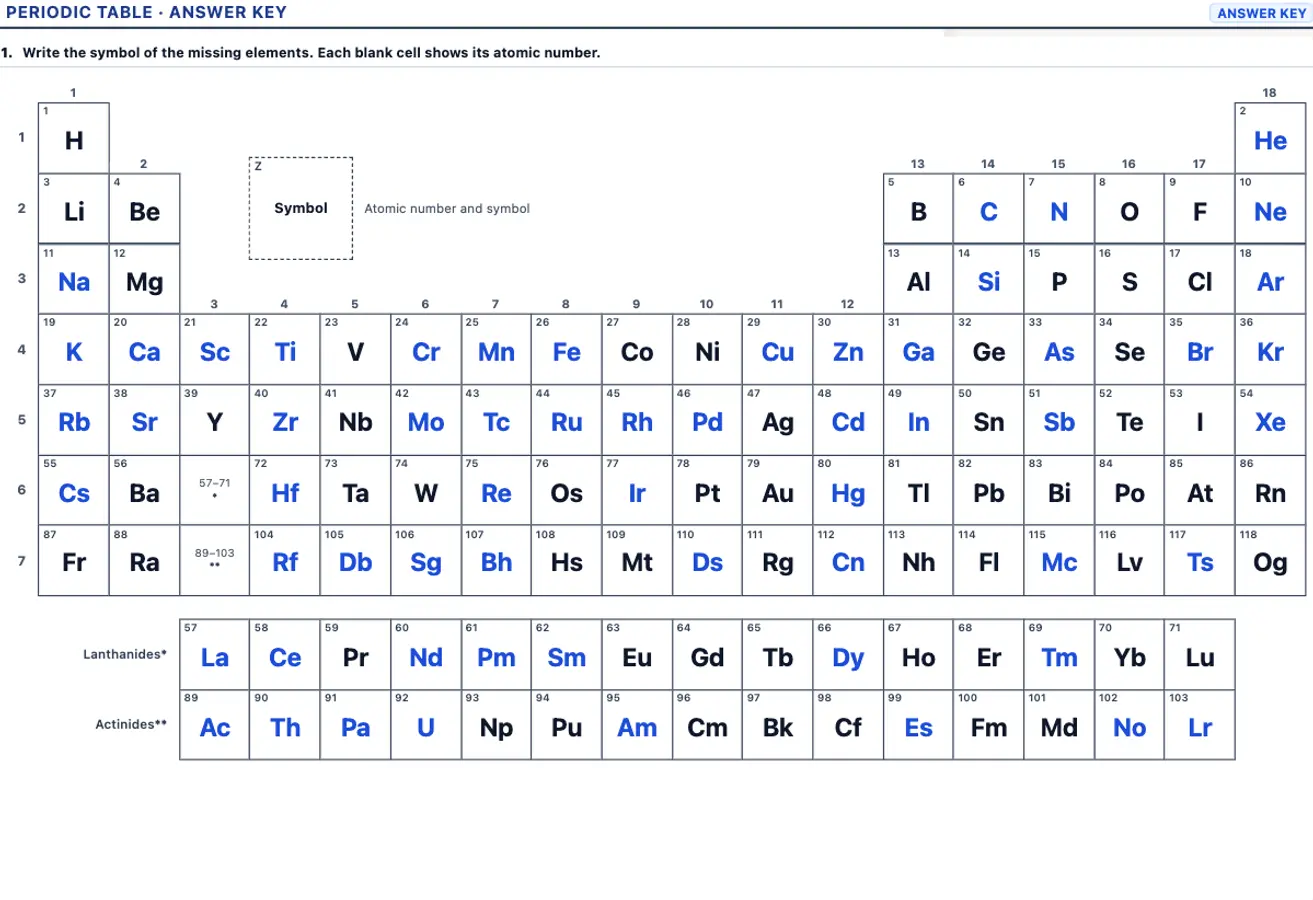 Answer key
Blank cells with the atomic number (or completely empty) to write in the symbol and name. The whole table is printed in landscape so the cells are large enough to write in.
From name to symbol and symbol to name, mixed or one way only. Ideal for short memory quizzes at the start of a lesson.
Each row gives one fact about the element and students fill in the atomic number, symbol, name, group and period.
Clues such as “Group 17, period 3” or “Period 4, alkali metals”: students use the table like a coordinate map.
Sorting into metals, non-metals, metalloids and noble gases with tick boxes, so it prints well in black and white.
The first 20 elements, the main groups, and the whole table with the transition metals, lanthanides and actinides.
Particle tables from the symbol and mass number, with ions (the electrons depend on the charge) and isotopes. At level 3 each row gives different data and students work out the rest.
Cation, anion or neutral atom from the protons and electrons, the ion each main group element forms to match the nearest noble gas, and pairs of nuclei to decide whether they are isotopes.
Draw the electrons in their shells (2, 8, 8, 2) or read a drawn model, write configurations as shells or as sublevels in the aufbau order up to krypton, and find the valence electrons, period and group.
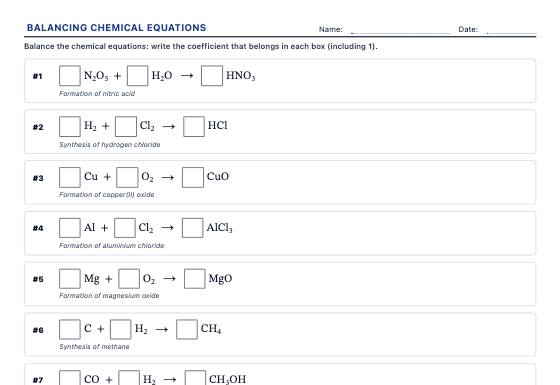
Real reactions to balance with coefficient boxes and an atom-count table, from simple formulas to groups in brackets, hydrates and large coefficients, with an answer key that checks every element.
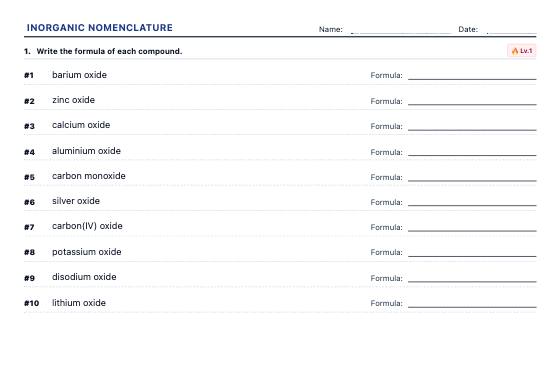
Worksheets to write formulas and name oxides, peroxides, hydrides, hydracids, binary salts, hydroxides, oxoacids and oxosalts, with stoichiometric, Stock and traditional names and an answer key with every name.
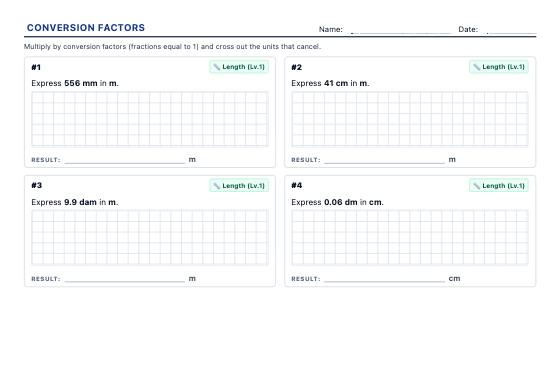
Unit conversion worksheets using chained conversion factors: length, mass, time, speed, density, area and volume, with scientific notation and a step-by-step answer key.