Types of angles
Acute, right and obtuse in Grade 4; the straight angle in Grade 5; reflex angles and the full turn in Grade 6. Each angle is classified by eye, without measuring.
Knowing what an angle is, measuring it with a protractor and working out missing angles are steps of geometry taught from Grade 4 to Grade 7 (Years 5 to 8). This free angles worksheet generator builds A4 worksheets with angles drawn to true size to classify them, read a protractor, measure and draw them, work out complements and supplements and find missing angles on straight lines, around a point and in triangles, with an answer key.
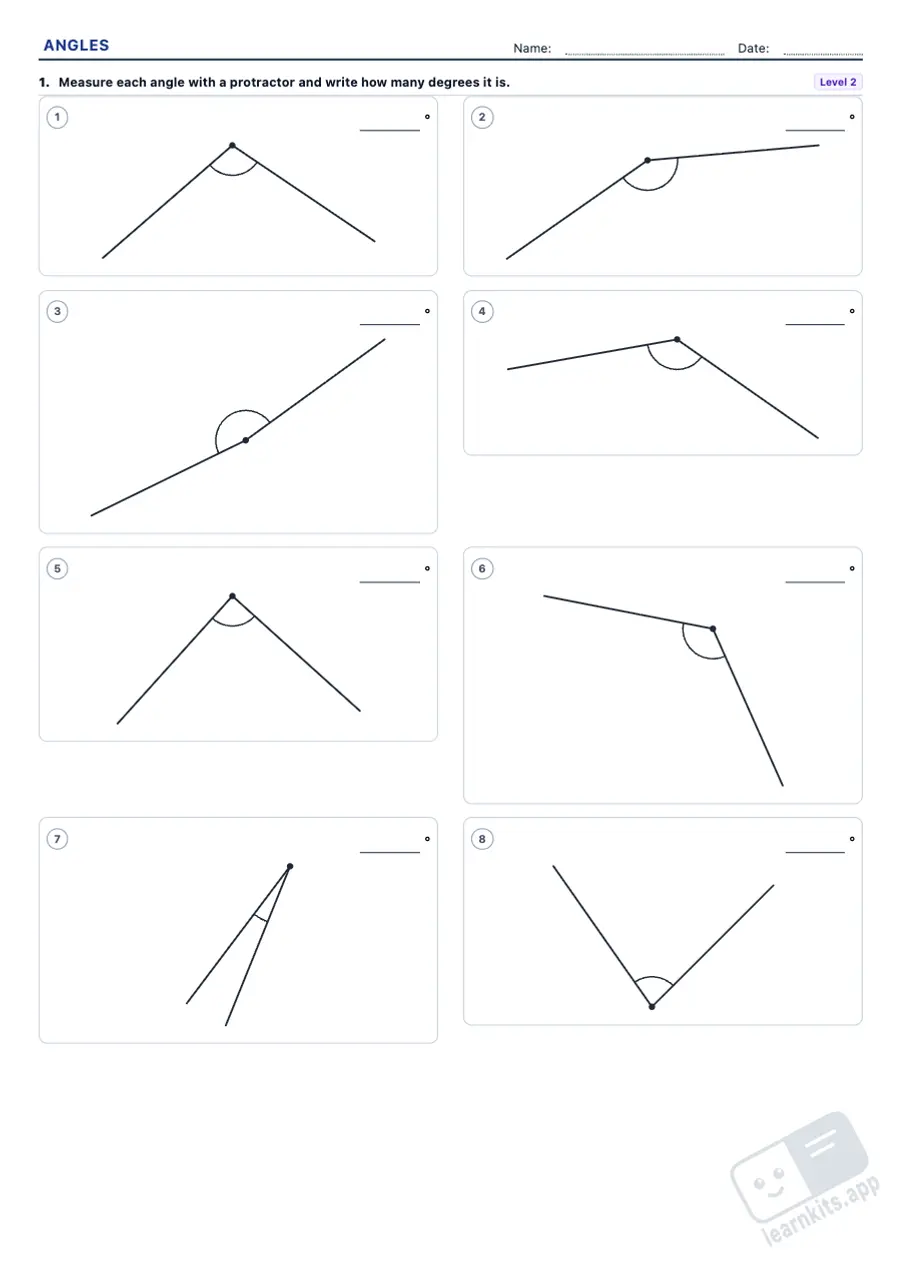 Student worksheet
 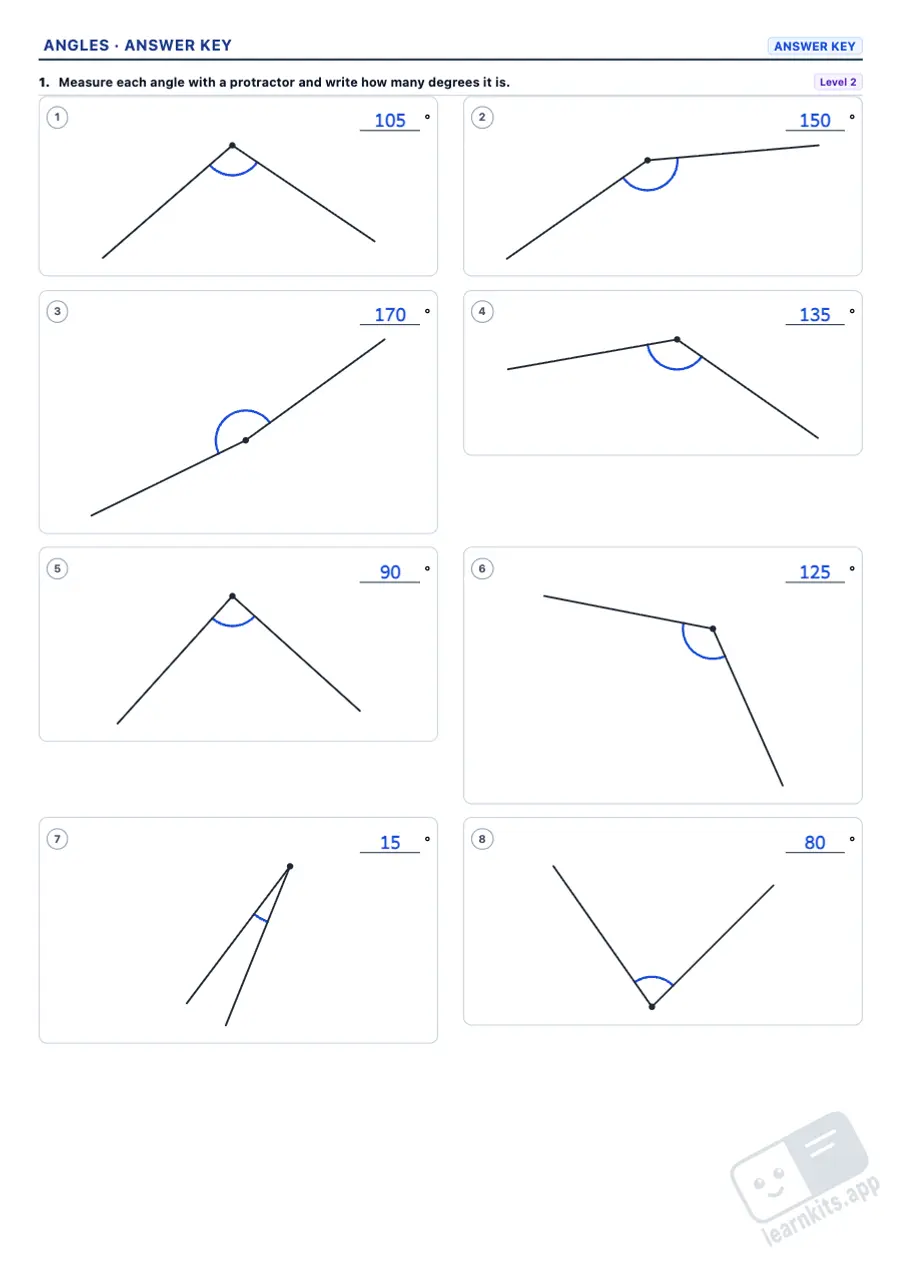 Answer key
 Acute, right and obtuse in Grade 4; the straight angle in Grade 5; reflex angles and the full turn in Grade 6. Each angle is classified by eye, without measuring.
A drawn protractor with both scales. The most common mistake is reading the wrong scale, so level 2 puts the arm on one 0 or on the other.
Angles print at true size with 4 cm arms, to be measured with the class protractor. At level 3, reflex angles are measured by taking the other angle from 360°.
The vertex and one arm are given; pupils line up the protractor, mark the degrees and draw the other arm. The answer key draws it in blue.
The complement of an angle is what it needs to make 90°, the supplement what it needs to make 180°. In Grade 7, in degrees and minutes: 89° 60′ − 47° 25′ = 42° 35′.
Angles on a straight line, around a point, vertically opposite and in triangles. Diagrams are drawn to scale, but the angles are worked out with the right angle fact.
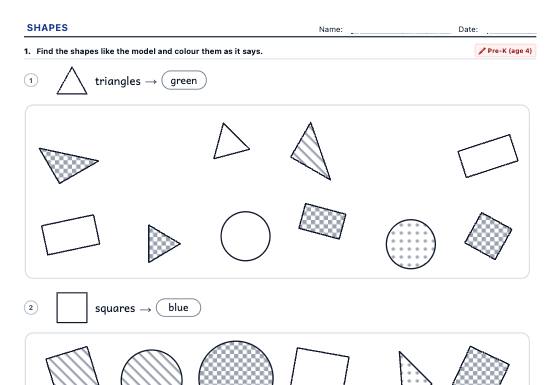
Shapes worksheets: colour the ones like the model, count them in a table, match them to their names, trace them and find them in a picture, from circles, squares and triangles to pentagons and first 3D shapes.
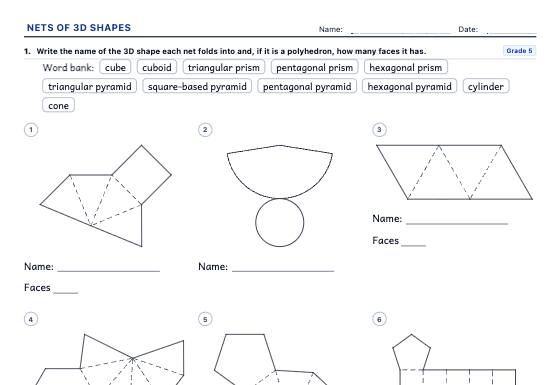
Printable nets to cut out and fold prisms, pyramids, cylinders and cones, nets to name, shapes that fold into a cube, opposite faces of a dice and surface area from a net.
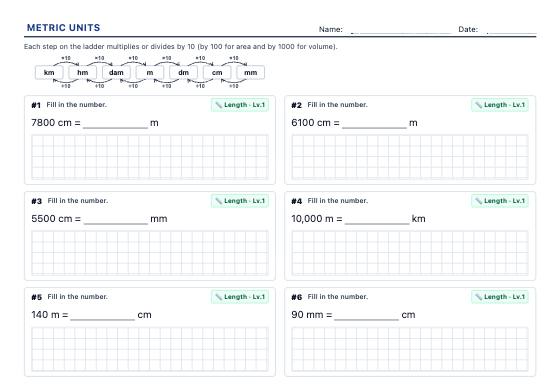
Metric conversion worksheets: length, mass, capacity, area and volume, with mixed units, comparing and ordering, and an answer key showing how the decimal point moves.