The hypotenuse
x² = 12² + 5² = 144 + 25 = 169, x = √169 = 13 cm. Level 1 uses Pythagorean triples, level 2 lengths with decimals and level 3 roots that are not exact, rounded.
In a right-angled triangle, the square of the hypotenuse equals the sum of the squares of the other two sides. This free Pythagorean theorem worksheet generator builds A4 worksheets with triangles and shapes drawn to scale, to find the hypotenuse and the shorter sides, test whether a triangle is right-angled, use the theorem in rectangles, rhombuses, triangles and trapeziums, solve word problems and understand the picture of squares on the sides. For Grades 8 and 9, with an answer key that shows every step.
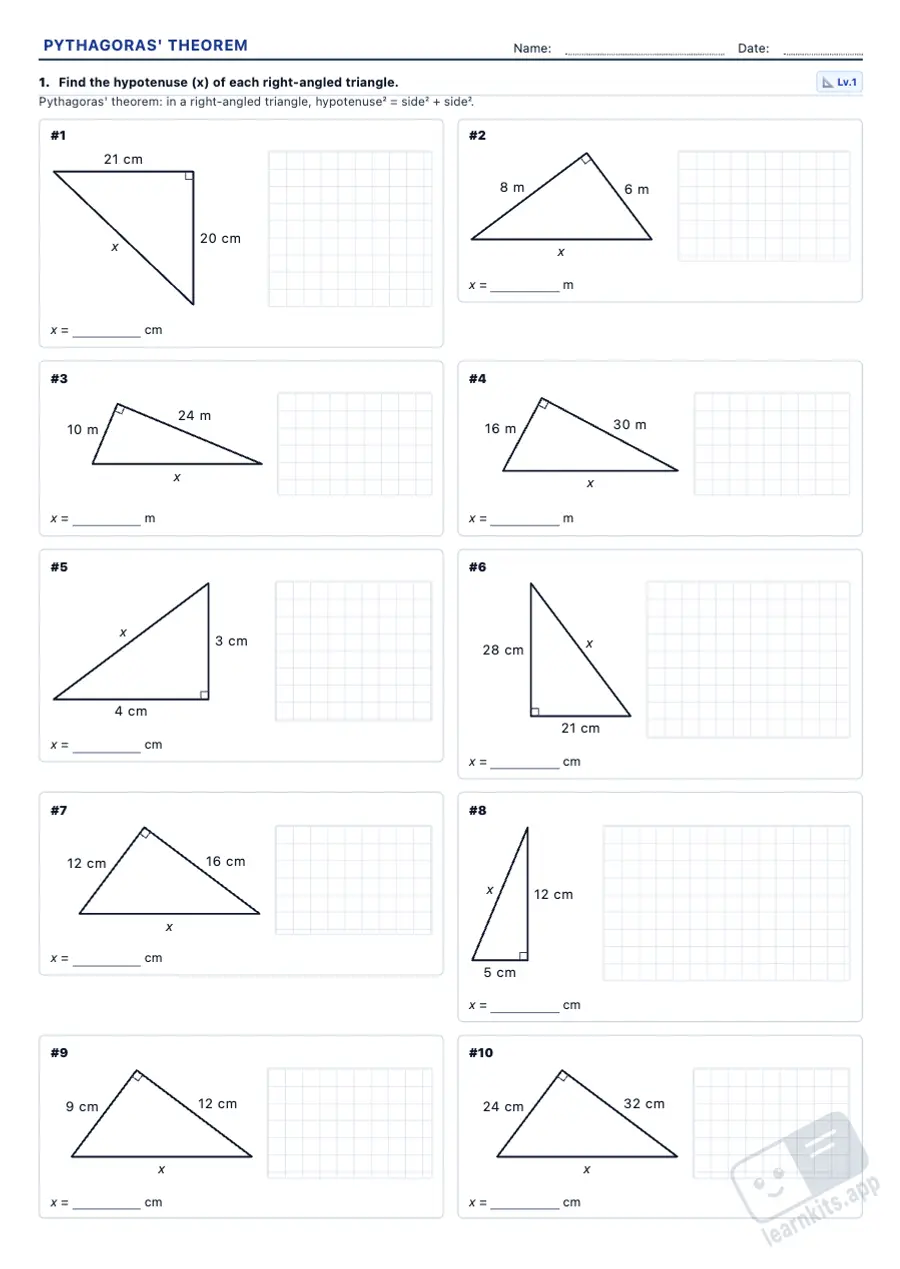 Student worksheet
 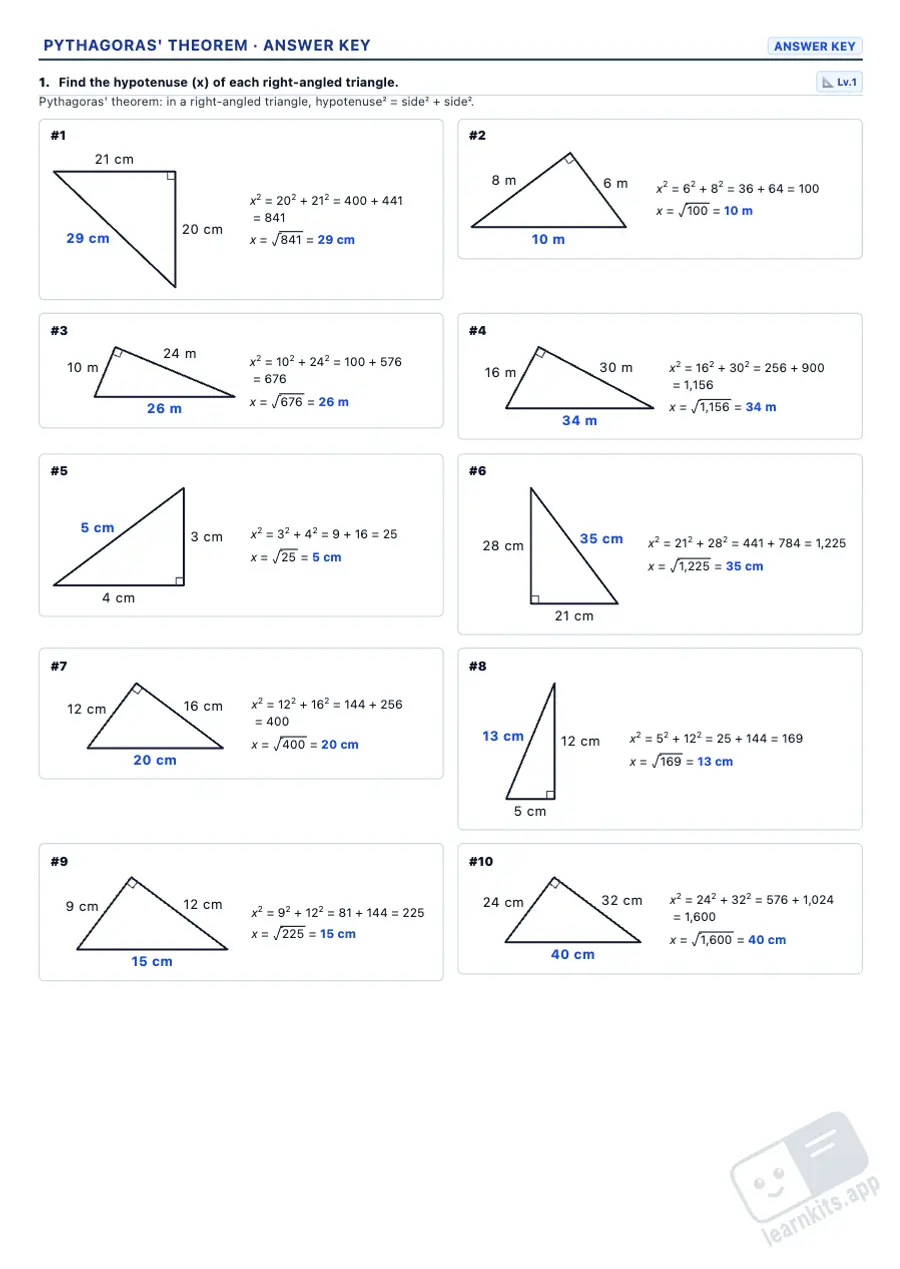 Answer key
 x² = 12² + 5² = 144 + 25 = 169, x = √169 = 13 cm. Level 1 uses Pythagorean triples, level 2 lengths with decimals and level 3 roots that are not exact, rounded.
When the hypotenuse is known, the missing side is the root of the difference: 13² = x² + 5², x² = 169 − 25 = 144, x = 12 cm.
The converse of the theorem: compare the square of the longest side with the sum of the squares of the other two. Near misses (6, 8, 11) make pupils calculate; at level 3, acute, right or obtuse.
The diagonal of a rectangle, the height of an isosceles or equilateral triangle, the side of a rhombus from half its diagonals and the slanted side of a trapezium: the answer key marks the right-angled triangle in each shape.
Ladders, screens, ramps, kites and short cuts: pupils sketch the triangle, decide whether the hypotenuse or a shorter side is unknown and interpret the answer.
The classic picture of the theorem: the areas of the squares on the two shorter sides add up to the area of the square on the hypotenuse. A good way in before the formula.
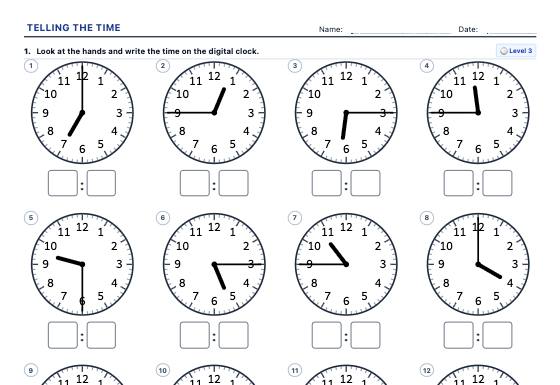
A4 worksheets for telling the time: read analogue clocks, draw the hands, the time in words (quarter past, half past, quarter to), what time it will be and the 24-hour clock.
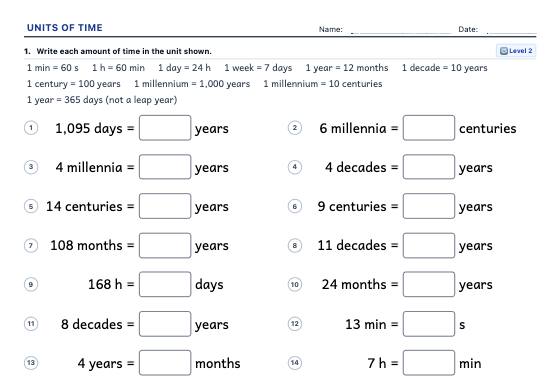
A4 worksheets to convert units of time (hours, minutes, seconds, days, weeks, years and centuries), write times in mixed units, add and subtract times in columns and solve timetable problems.
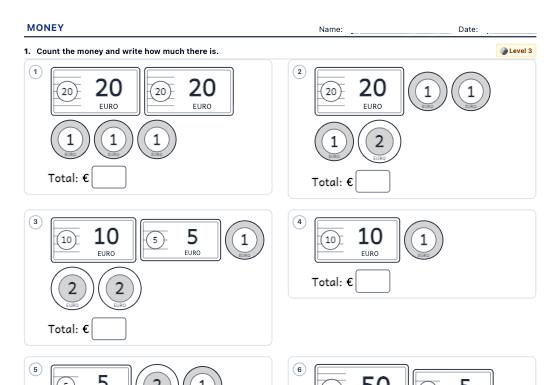
A4 worksheets with drawn euro coins and notes to count money, pay a price with the fewest pieces, compare purses, work out the change and solve shopping problems.