Perpendicular bisector and midpoint
Two arcs of the same radius from A and from B cross on both sides of the segment: the line through the crossings is the perpendicular bisector. Level 3 divides the segment into four parts.
Constructing a perpendicular bisector, an angle bisector or a parallel line with a compass is the base of geometric drawing taught from Grade 6 to Grade 8 (Years 7 to 9). This free geometric constructions worksheet generator builds A4 worksheets with the data drawn to true size, the room each construction needs and a measurement to check it, with an answer key that draws every arc.
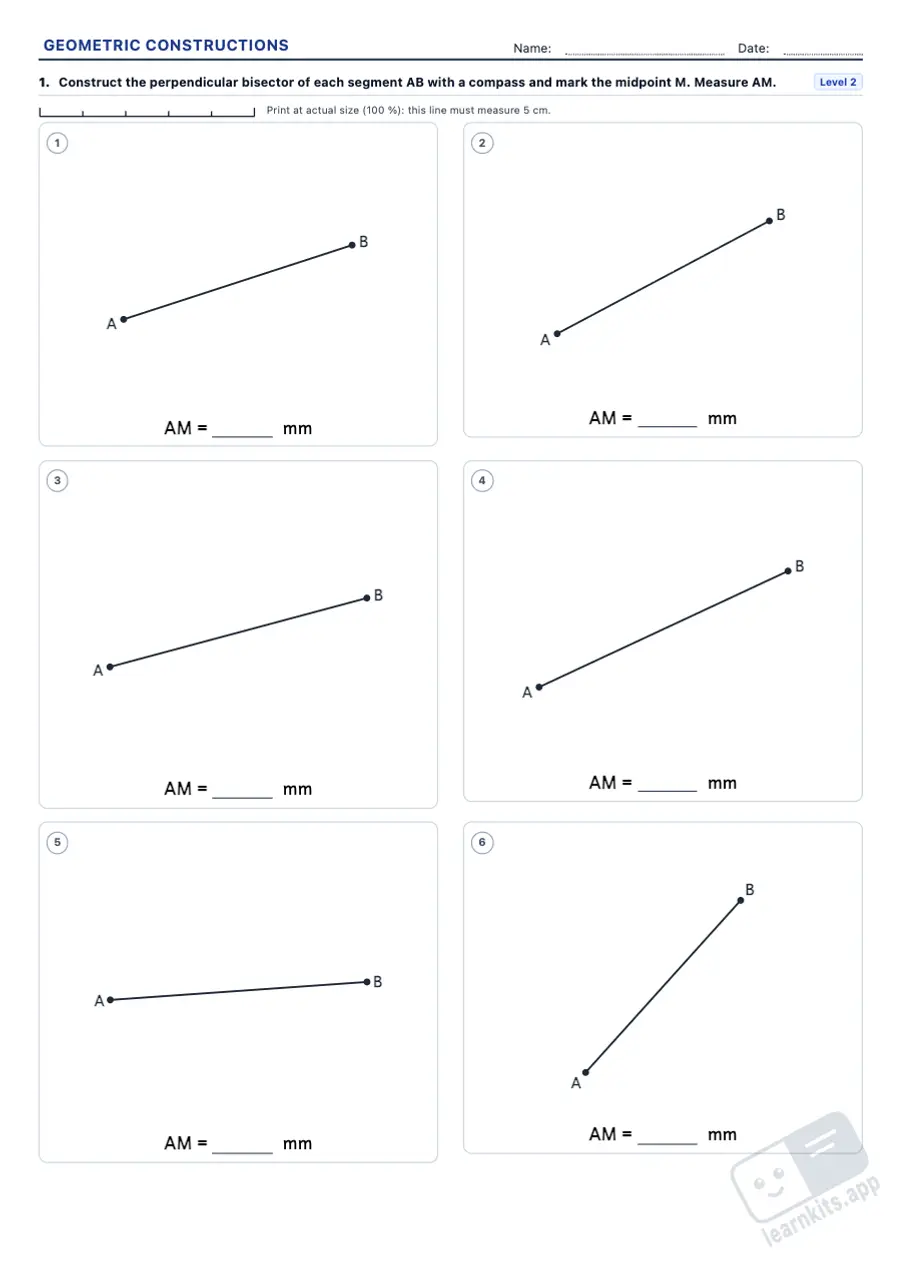 Student worksheet
 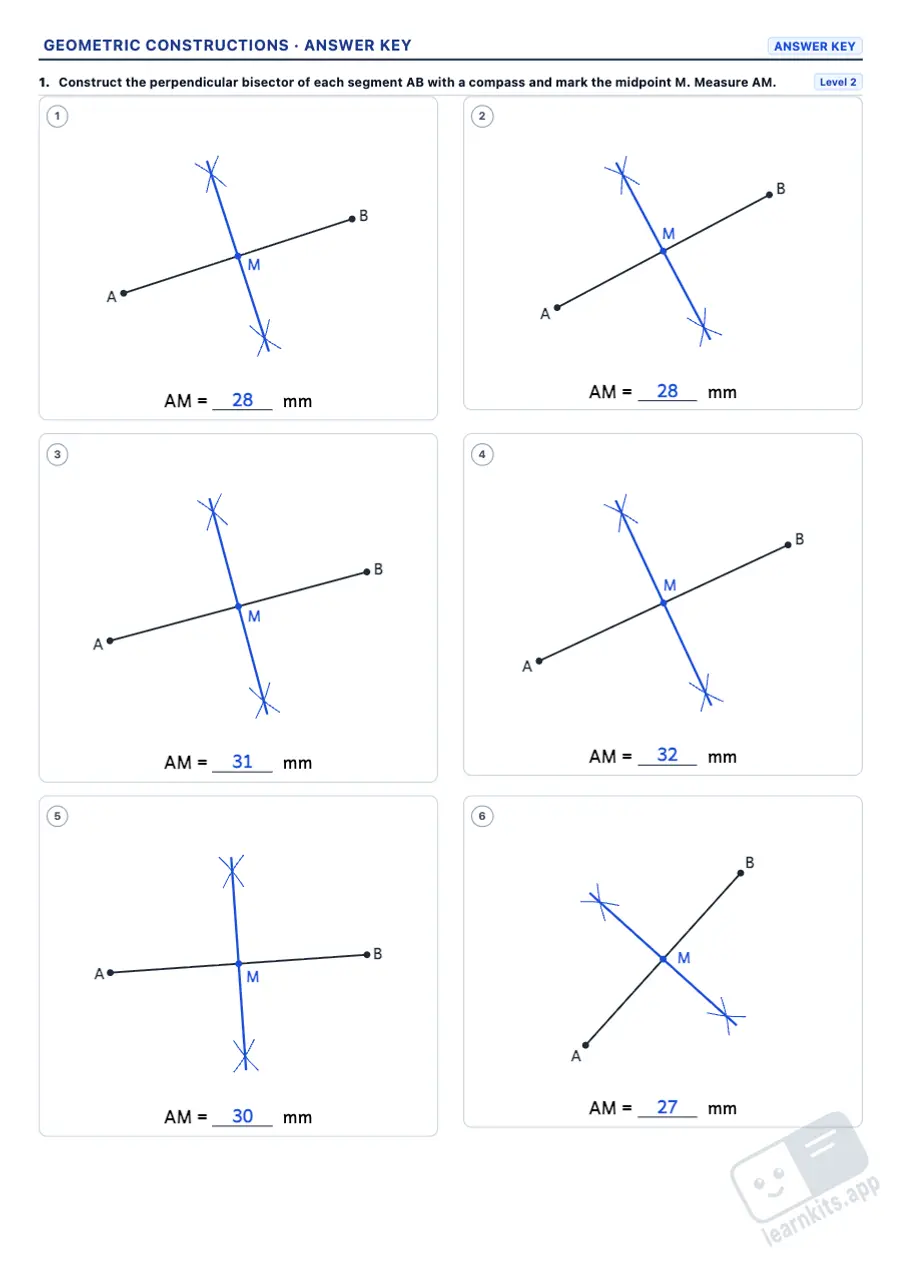 Answer key
 Two arcs of the same radius from A and from B cross on both sides of the segment: the line through the crossings is the perpendicular bisector. Level 3 divides the segment into four parts.
An arc from the vertex cuts both arms; two equal arcs from those points mark the bisector. Each half is checked with a protractor.
The perpendicular from a point on the line or off it, with its foot H and the distance, and the parallel by the rhombus method. Level 3 builds a square and a parallelogram.
Copying an angle onto a ray with a compass, and adding two angles by placing one next to the other.
From three sides (SSS), two sides and the included angle (SAS) or a side and two angles (ASA). The sides are drawn to true size to take with the compass.
The circumcentre, incentre and centroid with their circles, and regular polygons inscribed in a circle: from the hexagon and the square to the pentagon.
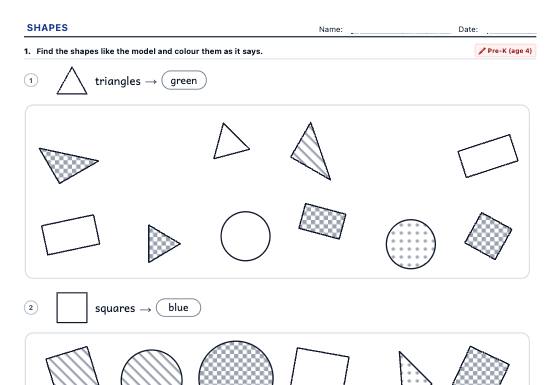
Shapes worksheets: colour the ones like the model, count them in a table, match them to their names, trace them and find them in a picture, from circles, squares and triangles to pentagons and first 3D shapes.
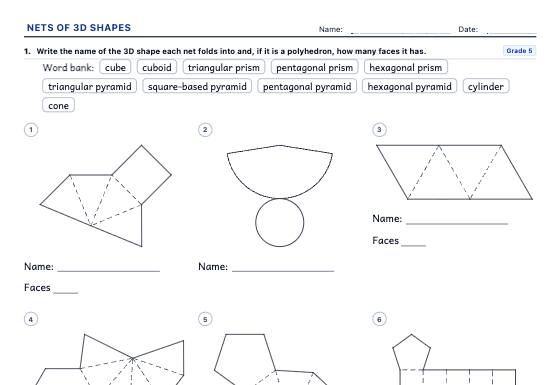
Printable nets to cut out and fold prisms, pyramids, cylinders and cones, nets to name, shapes that fold into a cube, opposite faces of a dice and surface area from a net.
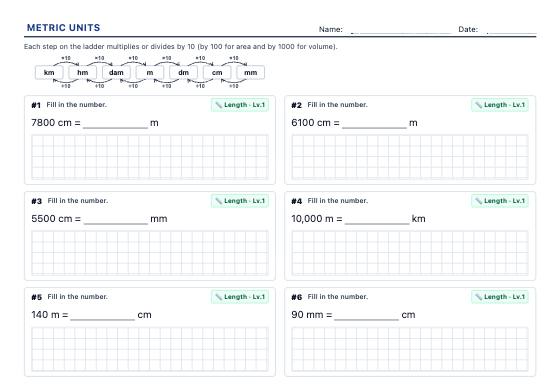
Metric conversion worksheets: length, mass, capacity, area and volume, with mixed units, comparing and ordering, and an answer key showing how the decimal point moves.