Converting units
Multiply to change into a smaller unit (3 h = 3 × 60 = 180 min) and divide to change into a larger one. In Grades 5 and 6, two steps in a row and hours with decimals (1.5 h = 90 min).
Time is measured in units that are not decimal: 60 seconds make a minute, 60 minutes an hour, 24 hours a day and 7 days a week; on the calendar, 12 months make a year, 10 years a decade and 100 years a century. This free units of time worksheet generator builds A4 worksheets to convert between units, write times in their smallest unit and back in larger units, compare durations, add and subtract times in columns and solve timetable problems, from Grade 3 to Grade 6, with an answer key that shows the working.
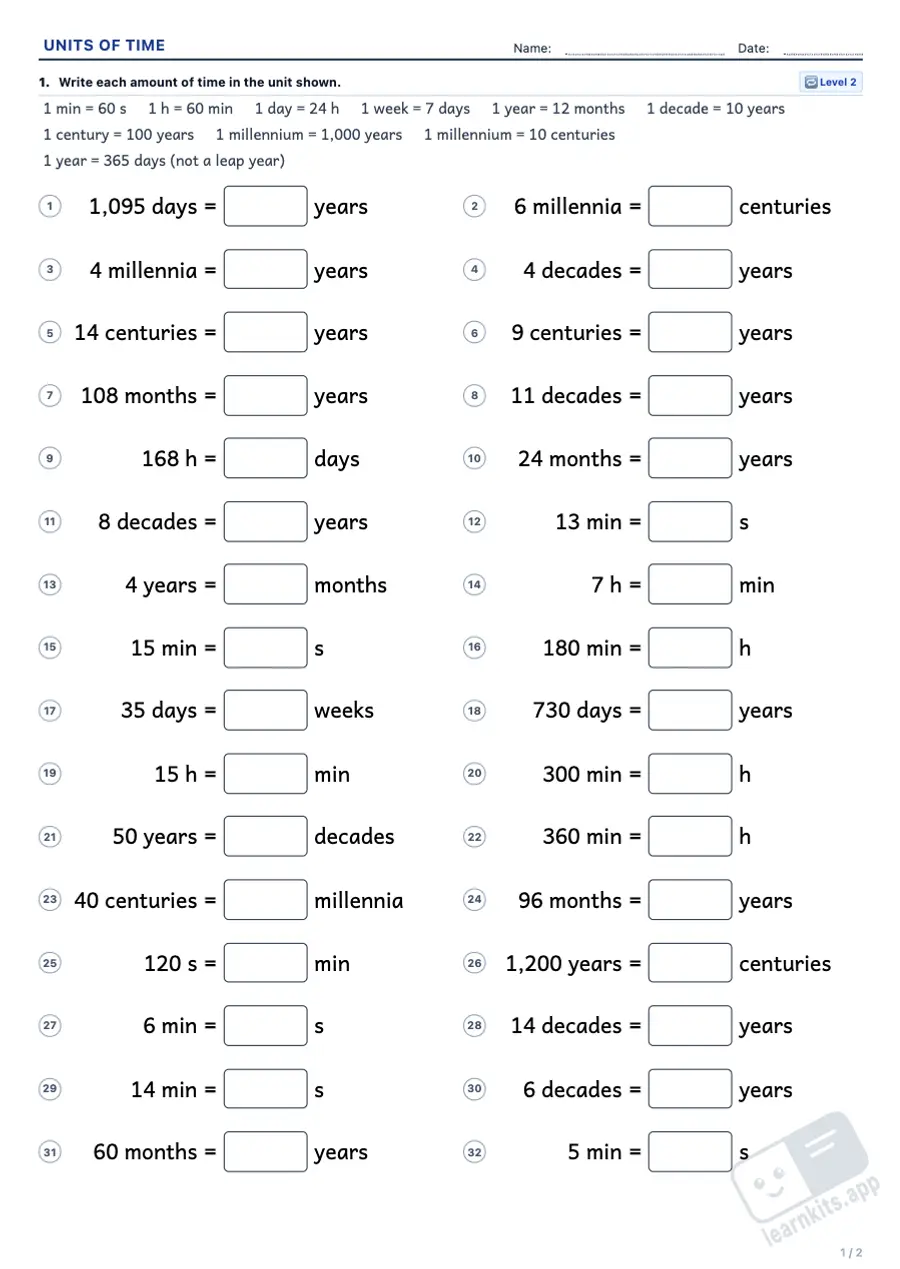 Student worksheet
 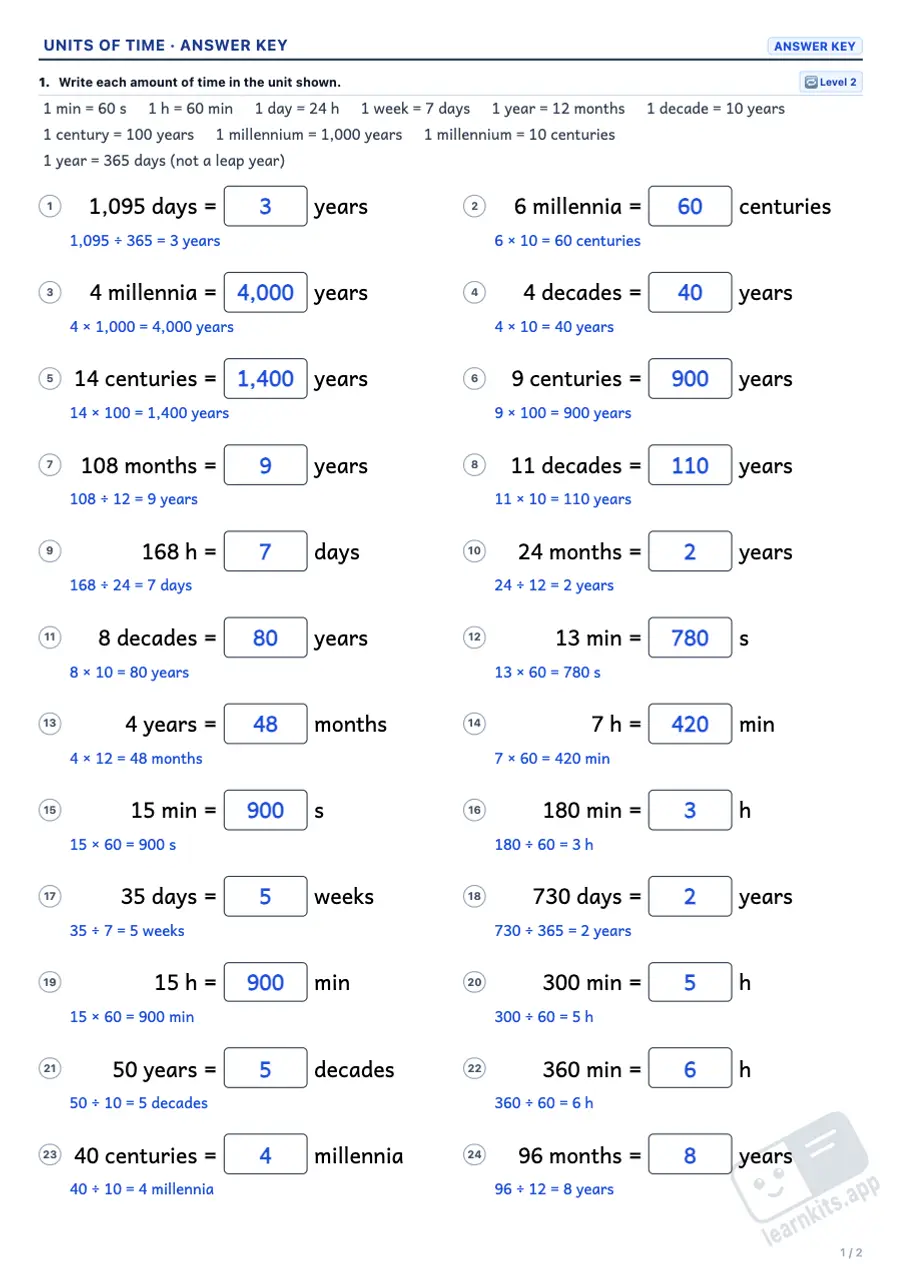 Answer key
 Multiply to change into a smaller unit (3 h = 3 × 60 = 180 min) and divide to change into a larger one. In Grades 5 and 6, two steps in a row and hours with decimals (1.5 h = 90 min).
2 h 15 min is 2 × 60 + 15 = 135 min: change each part into the smallest unit and add. With h, min and s, into seconds.
7,384 s ÷ 60 = 123 min remainder 4 s; 123 min ÷ 60 = 2 h remainder 3 min. Dividing step by step gives 2 h 3 min 4 s, and the answer key writes every division.
Which is longer, 2 h 10 min or 125 min? Both are changed into the same unit before comparing, and the differences are small so pupils have to work them out.
Hours, minutes and seconds in columns: when a column reaches 60 it carries into the next, and when it cannot be subtracted 1 h becomes 60 min or 1 min becomes 60 s.
What time the train arrives, how long the match lasted, how much of the audiobook is left: everyday problems with the working in the answer key.
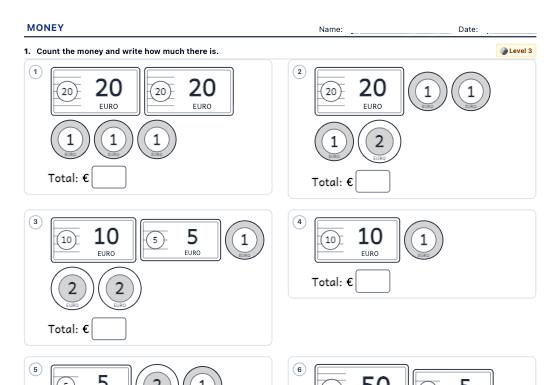
A4 worksheets with drawn euro coins and notes to count money, pay a price with the fewest pieces, compare purses, work out the change and solve shopping problems.
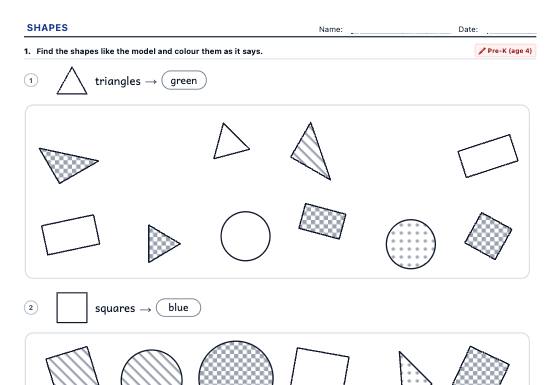
Shapes worksheets: colour the ones like the model, count them in a table, match them to their names, trace them and find them in a picture, from circles, squares and triangles to pentagons and first 3D shapes.
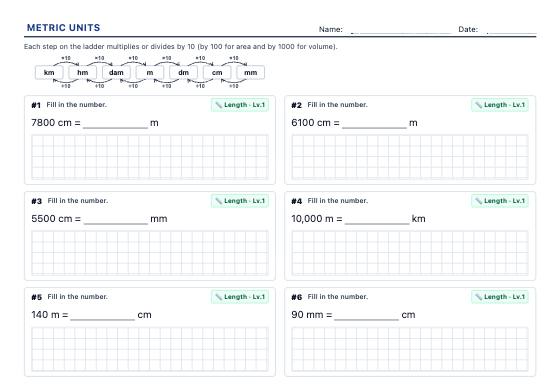
Metric conversion worksheets: length, mass, capacity, area and volume, with mixed units, comparing and ordering, and an answer key showing how the decimal point moves.