Number Sequences Worksheet Generator

Example ready: change it or print it as it is.

Teacher guide ↓

Teaching guide: how to practise number sequences

Number sequences help children understand how numbers are ordered: skip counting builds addition and the times tables, counting back builds subtraction, and finding the rule of a sequence is the first step into algebraic thinking. This free number sequence worksheet generator builds A4 worksheets with big boxes for Kindergarten to Grade 3, with an answer key that gives the rule of every sequence.
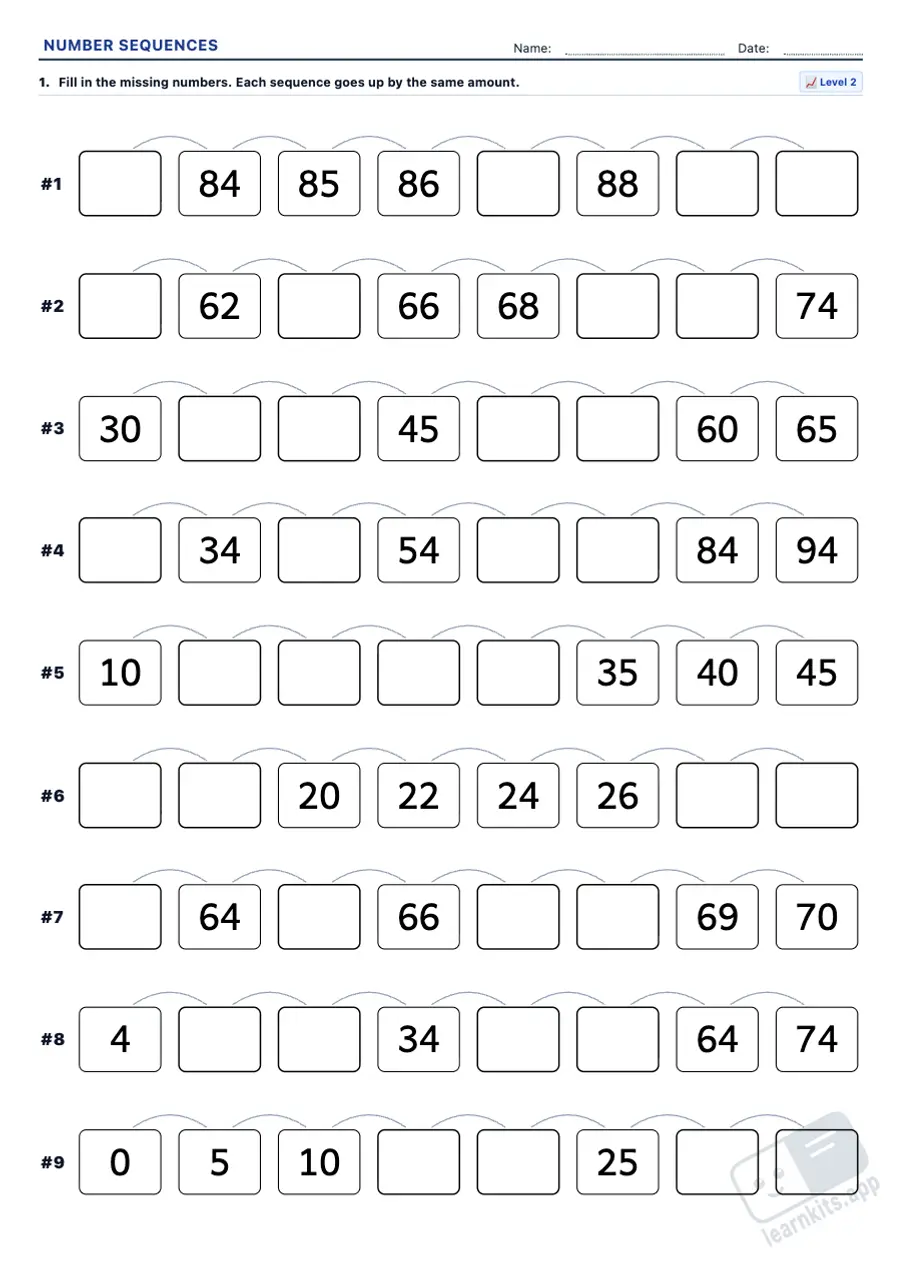
Number Sequences Worksheet Generator: sample printable A4 worksheet, first page of the student sheet Student worksheet
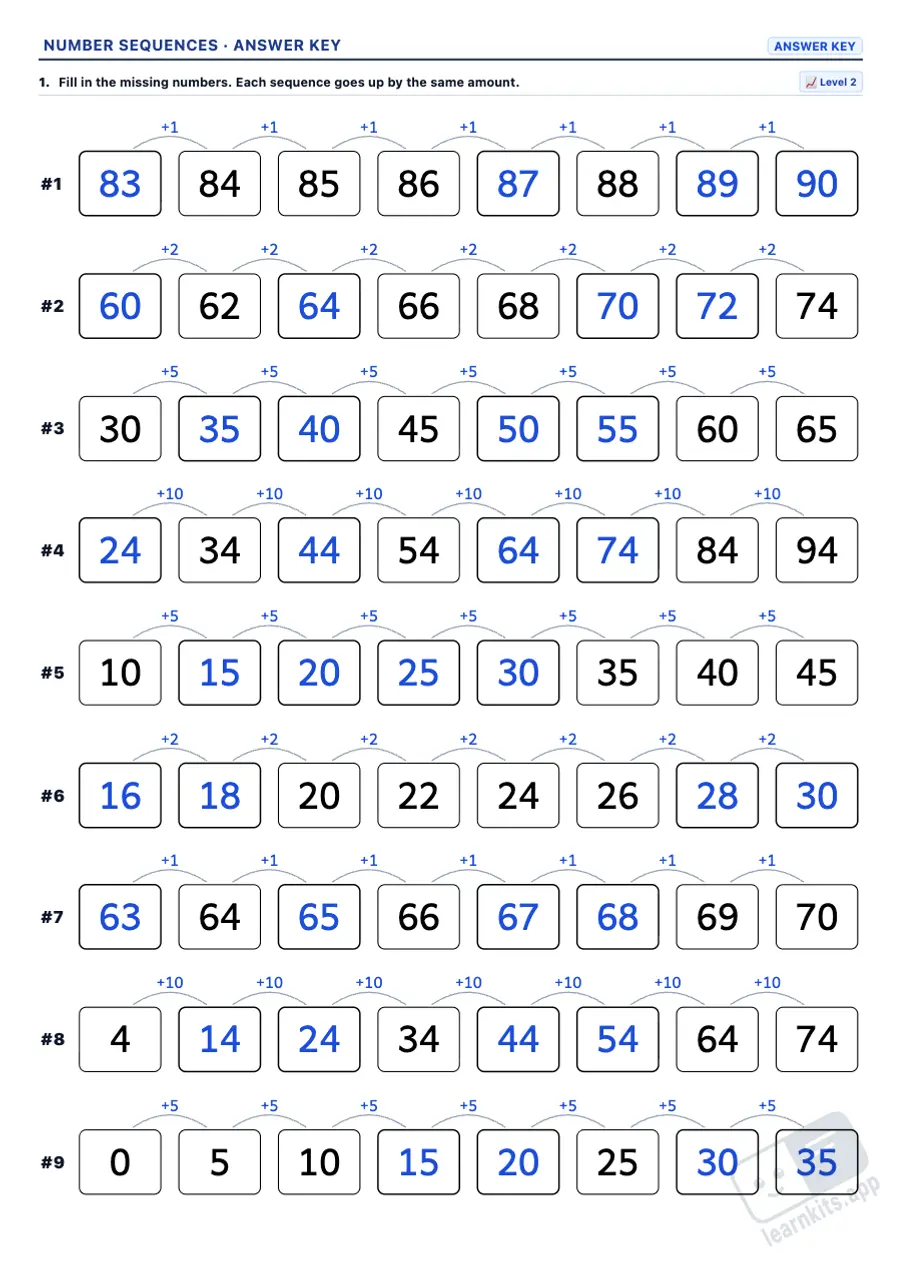
Number Sequences Worksheet Generator: sample answer key of the same worksheet, first page Answer key
Sample made with LearnKits. Every worksheet is new: choose the topic, level and amount and print it for free.

Skip counting

In ones, twos, fives and tens and, in Grades 2 and 3, in 3s, 4s, 25s, 50s and 100s. Each arc shows the jump.

Counting on

Numbers missing at the start, in the middle or at the end of a sequence that goes up, to 20, 100 or 1000.

Counting back

The same sequences going down: the harder direction in Grades 1 and 2, above all across a ten or a hundred.

Continue the sequence

From the first three or four numbers, pupils work out the jump and carry the sequence on to the end.

Find the rule

The whole sequence and a box to write its rule: +2, +10, −5, −100…

Grade 3 patterns

Growing jumps (+1, +2, +3…), two-step patterns (+5, −2) and doubling or halving, with the rule in the answer key.
Frequently asked questions about number sequence worksheets

Which grades are these worksheets for?
Kindergarten to Grade 3 (Reception to Year 4). Level 1 works with numbers to 20 (Kindergarten and Grade 1), level 2 to 100 (Grades 1 and 2) and level 3 to 1000 (Grades 2 and 3). Number patterns, with growing jumps or two steps, are for Grade 3.
Does each sequence have only one answer?
Yes. Every sequence is built from its rule and always shows two numbers side by side, so the jump can be read. Patterns give the first four numbers: the fewest that leave only one rule that fits.
What is in the answer key?
The missing numbers in blue, the jump written over each arc and, on find-the-rule and pattern worksheets, the rule of each sequence: +5, −10, ×2 or +1, +2, +3…
Do the worksheets repeat?
No. Every exercise you add is new, and selecting it on the sheet and clicking "New" gives you new sequences with the same settings. No sequence repeats within one exercise while there are others to use.
Can I mix several types of sequence on one worksheet?
Yes. Add exercises of different types and levels; each one has its own instruction. Then drag them, add a page break wherever you like and mix them with exercises from other generators.
What other worksheets go well with number sequences?
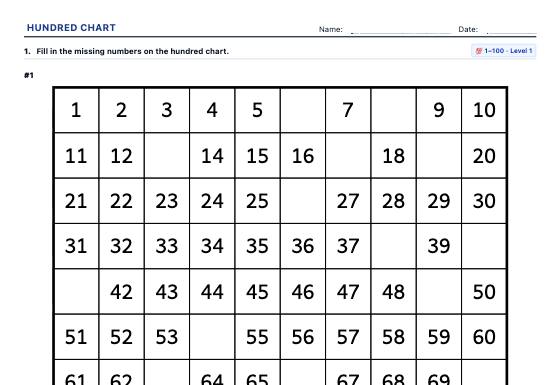
The hundred chart shows why the tens repeat, the skip counting dot-to-dot pictures practise the same through play, and the mental maths drills and times tables worksheets come next. Find every resource under maths worksheets.
How do I print only the answer key?
Click Print and choose "Answer key", or "Worksheet and answer key" for both. Your browser's print dialog can also save it as a PDF.
Is any pupil data sent anywhere?
No. Worksheets are generated in your browser and templates are saved in your browser's memory.