Roman Numerals Worksheet Generator

Example ready: change it or print it as it is.

Teacher guide ↓

Teaching guide: how to practise Roman numerals

Roman numerals are still everywhere: kings, queens and popes, chapters of books, clock faces, film credits and the dates on buildings. This free Roman numerals worksheet generator builds A4 worksheets to convert Roman numerals to numbers and back, spot the mistake, compare, order, add and subtract, read them where they are used and fill in the clock face, from Grade 3 to Grade 6 and up to 3,999, each with its answer key.
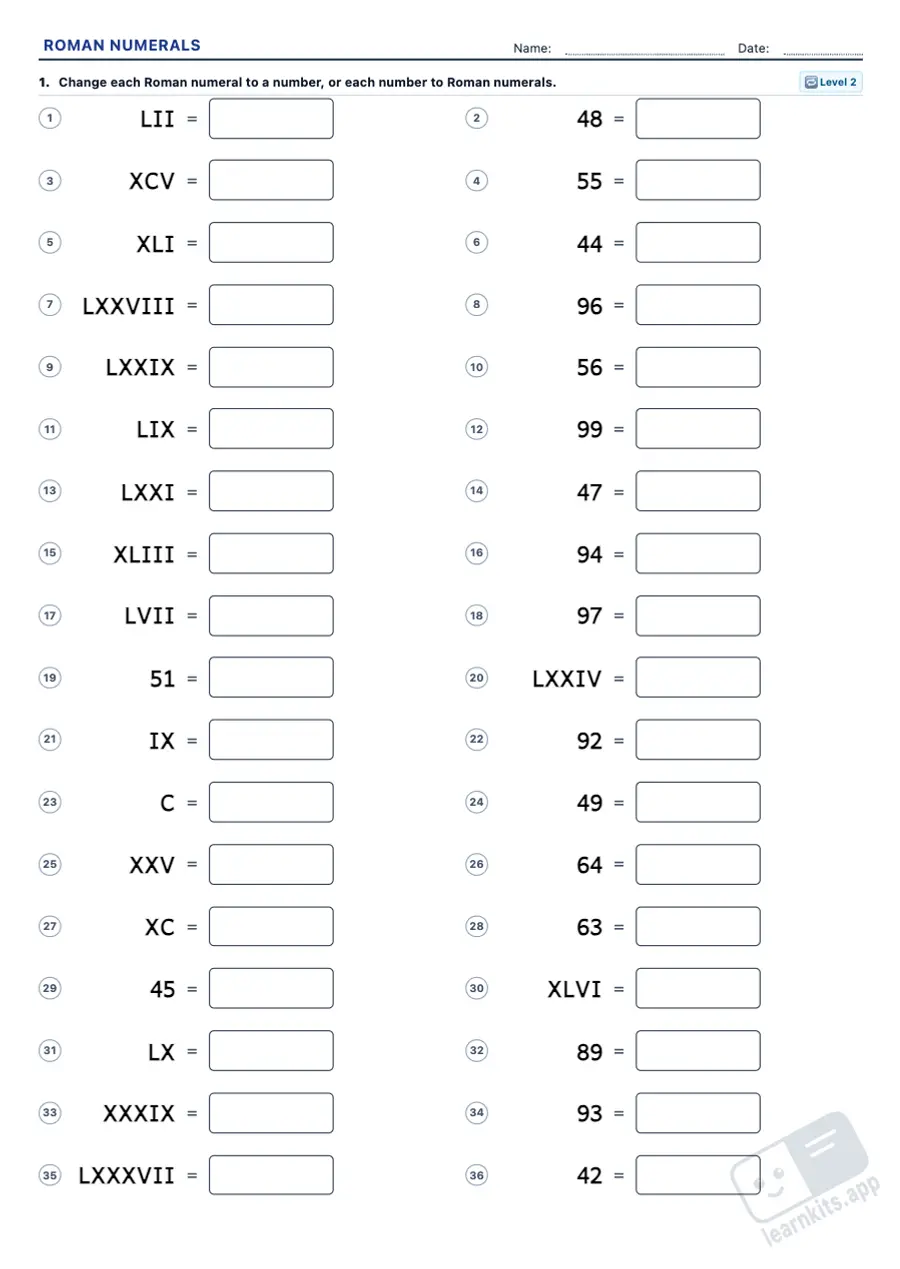
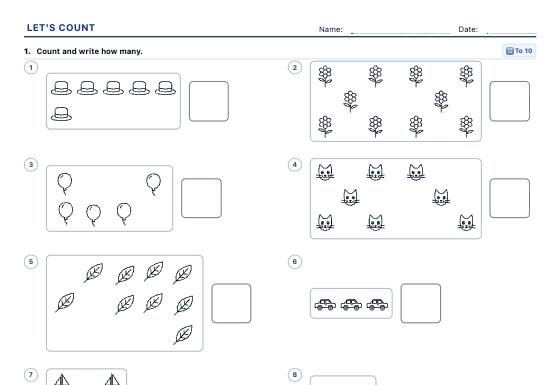
Roman Numerals Worksheet Generator: sample printable A4 worksheet, first page of the student sheet Student worksheet
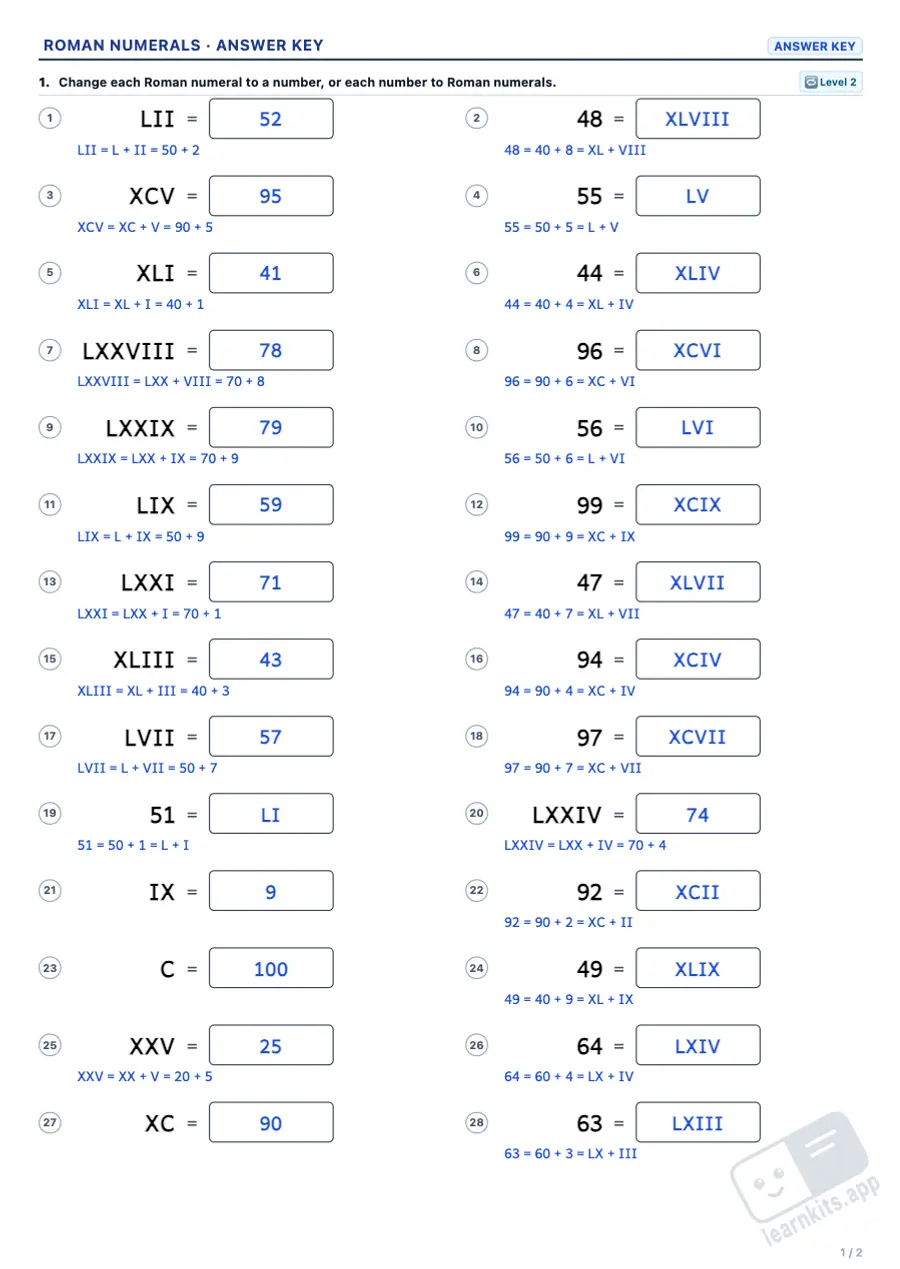
Roman Numerals Worksheet Generator: sample answer key of the same worksheet, first page Answer key
Sample made with LearnKits. Every worksheet is new: choose the topic, level and amount and print it for free.

Roman to numbers

Numbers pick the tricky parts of each level: IV, IX, XL, XC, CD and CM, three repeats at most and long numerals like DCCCLXXXVIII.

Numbers to Roman

Writing in Roman numerals means thinking in place value: 1,492 = 1,000 + 400 + 90 + 2 = M CD XC II. The answer key shows that step.

Is it right?

Half are right and the rest have a real mistake: IIII, VV, IIX, IC, VL or XL for 60. The answer key gives the rule that was broken.

Compare and order

With traps: the longest numeral is not always the largest (VIII and X) and the same symbols in another order make another number (IX and XI).

Where they are used

Kings, queens and popes with their real numbers, chapters, acts of a play, the Olympiads and the years on gravestones and buildings, to read and to write.

The clock face

A clock face with Roman numerals, like a church clock, with four, eight or eleven numerals to fill in.
Frequently asked questions about Roman numerals worksheets

What are the rules for Roman numerals?
There are seven symbols: I (1), V (5), X (10), L (50), C (100), D (500) and M (1,000). A symbol after a larger or equal one is added; before a larger one it is taken away. I, X, C and M can be repeated up to three times; V, L and D are never repeated or taken away. Only I goes before V and X, X before L and C, and C before D and M.
Why do clocks show IIII instead of IV?
Many clocks use IIII by clockmakers' tradition, but in school and on these worksheets 4 is written IV, the standard form. The clock face on the worksheets shows IV.
How high do the worksheets go?
Up to 3,999 (MMMCMXCIX), the largest number you can write with the seven symbols without bars on top. There are four levels: to 39 (Grade 3), to 100 (Grades 3 and 4), to 1,000 (Grades 4 and 5) and to 3,999 (Grades 5 and 6).
What mistakes come up in "Is it right?"
The common ones: a symbol four times (IIII, XXXX, VIIII), V, L or D repeated (VV, LL), two symbols taken away (IIX), subtractions that are not allowed (IC for 99, IL for 49, VL for 45) and symbols swapped round that make another number (XL for 60). Half the exercises are right.
What is in the answer key?
Every number or numeral with its place value parts (1,492 = 1,000 + 400 + 90 + 2), the tick or cross with the right writing and its rule, each comparison sign with the values, the order with the values, the sums in figures and the clock numerals, all in blue.
What about centuries?
In English centuries are written as ordinals (the 19th century), so these worksheets read kings, popes, chapters and Olympiads instead. To change a year to its century, place BC and AD dates and draw timelines, use the centuries and chronology worksheets.
What other worksheets go well with these?
The place value worksheets explain the parts a Roman numeral is built from, and the comparing and ordering numbers and numbers in words worksheets use the same numbers. Find every resource under maths worksheets.
Is any pupil data sent anywhere?
No. Worksheets are generated in your browser and templates are saved in your browser's memory.