Probability measures how likely an event is, as a number from 0 to 1. In Grades 6 and 7 pupils work with dice, bags of balls, spinners and the probability scale; from Grade 8 they add tree diagrams, two-way tables, conditional probability, counting and combinations, and relative frequency. This free generator makes A4 worksheets with new experiments every time and an answer key that shows the working behind each answer.
A4, to print or save as PDF; new exercises every time
Price
Free, no sign-up
Available in
Catalan, Spanish, English
Student worksheet
Answer key
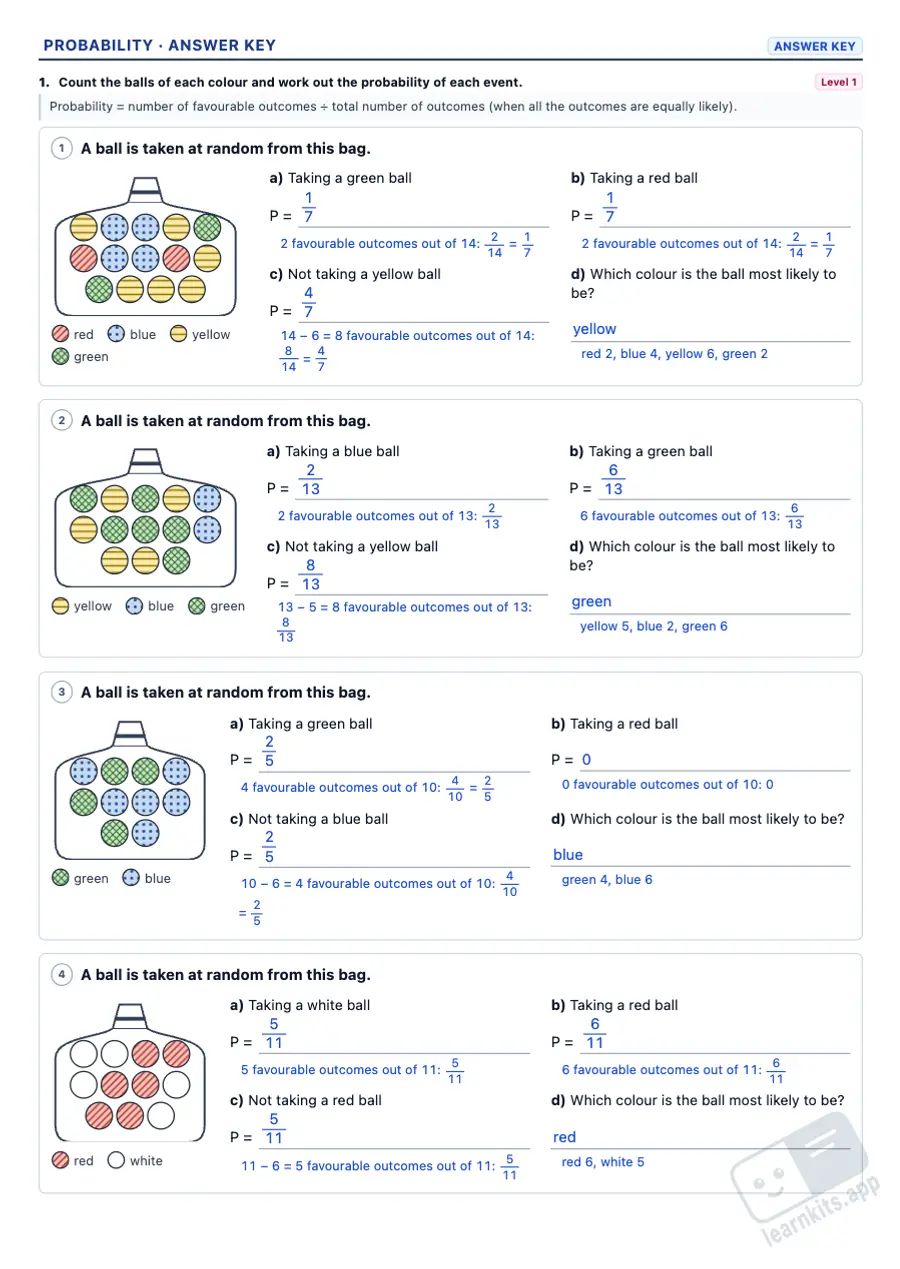
Sample made with LearnKits. Every worksheet is new: choose the topic, level and amount and print it for free.
Dice
Favourable and possible outcomes with dice of 4 to 12 faces, the sample space of two dice and combined events with coins.
Bags and spinners
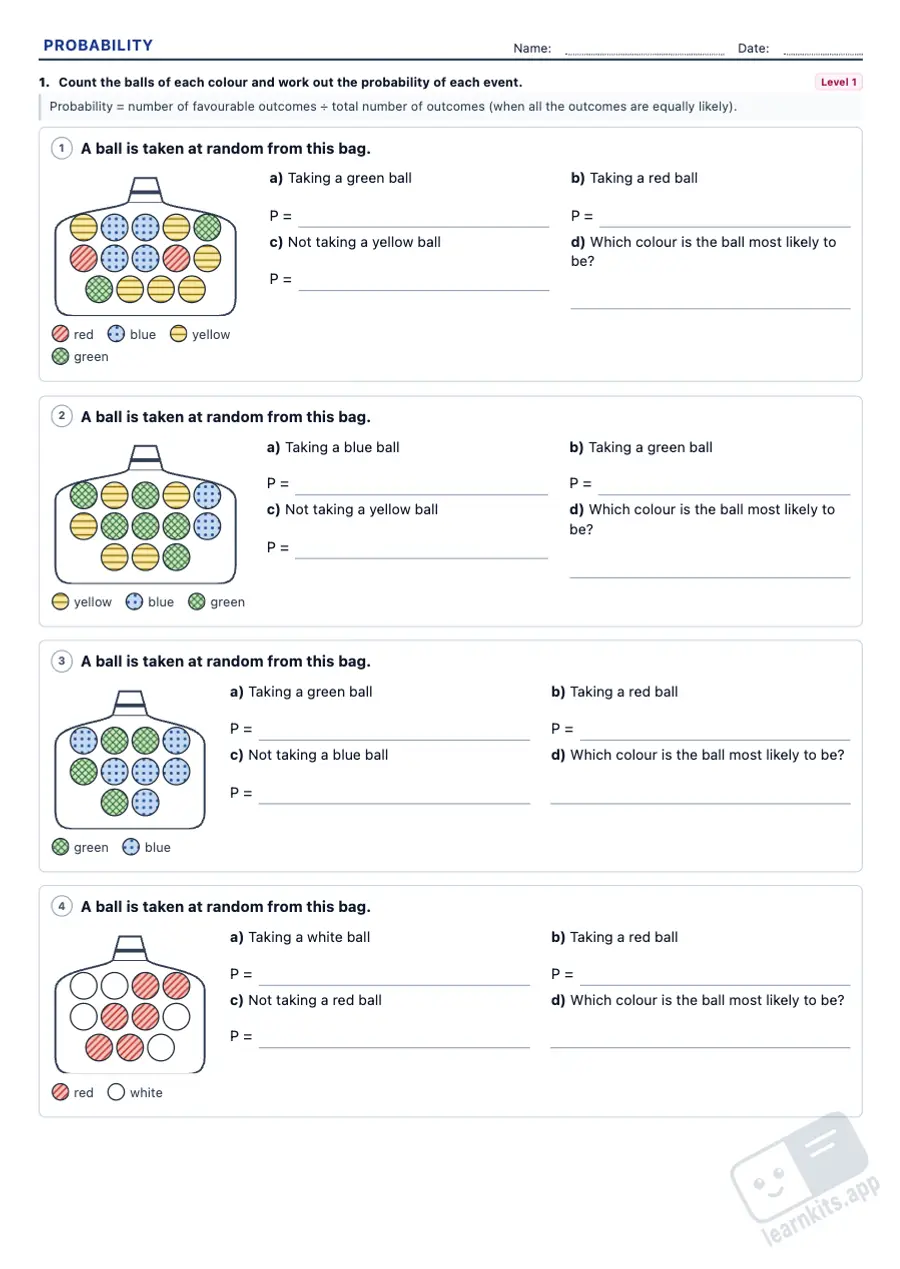
Bags drawn ball by ball and spinners with equal sections or with their angles, so pupils count before they calculate.
Tree diagrams
From counting menus and outfits to probability trees for two draws without replacement.
Two-way tables
Two-way tables to complete and use for “and”, “or” and conditional probability.
Counting
The multiplication principle, arrangements, permutations and combinations, with the key question: does order matter?
Relative frequency
Experimental probability from real trials, expected outcomes in N trials and estimating what is inside a bag.
Frequently asked questions about probability worksheets
How do you work out a probability?
When all the outcomes are equally likely, the probability of an event is the number of favourable outcomes divided by the total number of outcomes. For example, with a six-sided dice, P(even number) = 3/6 = 1/2. The rule is printed under the instruction on the worksheet.
Which grades are these worksheets for?
One dice, one bag and spinners with equal sections are for Grades 6 and 7; two dice, comparing bags, spinners with angles and relative frequency for Grades 7 to 9; combined events, probability trees, two-way tables and counting for Grades 9 and 10. Each level states its grade.
How do you find the probability of two draws?
Multiply the probabilities of each draw along the branches of the tree. Without replacement, the second fraction has one ball fewer in the total (and one fewer of the colour taken). If several paths give the event, add the probabilities of those paths.
What is conditional probability?
It is the probability of an event B when you already know that A has happened. In a two-way table you count only inside A’s row or column: the number in A and B divided by the total of A.
How do I know whether to use permutations or combinations?
Ask whether order matters. For a podium or choosing a captain and a deputy, it does: use permutations. For a committee, a group of cards or pizza toppings, it does not: use combinations. Level 3 of counting mixes both so pupils have to decide.
Why do the worksheets use “dice” for one dice?
“Dice” is the word most British pupils use for a single dice, so the worksheets use it throughout; “die” is also correct.
Click Print and choose "Answer key", or "Worksheet and answer key" for both. Your browser's print dialog can also save it as a PDF. Worksheets are generated in your browser and no data is sent anywhere.
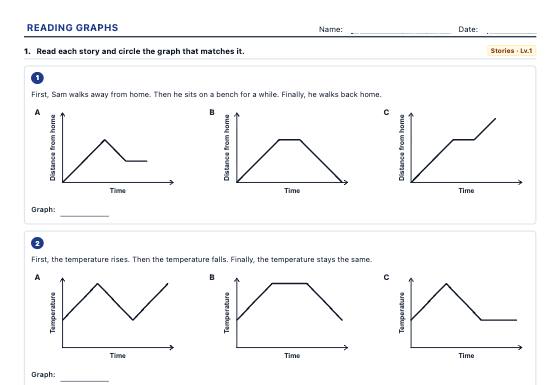
Everyday graphs to match to a story, read values and rates of change, describe trends, compare two series and spot misleading graphs, with an answer key.
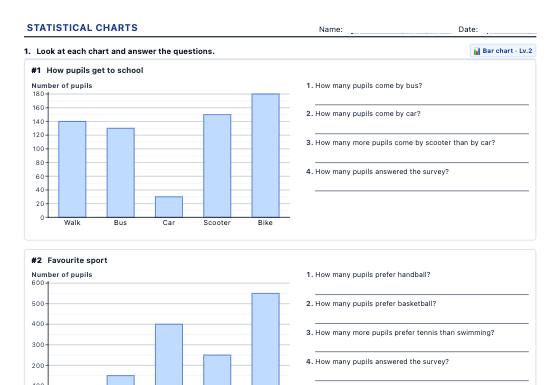
Pictograms, bar charts, line graphs and pie charts to read and to draw, and frequency tables with mode, mean and median, with new data every time and an answer key.
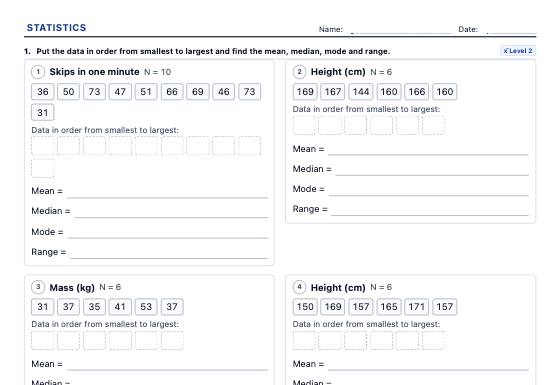
Mean, median, mode and range of lists and tables, frequency tables, quartiles and box plots, standard deviation and grouped data, with new data every time and an answer key with the working.
This feature is not yet available. We are actively building advanced tools for schools, tutoring centers, and teachers.
Notice: All current worksheet generators and printable materials on LearnKits are and will remain 100% free and open. Pro will be an optional enhancement for school institutions.
Features in development:
No Watermark: Print worksheets and answer keys without the LearnKits mark.
Cloud Collections: Access and organize your worksheets from anywhere.
School Branding: Add your school crest and custom header notes.
Direct PDF Export: One-click vector PDF downloads without print popups.
Thank you! We will notify you first as soon as LearnKits Pro becomes available.
Analytics and advertising cookies
We use Google Analytics to learn which resources are used and improve them, and Google AdSense to show ads that keep LearnKits free. If you accept, ads may be personalised; if you reject, they are non-personalised. You can change your choice at any time from the page footer. Cookie policy
 Student worksheet
  Answer key