Teaching guide: how to practise sequences and growth
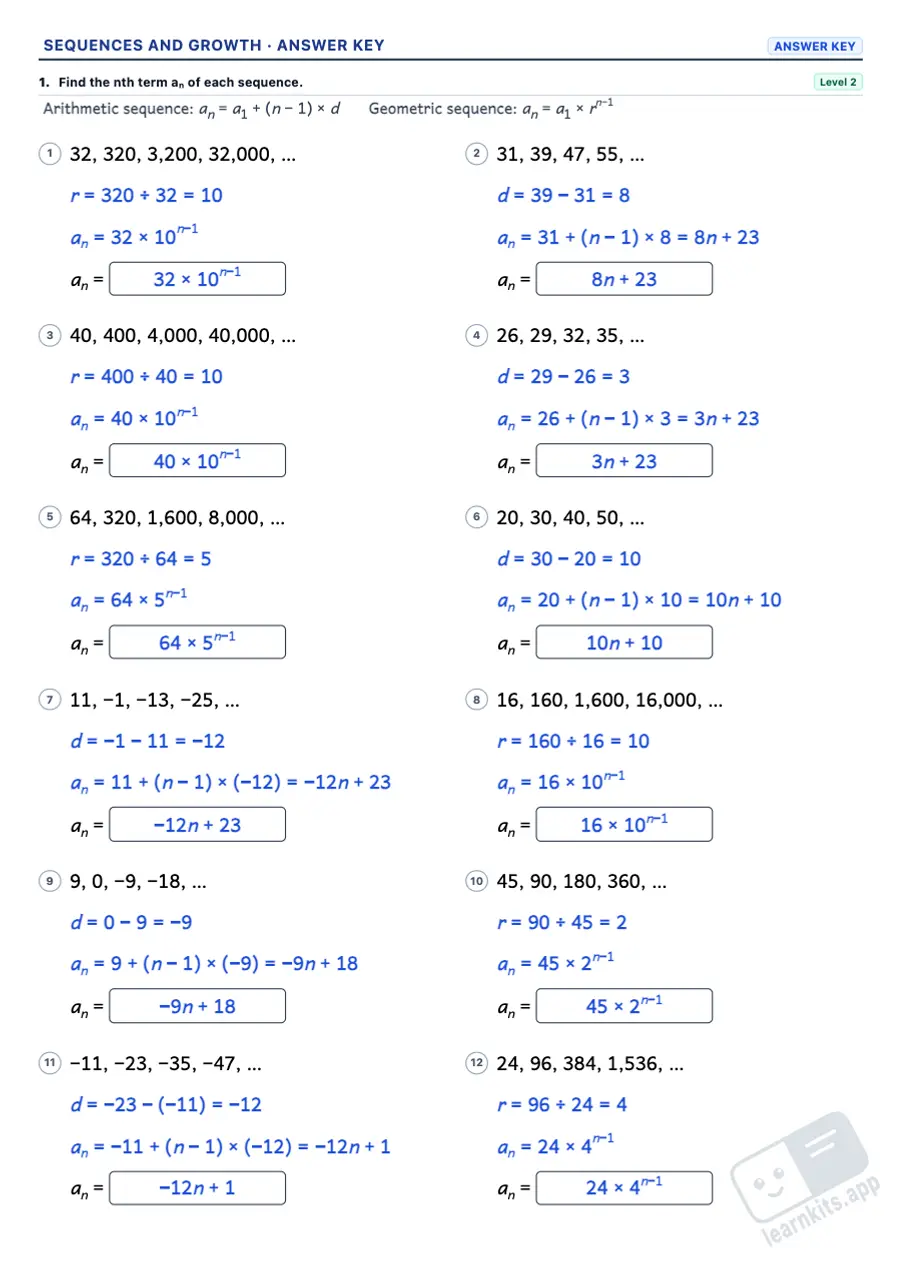
An arithmetic sequence always adds the same amount and a geometric sequence always multiplies by the same number: that is the difference between linear and exponential growth, which explains savings, a loan, an epidemic or the population of a city. This free arithmetic and geometric sequences worksheet generator builds A4 worksheets to recognise sequences, find the nth term, work out any term and the sum of n terms, and decide which model fits real data, with a step-by-step answer key.
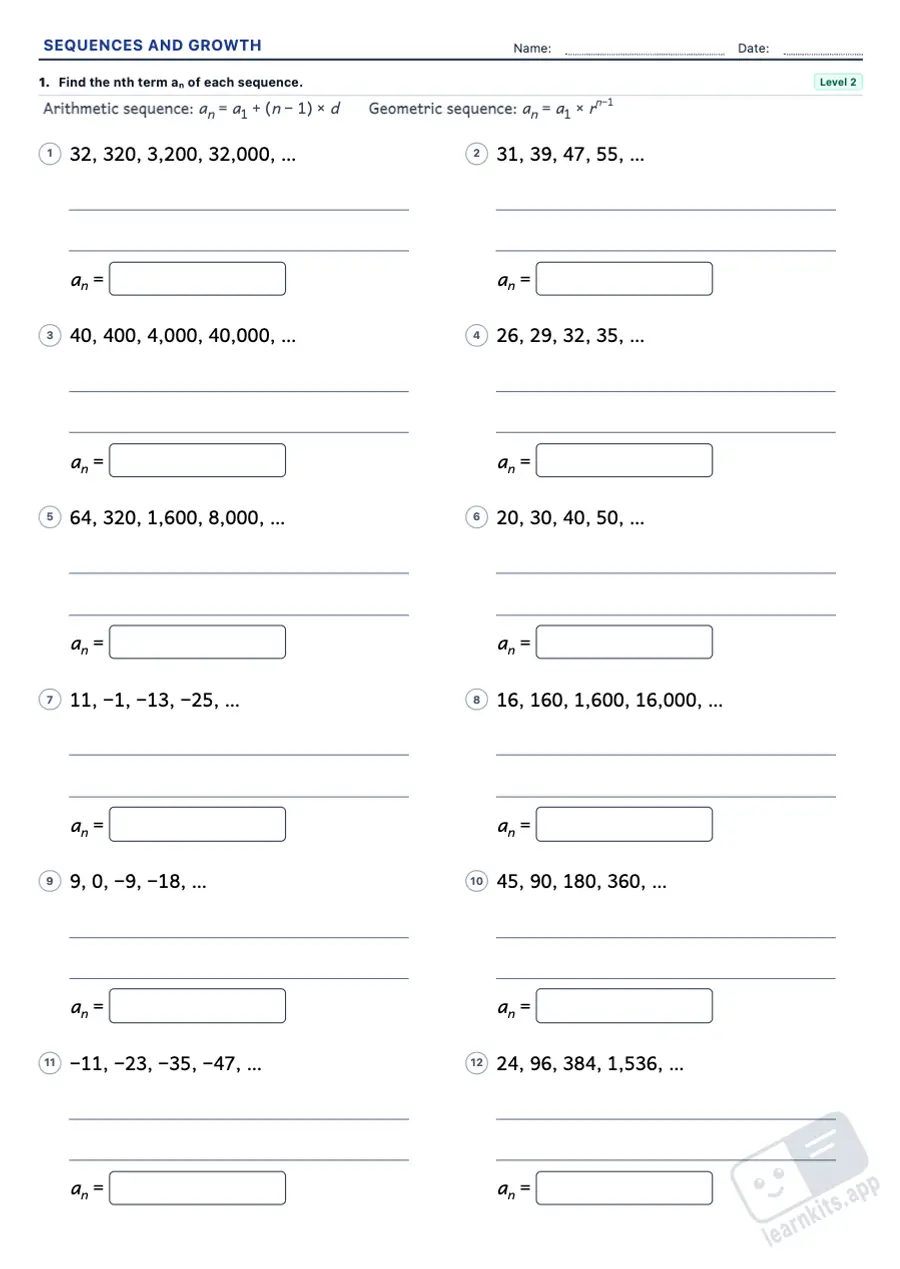
A4, to print or save as PDF; new exercises every time
Price
Free, no sign-up
Available in
Catalan, Spanish, English
Student worksheet
Answer key
Sample made with LearnKits. Every worksheet is new: choose the topic, level and amount and print it for free.
Arithmetic or geometric
If the difference between consecutive terms is always the same, the sequence is arithmetic; if the ratio is, it is geometric. The worksheets include sequences that are neither, so pupils have to check.
The nth term
aₙ = a₁ + (n − 1)d and aₙ = a₁ × rⁿ⁻¹, or 4n − 1 written the UK way. At level 3 only two terms are given, such as a₃ and a₈, and d or r comes first.
A term and its position
Find a₁₀₀ without writing out a hundred terms and, the other way round, find which term a number is, or show that it is not in the sequence.
The sum of n terms
Gauss's sum for arithmetic series, the formula for geometric series and, in Grade 10, the sum to infinity when the ratio is between −1 and 1.
Linear or exponential
Savings that grow by adding and interest that grows by multiplying, bacteria that double or a car that loses 20 % a year: the table, the formula y = a + bt or y = a × rᵗ and a prediction.
Which model fits?
As in PISA's change and relationships items: faced with a table of data, look at differences and ratios to choose the model, then use it to predict.
Frequently asked questions about sequences worksheets
Which grades are these worksheets for?
Grades 7 to 10 (Years 8 to 11). Grades 7 and 8 recognise sequences and continue them; Grade 9 works on the nth term, any term, the sum of n terms and linear and exponential growth; Grade 10 adds the sum to infinity, repeated percentage change and comparing models.
What is the difference between an arithmetic and a geometric sequence?
In an arithmetic sequence each term is the previous one plus the common difference d (3, 7, 11, 15…, d = 4); in a geometric sequence it is the previous one times the common ratio r (3, 6, 12, 24…, r = 2). To tell them apart, work out the differences and the ratios of consecutive terms.
How do you find the sum of the first n terms?
For an arithmetic series, Sₙ = (a₁ + aₙ) × n ÷ 2: the first plus the last term, times half the number of terms. For a geometric series, Sₙ = a₁(rⁿ − 1) ÷ (r − 1). If the ratio is between −1 and 1, the sum to infinity is a₁ ÷ (1 − r).
What does this have to do with exponential growth?
An amount that grows by a fixed percentage each period, such as money with compound interest or a population, forms a geometric sequence with ratio 1 + p/100. The worksheets show this with tables and the formula y = a × rᵗ, and compare it with linear growth.
Are the numbers in the problems exact?
Yes. The numbers are chosen so that every value in the tables and every answer is exact, with no rounding: bacteria and people always come out as whole numbers and money to the cent at most.
What is in the answer key?
The answer to every exercise and the steps: the difference or the ratio, the formula with the numbers substituted, the equation that gives the position of a term, the sum and, in the growth problems, the completed table and the formula.
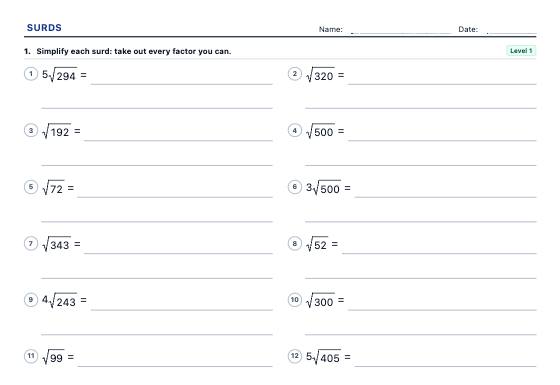
Surds and radicals: fractional indices, equivalent roots and a common index, simplifying surds, adding, multiplying and dividing them and rationalising the denominator, with a fully worked answer key.
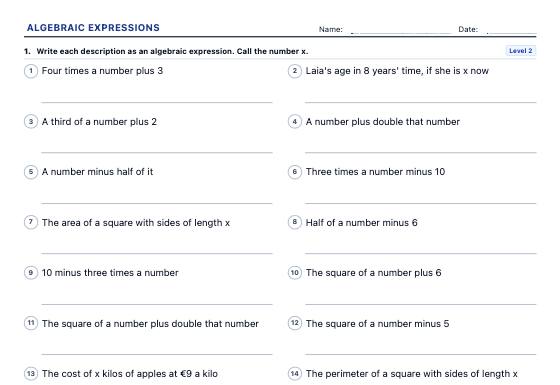
Algebraic expressions: from words to expressions and back, substitution, the coefficient and degree of a term, collecting like terms and forming and solving equations from word problems, with fully worked answers.
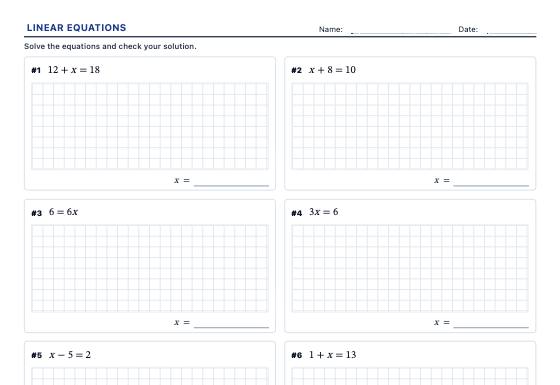
One-step and two-step linear equations, x on both sides, brackets and fractions, with whole, negative or fraction solutions and a step-by-step answer key with the check.
This feature is not yet available. We are actively building advanced tools for schools, tutoring centers, and teachers.
Notice: All current worksheet generators and printable materials on LearnKits are and will remain 100% free and open. Pro will be an optional enhancement for school institutions.
Features in development:
No Watermark: Print worksheets and answer keys without the LearnKits mark.
Cloud Collections: Access and organize your worksheets from anywhere.
School Branding: Add your school crest and custom header notes.
Direct PDF Export: One-click vector PDF downloads without print popups.
Thank you! We will notify you first as soon as LearnKits Pro becomes available.
Analytics and advertising cookies
We use Google Analytics to learn which resources are used and improve them, and Google AdSense to show ads that keep LearnKits free. If you accept, ads may be personalised; if you reject, they are non-personalised. You can change your choice at any time from the page footer. Cookie policy