Counting cubes
Structures drawn in 3D: first cubes that are all in sight, then cubes hidden under others and, at the top level, how many more would fill a cuboid.
Spatial reasoning is the ability to picture objects in three dimensions, turn them round in your head and see them from somewhere else. It is the part of geometry PISA assesses under "Space and shape" and it turns up in reasoning tests. This free spatial reasoning worksheet generator makes A4 worksheets for Grades 2 to 8: cube structures to count, views, rotated shapes and the cubes that nets fold into, with an answer key.
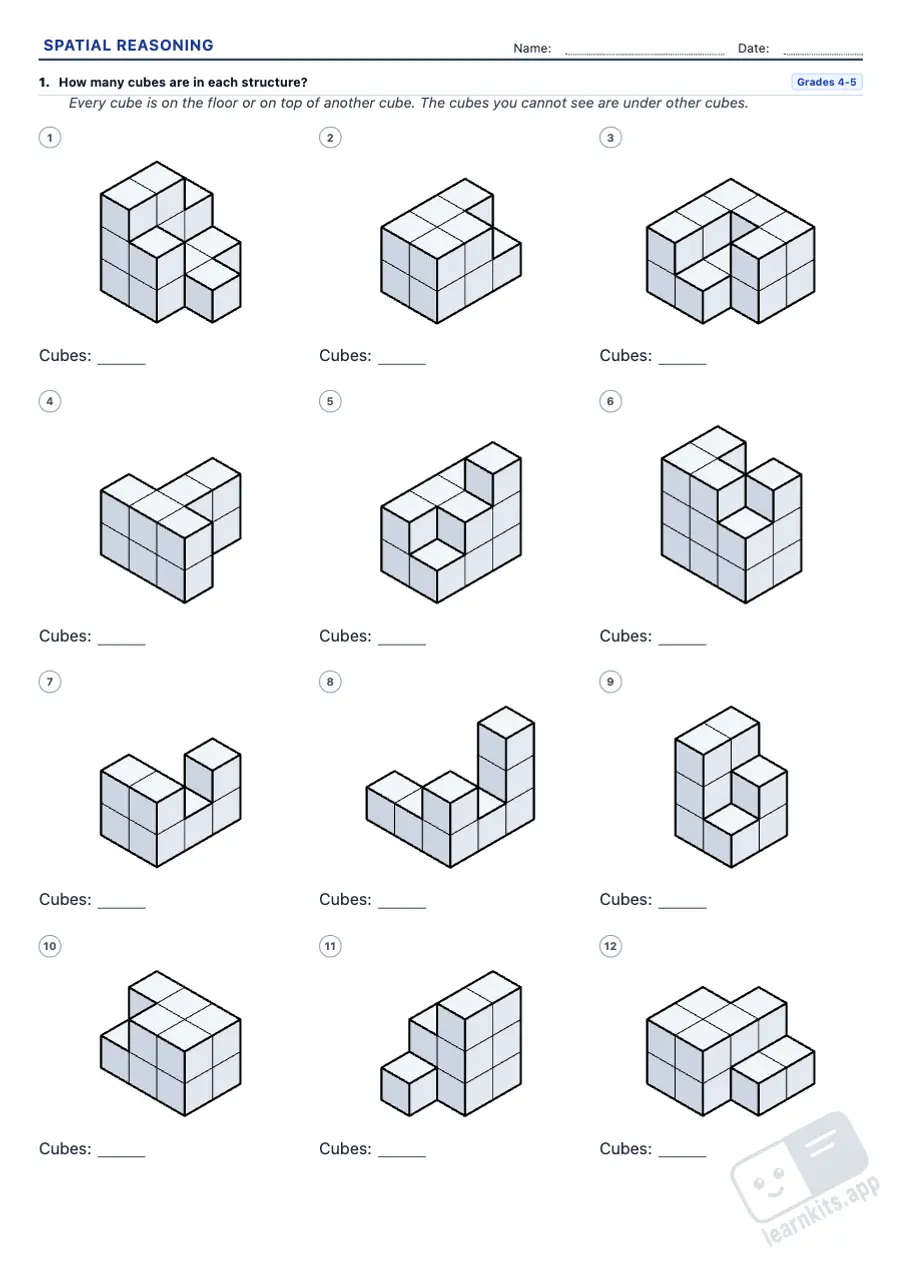 Student worksheet
 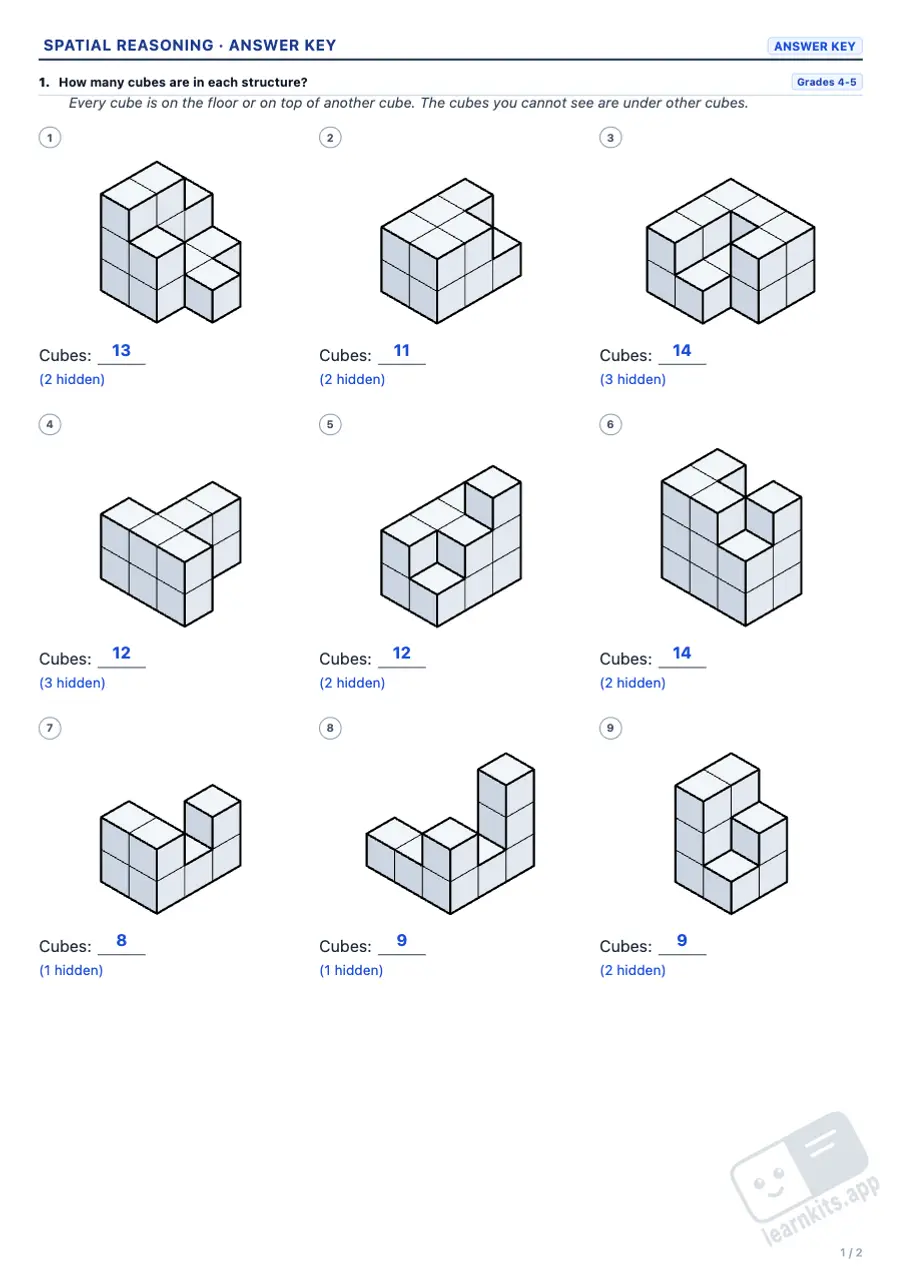 Answer key
 Structures drawn in 3D: first cubes that are all in sight, then cubes hidden under others and, at the top level, how many more would fill a cuboid.
A structure with an arrow marking its front and four drawings: pupils pick the one seen from the front, from above or from one side.
Of four shapes, only one is the model turned round. The others have a cube added, taken away or moved, or are its mirror image, which no turn can give.
A cube with marks on its faces and four nets to fold in your head. At Grades 7-8, the other way round: which of four cubes the net makes.
Every drawing reads one way: the generator checks that no other cube structure gives the same drawing and that the wrong options really are wrong.
The number of cubes (and how many are hidden) and the right letter circled in blue. Black lines and light greys that print well in black and white.
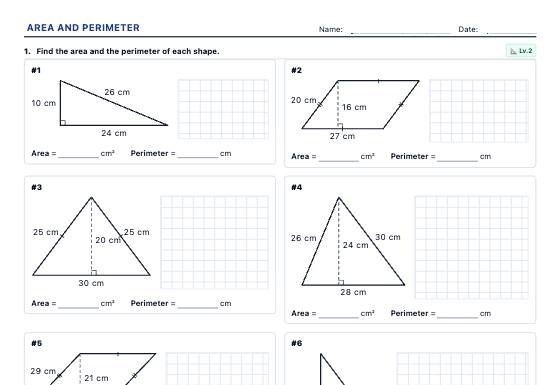
Area and perimeter worksheets with shapes drawn to scale: squared grids, polygons, circles, composite shapes, estimating irregular areas on a map and missing sides, with a step-by-step answer key.
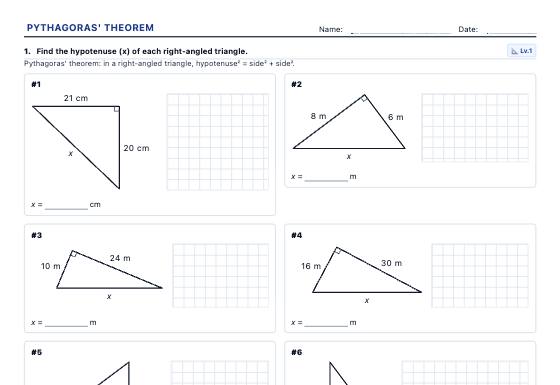
Pythagoras' theorem worksheets with triangles drawn to scale: find the hypotenuse and the shorter sides, test whether a triangle is right-angled, diagonals and heights of shapes, word problems and the squares picture, with a step-by-step answer key.
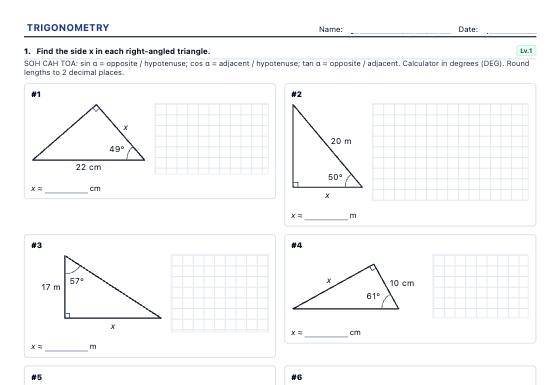
Right-angled triangle trigonometry worksheets: sin, cos and tan, missing sides and angles, solving triangles, angles in shapes and word problems with angles of elevation, with a step-by-step answer key.