Properties of materials
Transparent or opaque, waterproof or absorbent, flexible or rigid, floats or sinks, and in Grades 5-6 magnets and conductors of electricity and heat.
Matter is one of the first topics in science: primary pupils study the properties of materials, the three states and changes of state, and secondary pupils the particle model, heating curves, pure substances and mixtures, and how to separate them. This free generator makes printable worksheets for every step, with the answer key.
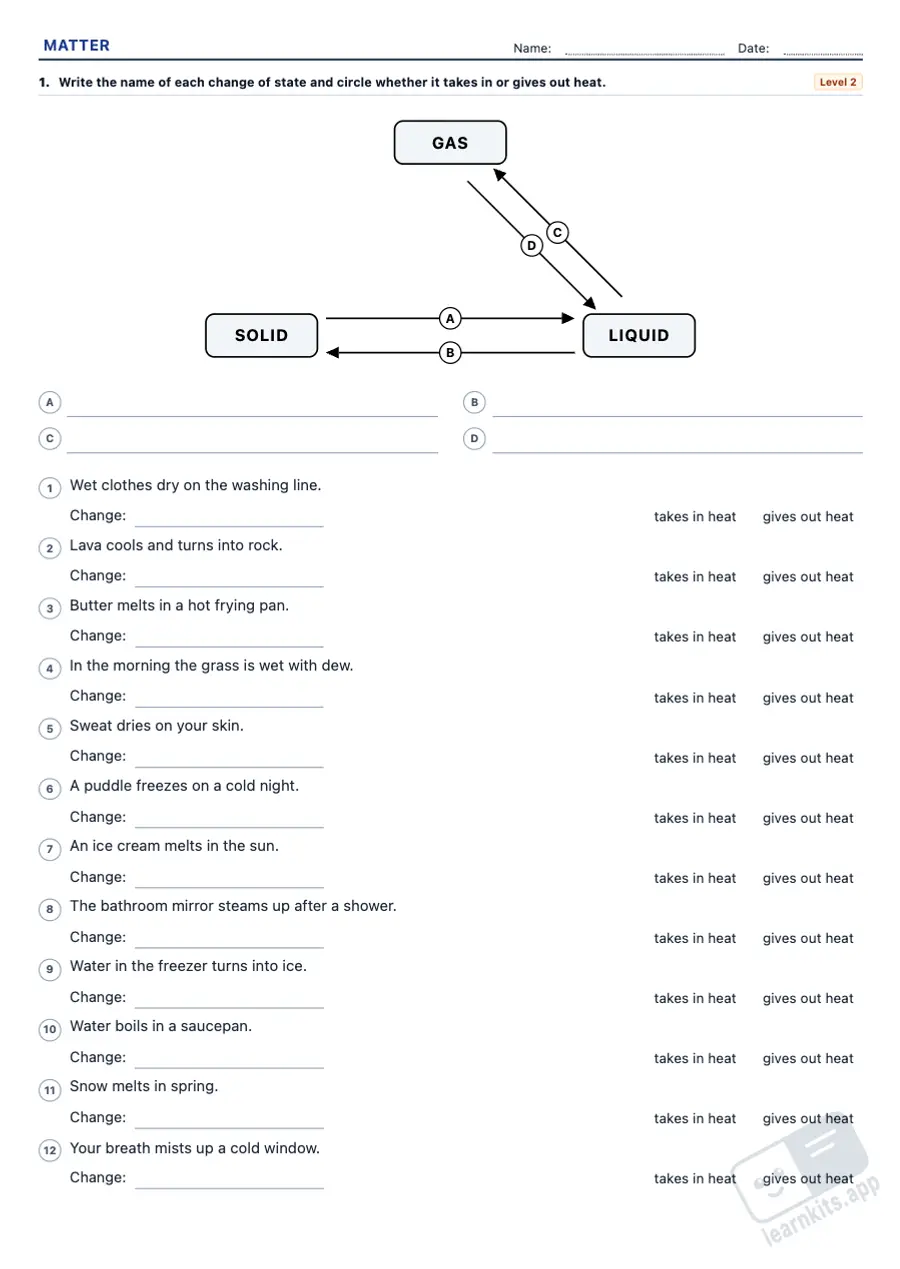 Student worksheet
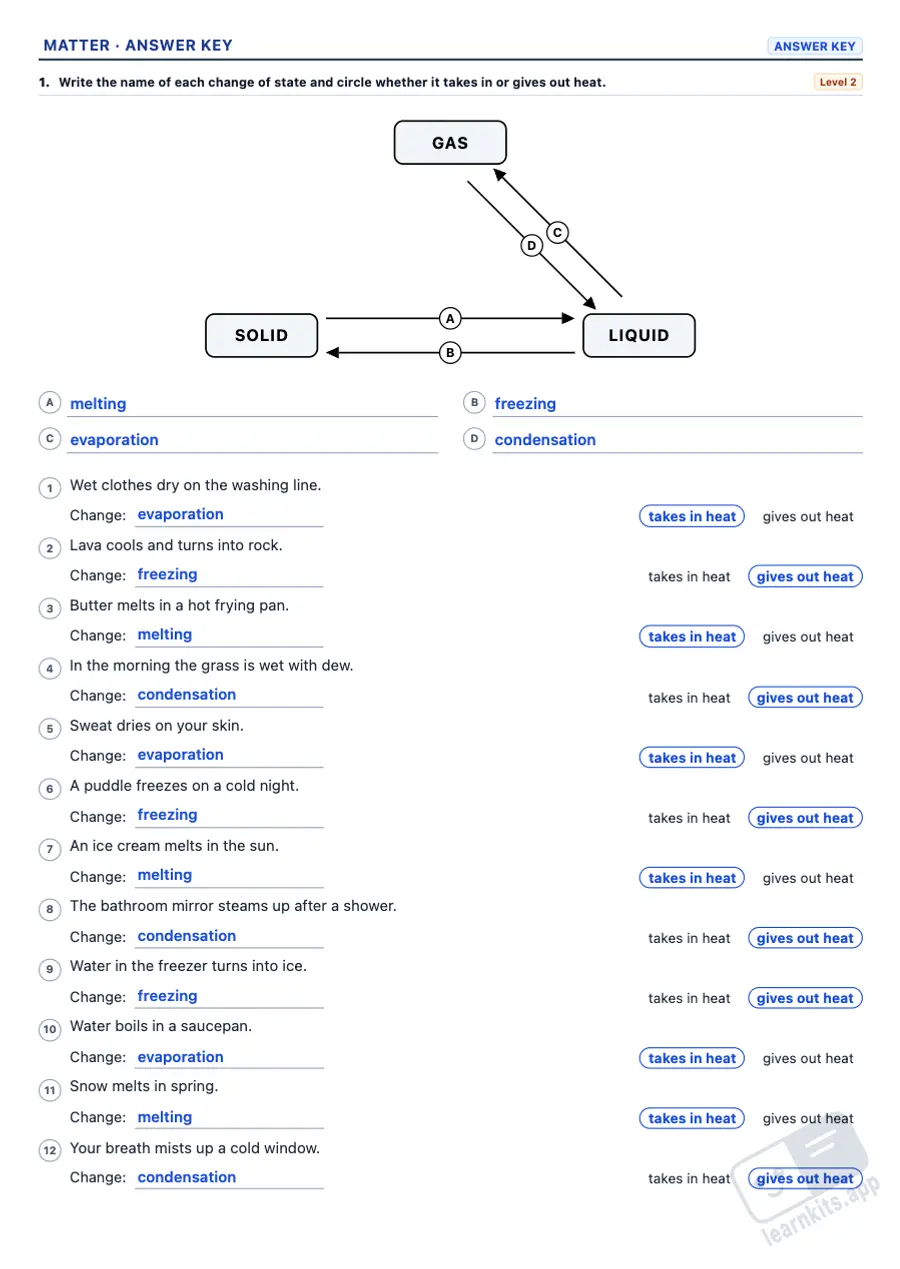 Answer key
Transparent or opaque, waterproof or absorbent, flexible or rigid, floats or sinks, and in Grades 5-6 magnets and conductors of electricity and heat.
Sort substances into solids, liquids and gases, recognise the particle model of each state and draw it.
Melting, freezing, evaporation and condensation in everyday situations, and in secondary school sublimation and whether heat is taken in or given out.
Read the melting and boiling points from the flat parts, identify the substance and draw the curve from a table.
Pure substances, homogeneous and heterogeneous mixtures, with clear examples and none of the doubtful cases.
Sieving, magnets, filtration, decanting, evaporation and distillation, with the meaning of each method on the sheet.
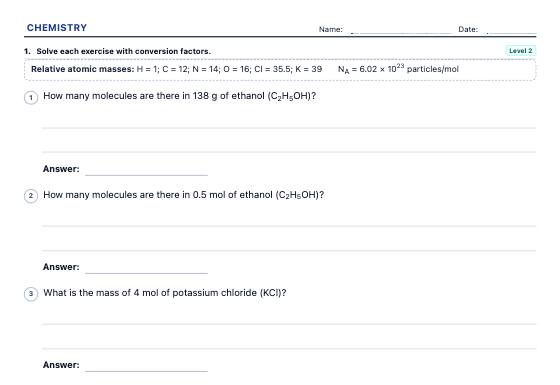
Chemistry exercises: concentration in g/L, percentage by mass and by volume and dilutions, molar mass, grams, moles and particles, molarity and stoichiometry on balanced equations, in three levels with an answer key by conversion factors.
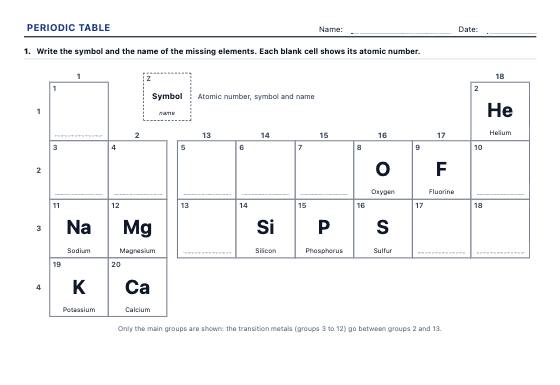
Blank periodic tables to complete, symbols and names, group and period data tables, clue puzzles and metal and non-metal sorting, from the first 20 elements to the whole table, and atomic structure: protons, neutrons and electrons, ions and isotopes, Bohr model, electron configuration and valence electrons, with an answer key.
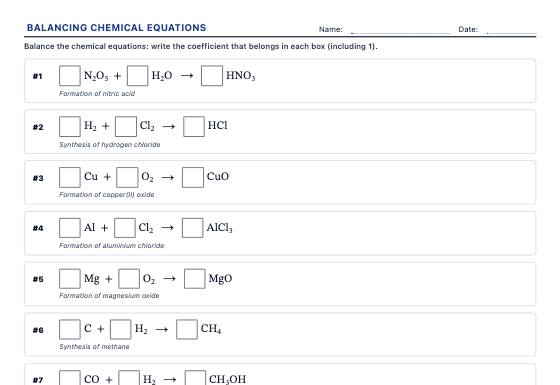
Real reactions to balance with coefficient boxes and an atom-count table, from simple formulas to groups in brackets, hydrates and large coefficients, with an answer key that checks every element.