Prisms
V = area of the base × height. From the cube (V = a³) and the cuboid (V = a × b × h) to triangular and regular hexagonal prisms, where the base area comes from the perimeter and the apothem.
Volume measures the space a solid takes up. This free volume of solids worksheet generator builds A4 worksheets with every solid drawn in 3D, with dashed hidden edges and labelled lengths: prisms, pyramids, cylinders, cones, spheres and hemispheres, composite solids and capacity problems in litres. For Grades 8 and 9, with an answer key that writes the formula, the substitution and every calculation.
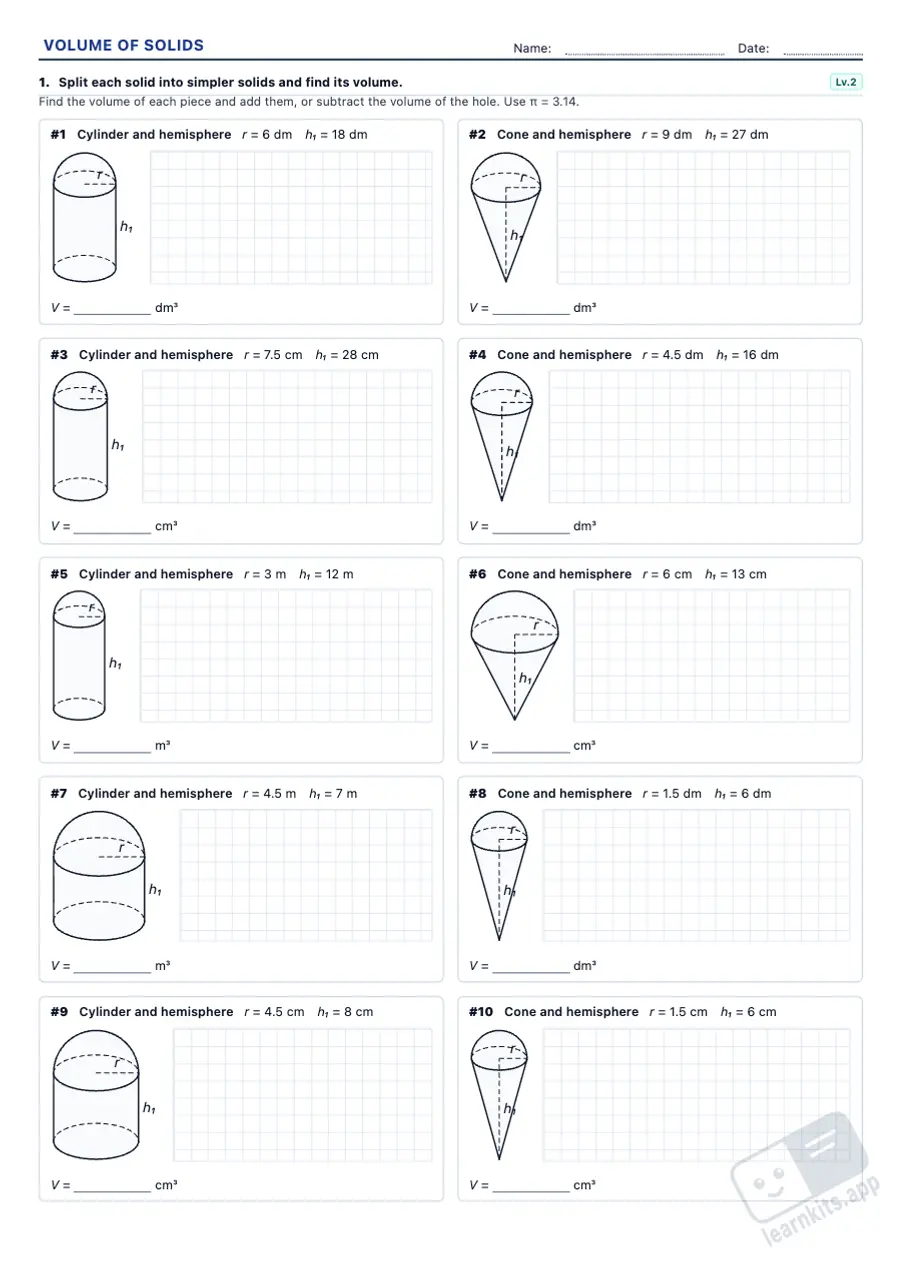 Student worksheet
 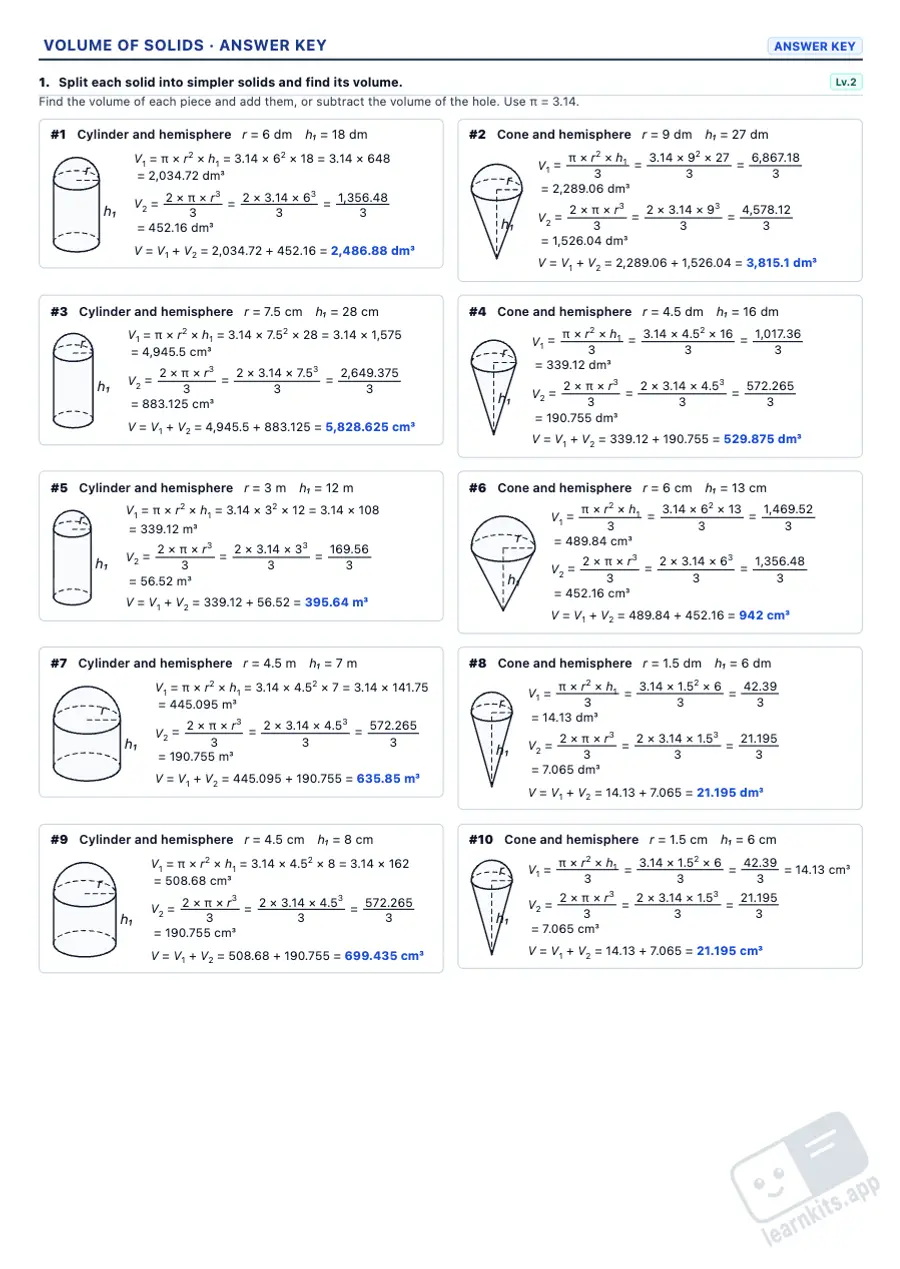 Answer key
 V = area of the base × height. From the cube (V = a³) and the cuboid (V = a × b × h) to triangular and regular hexagonal prisms, where the base area comes from the perimeter and the apothem.
They hold a third of the prism or cylinder with the same base and height. At level 3 the height comes from Pythagoras' theorem and the slant height.
V = π × r² × h and V = (4 × π × r³) ÷ 3. Given the diameter, halve it first; at level 3 pupils work back from the volume to the radius or the height.
Choose whether answers use π = 3.14 or are left in terms of π (12π cm³). The lengths are chosen so that every calculation is exact either way.
A house, a rocket, a silo or an ice cream: split the solid into known pieces and add their volumes; when it has a hole, subtract it.
Fish tanks, pools, cans and water tanks: volumes become litres (1 dm³ = 1 L) and, at level 3, pupils find how deep the water is or how long a pool takes to fill.
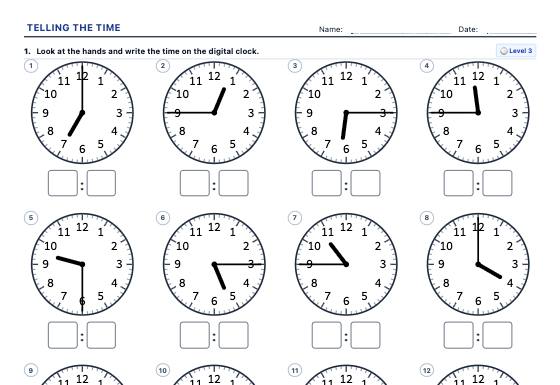
A4 worksheets for telling the time: read analogue clocks, draw the hands, the time in words (quarter past, half past, quarter to), what time it will be and the 24-hour clock.
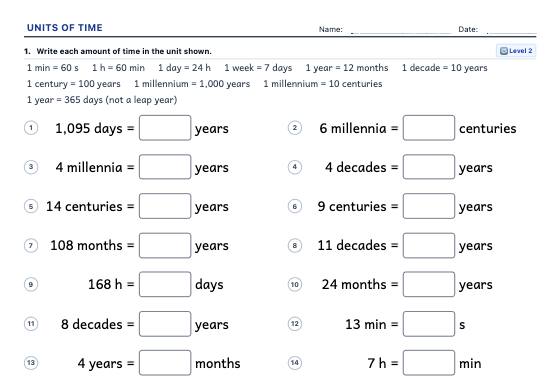
A4 worksheets to convert units of time (hours, minutes, seconds, days, weeks, years and centuries), write times in mixed units, add and subtract times in columns and solve timetable problems.
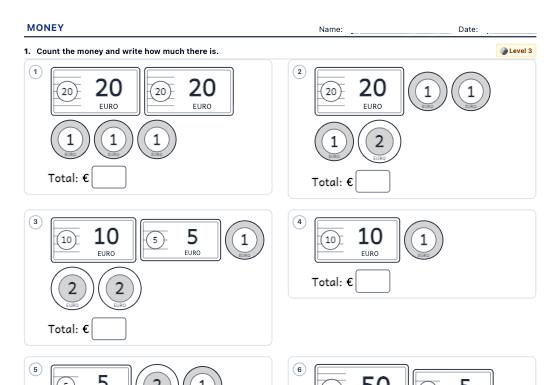
A4 worksheets with drawn euro coins and notes to count money, pay a price with the fewest pieces, compare purses, work out the change and solve shopping problems.